

Crystal structure of 3-methyl-1-phenyl-6-propyl¬amino-1H-pyrazolo[3,4-b]pyridine-5-carbo¬nitrile

Research Abstract

In the title compound, C17H17N5, the dihedral angle between the 1H-pyrazolo­[3,4-b]pyridine ring system (r.m.s. deviation = 0.001 Å) and the attached phenyl group is 2.56 (6)°. The propyl­amino side chain has a contorted conformation [Car—N—C—C = −77.97 (16)° and N—C—C—C = −57.37 (17)°]. An intra­molecular C—H⋯N inter­action closes an S(6) ring. In the crystal, inversion dimers linked by pairs of N—H⋯N hydrogen bonds generate R 2 2(12) loops. Aromatic π–π stacking inter­actions [centroid–centroid distance = 3.5726 (8) Å] are also observed.

Research Authors
Jerry P. Jasinski, Mehmet Akkurt, Shaaban K. Mohamed, Hajjaj H. M. Abdu-Allah and Mustafa R. Albayati
Research Date
Research Journal
Acta Crystallogr E Crystallogr Commun.
Research Pages
o766–o767
Research Publisher
IUCr
Research Vol
71(Pt 10)
Research Website
https://journals.iucr.org/e/issues/2015/10/00/hb7504/index.html
Research Year
2015

Exploring the impact of carboxylic group on the anti-proliferative activity of 5-aminosalicylic-4-thiazolinone based hybrids: design, synthesis, biological evaluation and ADME study

Research Abstract

To explore the contribution of the carboxylic group to the antiproliferative activity of 5-aminosalicylic-4-thiazolinone-based hybrids, multiple derivatives were synthesized, including free carboxylic, hydroxamic acid, and amidation with glycine or 2-amino-5-nitrothiazole. The antiproliferative activity of these derivatives was compared with that of methyl ester, aliphatic, and aromatic amides of the hybrid against eight cancer cell lines and one normal cell line using the sulforhodamine B (SRB) assay. Among the newly synthesized compounds, glycinate amide 9b exerted good to moderate antiproliferative activity against five cancer cell lines., It displayed superior activity against the Jurkat and Lymphoma cell lines with IC50 values of 4.74 µM and 7.16 µM, The overall results show that the methyl ester derivative of the hybrids is the most active among the tested derivatives against all tested cell lines with low micromolar to nanomolar potency. While hybrids with free or amidated carboxylic groups are much less potent. ADME study revealed that the difference in physicochemical properties might rationalize the activity pattern. This study demonstrates that the nature of the carboxylic group in these hybrids critically influences their antiproliferative activity. The findings pave the way for developing optimized anticancer salicylate drugs by focusing on modifications that improve key physicochemical properties.

Research Authors
Shimaa A. Othman, Varsha Menon, Wafaa S. Ramadan, Abdel-Nasser A. El-Shorbagi, Raafat El-Awady, Hajjaj H. M. Abdu-Allah
Research Date
Research Journal
Chemistry & Biodiversity
Research Pages
e03599
Research Publisher
Wiley
Research Vol
23 (4)
Research Website
https://onlinelibrary.wiley.com/doi/abs/10.1002/cbdv.202503599
Research Year
2026

Meeting of the Executive Committee (Clinical Pharmacy Program) This will take place on Thursday, May 14, 2026.

God willing, the Executive Committee meeting This will take place on Thursday, May 14, 2026. at 10:30 AM. 

The meeting will take place in the Faculty Council Hall, 5th Floor (Administrative Building)

Dean of the Faculty

(Prof. Gihan Nabil Hassan Fetih)

news category
خبر عام

The Library Committee at the Faculty of Pharmacy will hold its meeting This will take place on Thursday, May 14, 2026.

God willing, the meeting of the Libraries Committee at the Faculty of Pharmacy Pharmacy Pharmacy This will take place on Thursday, May 14, 2026. at 10:00 AM at the invitation of Professor Mrs. Professor Dr. Gihan Nabil Hassan Fetih

This meeting will be held in the office of Prof. Dr. / Dean of the Faculty - Fifth Floor (Administrative Building).

news category
خبر عام

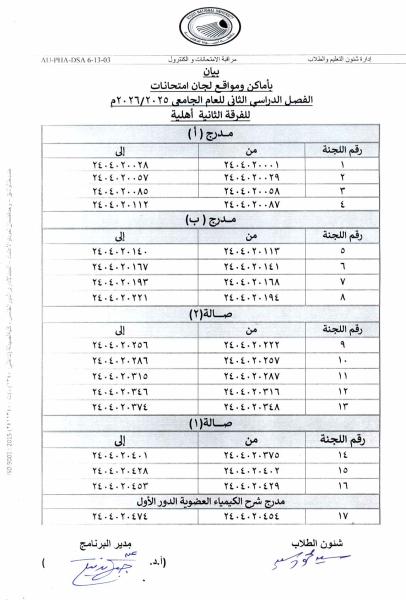
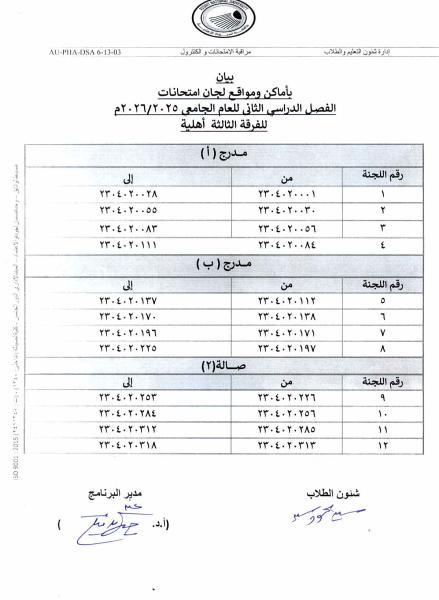
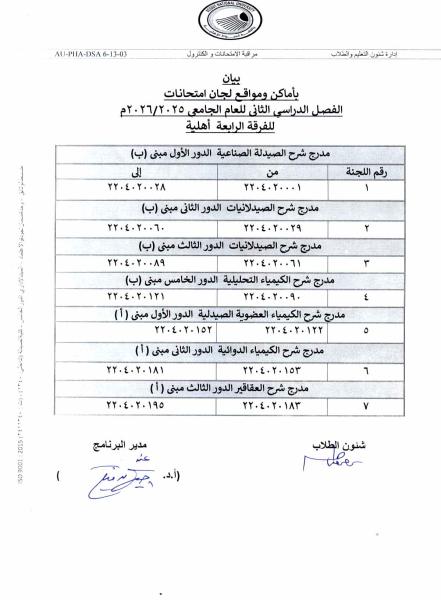
Statement of the Locations and Venues of Examination Committees for the Second Semester – Academic Year 2025/2026 for the Different Classes (First, Second, Third, and Fourth Year) Students of the Faculty of Pharmacy and Pharmaceutical Research

Subscribe to