

Announcement of a seminar in the Department of Pharmaceutical Organic Chemistry

As part of the scientific and research activities of the Department of Pharmaceutical Organic Chemistry, the department announces the holding of a seminar on the achievements of the internship students during the period from January 1, 2025, to February 15, 2025. The session will take place on Thursday, February 13, 2025, at 9:00 AM in the department's lecture hall

news category
قسم الكيمياء العضوية

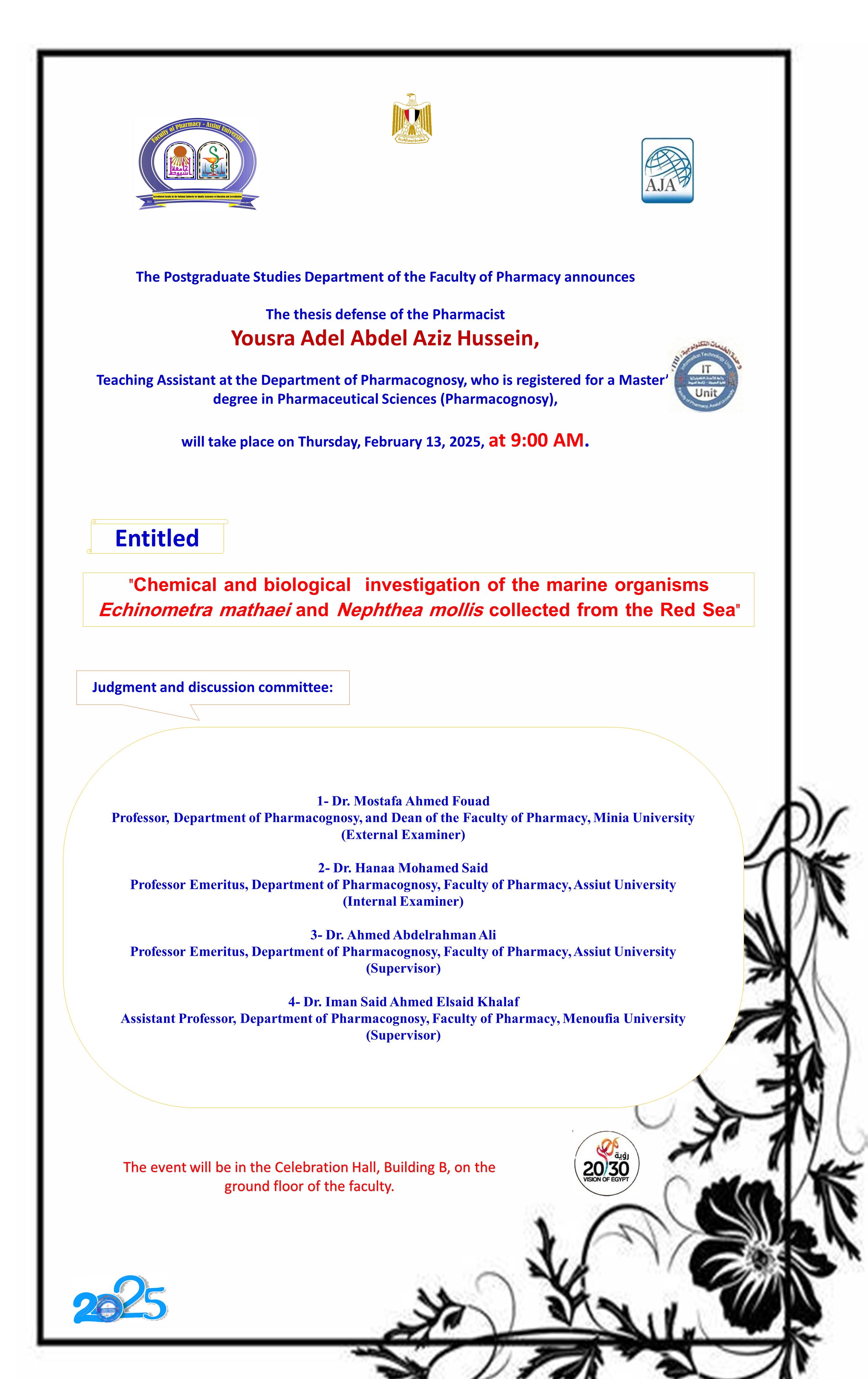
The thesis defense of Pharmacist / Yosra Adel Abdel Aziz, Teaching Assistant in the Department of Pharmaceutical Sciences, registered for a Master's degree in Pharmaceutical Sciences (Pharmacognosy), will take place on Thursday, February 13, 2025

A meeting of the cultural and international relations committee, Faculty of Pharmacy That will be on Thursday, February 13, 2025, at 10:00 AM

The cultural and international relations committee will hold its monthly meeting That will be on Thursday, February 13, 2025, at 10:00 AM

in the office of Vice Dean for Graduate Studies and Research Affairs.

news category
خبر عام

Meeting of the (Postgraduate Studies and Research) Committee at the Faculty of Pharmacy That will be on Thursday, February 13, 2025, at 11:00 AM

    God willing, the meeting of the Graduate Studies and Research Committee and That will be on Thursday, February 13, 2025, at 11:00 AM

And that in the office of the Prof. Dr. / Vice Dean for Graduate Studies and Research Affairs.

news category
خبر عام

A meeting of the laboratories and scientific equipment committee at the Faculty of Pharmacy That will be on Thursday, February 13, 2025, at 12:00 PM (noon)

God willing, the laboratories and scientific equipment committee will hold its meeting That will be on Thursday, February 13, 2025, at 12:00 PM (noon)

 in the office of Vice Dean for Community Services and Environmental Development Affairs.

news category
خبر عام

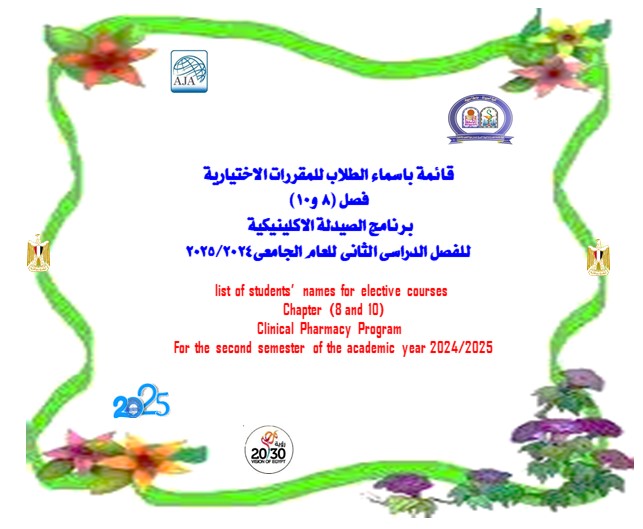
List of students of the elective courses of the (8th and 10th) semesters of the Clinical Pharmacy Program for the second semester of the 2024/2025 academic year.

Methylene blue-assisted molecularly-imprinted film modified nitrogen and sulfur co-doped molybdenum carbide for simultaneous electrochemical determination of two hepatotoxic drugs

Research Abstract

A novel electrochemical sensor with a dual-template molecular imprinting technology was fabricated for the simultaneous detection of paracetamol (PAR) and isoniazid (INZ). The sensor was constructed using nitrogen and sulfur co-doped molybdenum carbide (N, S@Mo2C) and a thin layer of electro-polymerized methylene blue was applied onto the surface of the N, S@Mo2C. The electrochemical sensor demonstrated remarkable analytical efficiency for the concurrent PAR and INZ quantification under optimal circumstances. The system achieved an exceptionally low limit of detection (S/N = 3) of  3.7 nM for PAR, with a concentration range  of  0.013 and 140 µM.  A LOD of 7.6 nM was attained for INZ, with a linear range  between 0.025 and 140 µM. Furthermore, the platform’s selectivity was evaluated using differential pulse voltammetry  (DPV). The designed platform successfully detected PAR and INZ in authentic samples with recoveries varying between 98.3% and 104.9%. The relative standard deviations (RSD) for these measurements ranged from 2.7 to 4.0%, demonstrating that the proposed sensor is extremely stable, repeatable, and reproducible. These promising results suggest that the sensor holds potential for the detection of various (bio) molecules, paving the way for future applications in sensing fields.

Graphical abstract

Research Authors
Ali O. Alqarni, Ashraf M. Mahmoud, Bandar A. Alyami, Ramadan Ali & Mohamed M. El-Wekil
Research Date
Research Journal
Microchimca Acta
Research Publisher
Springer
Research Rank
Q1
Research Vol
191
Research Year
2024

Near-infrared fluorescent probe for selective and sensitive detection of glutathione based on thioctic acid-functionalized Ag/Au NCs-assisted by ferric ion

Research Abstract

Accurate determination of glutathione (GSH) levels in biological fluids and food supplements is paramount. To address this need, we developed a near-infrared (NIR) fluorescent probe with high sensitivity and selectivity for GSH detection. This probe comprises thioctic acid-functionalized silver and gold nanoclusters (ThA@Ag/Au NCs), emitting red light at 720 nm upon excitation at 310 nm. In the presence of Fe3+ ions, which form complexes with ThA, the fluorescence of ThA@Ag/Au NCs is quenched due to aggregation. However, upon addition of GSH, a potent chelator for Fe3+, the fluorescence of the probe is restored, leading to enhanced emission. Under optimized conditions, the fluorescence response (F/F°) exhibits a linear relationship with increasing GSH concentration within the range of 0.03–95 µM, achieving a limit of detection (LOD) of 9.0 nM. This designed scheme demonstrates excellent selectivity, sensitivity, and accuracy for GSH detection. Furthermore, the NIR fluorescent probe effectively estimated GSH levels in various matrices, including capsules, serum, urine, and saliva samples, yielding recoveries % ranging from 97.2 % to 103.2 %, with RSD % below 4.34 %. Due to its NIR properties, this fluorescent probe holds promise for diagnosing various diseases and potential in vivo applications.

Graphical abstract

Research Authors
Yahya S. Alqahtani a , Ashraf M. Mahmoud a , Masood Medleri Khateeb b , Ramadan Ali c , Mohamed M. El-Wekil
Research Date
Research Journal
Microchemical Journal
Research Publisher
ElSevier
Research Rank
Q1
Research Vol
201
Research Year
2024

Fluorometric detection of quinolones via AIE and FRET with terbium-doped carbon dots and copper nanoclusters

Research Abstract

Terbium and nitrogen co-doped carbon dots (Tb@N-CDs), combined with α-lipoic acid-functionalized copper nanoclusters (LA@CuNCs), were proposed for the ratiometric detection of quinolone (QA) antibiotics. In this system, Tb@N-CDs facilitate the aggregation of LA@CuNCs, enhancing its fluorescence emission at 670 nm via aggregation-induced emission enhancement (AIEE). Meanwhile, the fluorescence emission of Tb@N-CDs at 460 nm diminishes due to Förster resonance energy transfer (FRET). Upon the introduction of QA, the binding between Tb3+ ions and N-CDs weakens, disrupting both AIEE and FRET processes. This disruption results in a reduction in fluorescence emission at 670 nm and a concurrent increase at 460 nm. The fluorescence response ratio (F460/F670) increases with higher concentrations of ciprofloxacin (CFX), demonstrating a linear range from 0.008 to 120 μmol L−1 and LOD of 1.6 nmol L−1. The method successfully detected CFX in milk and urine samples, achieving recoveries between 97.7 % and 103.8 %, RSD of less than 3.79 %.

Research Authors
Ramadan Ali a , Reem Alshaman b , Abdullah S. Albalawi a , Osama M. Alsharif c , Osama A. Hakami c , Hamzah Hussain Alharthi c , Faisal F. Jumah c , Abdulrhman M. Al-Qarni c , Naif S. Albalawi c , Meshari Saud Alashjaee c , Faisal S. Aljohani c
Research Date
Research Journal
Food Chemistry
Research Publisher
ElSevier
Research Rank
Q1
Research Vol
465
Research Year
2024
Subscribe to