Milk-sucking in Cows and Buffaloes of Egyptian Western Area with Special Reference to the Outcome of Treatment

Research Abstract

Milk-sucking (self-sucking and inter-sucking) is an anxious problem causing economic losses in dairy farms. Although several studies were conducted to elucidate the main cause, the etiology is still unclear and might be a multi-factorial problem. The present study aimed to meticulously study individual cases of milk-sucking as well as the outcome of conservative and surgical treatment in cows and buffaloes. One hundred self-sucking cows and buffaloes were admitted to different clinics of Elkharga city in New-Valley Governorate between January 2019 and August 2020. Complete clinical examination of the animals was conducted. The recorded data were the history, signalment of the animals, clinical findings, associating problems and response to conservative treatment. Forty cows were treated conservatively through the application of the plastic nose (n= 27) or mouth rings milk-sucking preventer (n= 13). Surgically operated animals were divided into two groups according to the surgical technique. Twenty animals (cows=14, buffaloes=6) were subjected to ventral partial glossectomy, and the other ten cases (cows=6, buffaloes=4) were treated using inverting technique (tongue reshaping). The results revealed good body condition, normal physiological parameters, good appetite, good fertility and conception rate and good milk yield in 70 cases. Thirty animals had suffered depraved appetite, nutritional deficiency and delay of post-partum estrus and ovulation. Fore teats were the most common sites for milk-sucking. Cross-sucking in the calf-hood period, energy and some mineral deficiency, and overcrowding in the markets might be the main causes of milk-sucking. Conservative treatment was effective as far as the device present in situ. Ventral glossectomy was better than tongue reshaping in treatment of the milk-sucking in cows and buffaloes.
 

Research Authors
Mohamed A.H. Abdelhakiem1, Salah M. Soliman2, Ahmed F. Ahmed1
Research Date
Research Department
Research Journal
Journal of advanced veterinary research
Research Pages
161-165
Research Rank
Q3
Research Vol
13 (2)
Research Website
https://www.advetresearch.com/index.php/AVR/article/view/1161
Research Year
2023

Evaluation of the subconjunctival injection of Hesperidin with or without olive oil on the healing of alkali burn corneal ulcer in rabbits

Research Abstract

Corneal ulcers represent an anxious problem in animals and humans. The alkali burn corneal ulcer is severe and may be associated with damage to most of the corneal structure. The healing of the corneal ulcer is mainly complicated by the impairment of vision. The striving to find a new therapy that promotes the healing of corneal injuries with the maintenance of the power of vision is the main aim of most studies. The current study was conducted to evaluate the effect of hesperidin with or without olive oil after its deposition under the bulbar conjunctiva on the healing of induced alkali burn corneal ulcers. For carrying out the study, 18 New Zealand albino rabbits were included. They were divided into three equal groups. Group I (control) received 0.5 ml of normal saline 0.9% under the bulbar conjunctiva 5 times at one-week intervals. Group II (H) received 0.5 ml of hesperidin nanovesicles subconjunctivally 5 times at one-week intervals. Group III (HO) received 0.5 ml of nanovesicles of hesperidin with olive oil under the bulbar conjunctiva 5 times one week apart. The right eye of animals was subjected to induction of corneal ulcer using 1% NaOH before the commencement of treatment. The left eye was used as a negative control one. The animals were examined clinically (lacrimation, neovascularization, pus formation, corneal perforation, measurement of corneal ulcer), and with fluorescein test staining every week just before each treatment. The animals were examined on days 1, 8, 15, 22, 29, 36 post corneal ulcer induction. At the end of the experiment, the treated and nontreated eye samples were collected for histopathological and electron microscopy examination. The results showed an improvement in the total clinical score in groups H and HO especially in the fifth week, while the control group displayed increasing in the inflammatory process of the injured eye throughout the time of experiment. There was a significant difference between both of H and HO groups and the control group in the third, fourth, and fifth weeks. The results of the histopathological and electron microscopy revealed the superiority of hesperidin with olive oil over hesperidin alone in promoting the healing of corneal ulcers (p= 0.045). The current study concluded that the subconjunctival injection of hesperidin with or without olive oil has a beneficial and promoting effect in the healing and regeneration of alkali burn corneal ulcers in rabbits. Moreover, subconjunctival injections can ensure long-term drug maintenance compared to topical methods, which in turn saves time and effort.
 

Research Authors
Aya Hamdy1, Khaled M.A. Hassanein2, Magda M. Ali1, Ahmed U. Ali3, Iman S.A. Khallaf 4, Mohammed A.H. Abdelhakiem
Research Date
Research Department
Research File
Research Journal
Journal of Advanced Veterinary Research
Research Pages
1096-1101
Research Rank
Q3
Research Vol
14 (7)
Research Website
https://www.advetresearch.com/index.php/AVR/article/view/1957#:~:text=The%20current%20study%20concluded%20that,burn%20corneal%20ulcers%20in%20rabbits.
Research Year
2024

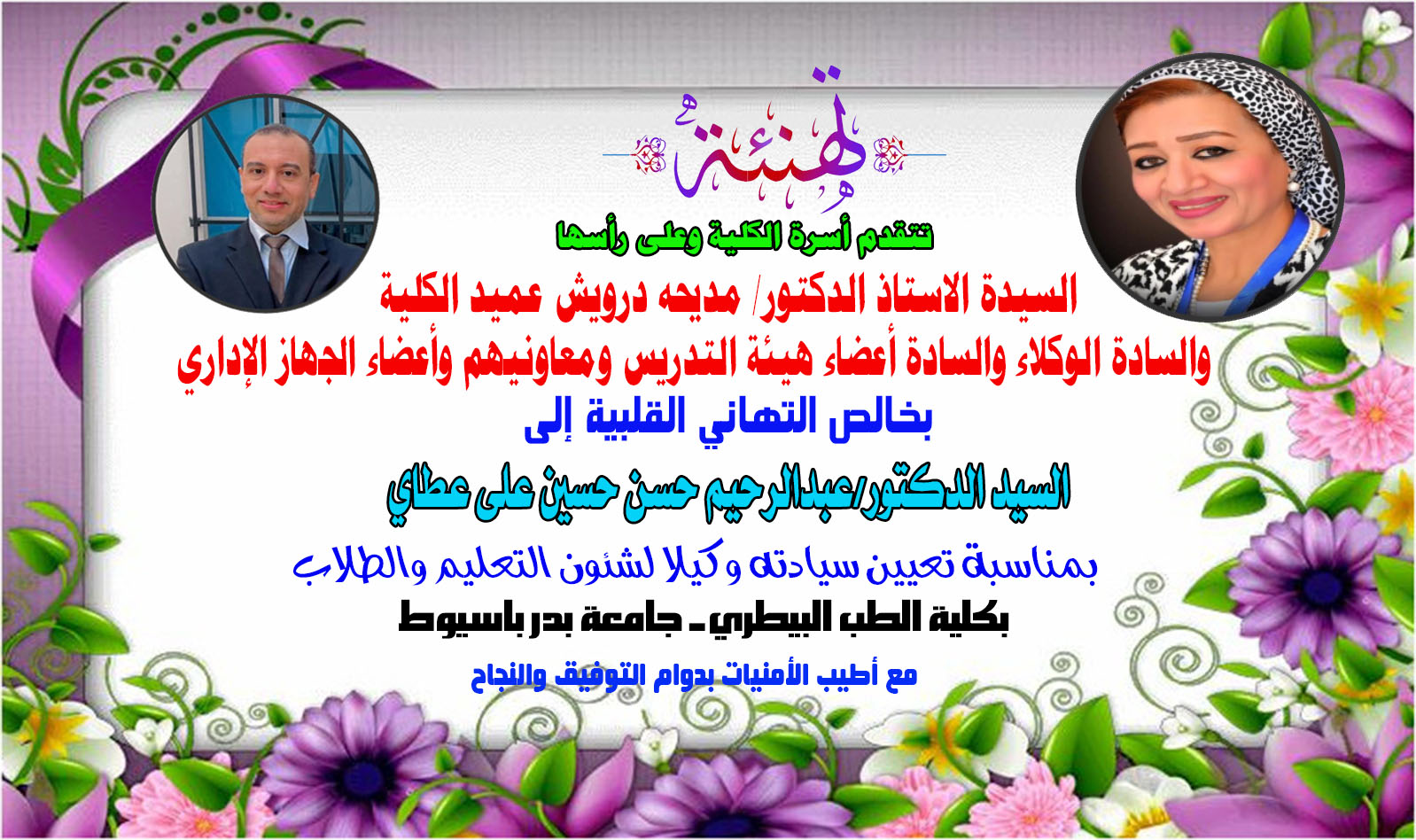
Congratulations on the appointment of Dr. Abdel Rahim Hassan Hussein Ali Atay as Acting Vice President for Education and Student Affairs and General Supervisor of the Anatomy Department at the Faculty of Veterinary Medicine, Badr University, Assiut

Cleavage and in vitro cultivation rates monitoring in culture media supplemented with energy sources, non-essential amino acids, and antioxidants in the buffalo embryos

Research Abstract

The study was designed to monitor the cleavage rate (CR) and in-vitro cultivation rate (IVC) after addition of energy sources, non-essential amino acids, and antioxidants to the Synthetic oviductal fluid (SOF) and FertiCult. After in-vitro maturation and in-vitro fertilization, presumptive zygotes were cultured in one of two culture media: FertiCult media and SOF medium, supplemented with pyruvate, glucose, and sodium lactate as energy sources, as well as 10, 20, 250, 500, and 750 mg non-essential amino acids, and antioxidants. All stages of cleavage rate (CR), and in-vitro cultivation rate (IVC) of embryonic development including morula stage (MOR) and blastocyst (BLAS) have been assessed. The findings revealed that there were no significant differences in the CR between the control and other treated groups with sources of energy when added to SOF media (P > 0.05), while there were significant differences (P < 0.05) in the IVC of embryonic development between groups (The percentages of MOR stage in the control, pyruvate, glucose and mixture of source of energy (MIX) were at 50%, 62.5%, 60%, and 63.6%, respectively). The highest percentage of the BLAS was recorded after SOF supplementation with glucose (40%). Similarly, there were no significant differences (P > 0.05) in the CR between control and FertiCult supplemented with sources of energy, while the IVC stages increased significantly (P < 0.05) in the FertiCult media supplemented with glucose, pyruvate, sodium lactate, and MIX. The percentages of the MOR stage in the control, pyruvate, glucose and mix media were at 50%, 55.6%, 55.6%, 54.5%, 57.1% respectively. The lowest percentage of the BLAS was recorded after FertiCult supplementation with pyruvate (11.1%). Replenishing the SOF maturation media with 20 mg of non-essential amino acids significantly (P < 0.05) enhanced the MOR stage (100%). There was also an improvement in the development of BLAS stage, where it reached 31.2% and 47.4% in the SOF maturation media supplemented with 10, and 750 mg non-essential amino acids, respectively. There were no significant differences (P > 0.05) in neither CR nor IVC between control and FertiCult supplemented with antioxidants. There were significant differences (P < 0.05) in the MOR stages (control, 42.9% & treated, 57.9%) and BLAS stages (control, 21.4% & treated, 42.1%) in antioxidant supplemented SOF maturation media compared to control. In conclusion, supplementation of SOF cultivation medium with energy sources, 20 mg of non-essential amino acids and antioxidant addition may improve the cleavage rate (CR) and in vitro cultivation rate (IVC) of buffalos’ embryonic development.

Research Authors
Eman M Abu El-Naga, Montaser E. Ali , Rawda H. Ali, Heba F. Hozyen and Hassan A. Hussein
Research Date
Research Department
Research File
Research Journal
BMC Veterinary Resaerch
Research Pages
521 (2024)
Research Publisher
Springer
Research Rank
Q1, Impact Factor 2.3
Research Vol
20
Research Website
https://bmcvetres.biomedcentral.com/articles/10.1186/s12917-024-04118-4
Research Year
2024

The ameliorative effects of bee bread supplement on the ovarian dysfunction induced by high-fat diet: Comparison with S. officinalis and shifting to normal diet supplement

Research Abstract

Bee bread, a naturally fermented bee product, could alleviate obesity-related disorders but its protective role against high-fat diet (HFD)-induced ovarian dysfunction has not been studied yet. Thirty-eight Wister albino female rats were divided into control and HFD groups. The control group (n=7) received a normal diet for 14 weeks whereas HFD group was supplemented with 40% HFD for 10 weeks and then subdivided into 4 subgroups that received either HFD or HFD and S. officinalis (300 mg/kg) or HFD and bee bread (0.5 gm/kg) or normal diet for another 4 weeks. Histopathological examination of ovarian tissues was done. The estrus cycle, final body weight, lipid profile, fasting serum glucose, and reproductive hormone levels were investigated. mRNA expression of TNF-α and IL-6 in the blood and the ovarian cytochrome P450 family 17 subfamily A member 1 (CYP17A1), cyclin D1(CCND1) and autophagy-related protein-5 (Atg5) were determined. Immunohistochemical assessment of nuclear factor-kappa B (NF-κB), peroxisome proliferator-activated receptors gamma (PPARγ), and caspase-3 was done in all groups. Irregular estrous cycle altered folliculogenesis and reproductive hormones, dyslipidemia, and increased body weight were detected in HFD group. Also, upregulation of NF-κB, TNF-α, IL-6 and caspase -3 expressions, and downregulation of CCDN1, Atg5 and PPARγ were observed in HFD group. Bee bread, S. officinalis and to a lesser extent normal diet supplements bee bread improved ovarian dysfunction induced by HFD by inducing autophagy and steroidogenic genes and inhibiting inflammation and apoptosis.
 

Research Authors
Ghada M. Ezzat. Marwa F. Ali, Hassan A. Hussein, Yasmeen A.A. Morsi, Mona A. H. EL-BAZ
Research Date
Research Department
Research Journal
Journal of Advanced Veterinary Research
Research Pages
1248-1257
Research Rank
Q3
Research Vol
14 (7)
Research Website
385096665_The_ameliorative_effects_of_bee_bread_supplement_on_the_ovarian_dysfunction_induced_by_high
Research Year
2024

Sperm rheotaxis as a parameter for laboratory Evaluation of frozen semen in bull

Research Abstract

Sperm rheotaxis is a sperm guidance mechanism that helps to guide and select high-quality sperm cells within the female reproductive tract. Semen is usually evaluated using either the traditional subjective method of evaluation or computer assisted sperm analysis (CASA). These methods provide information about sperm concentration, viability and motility parameters and ignoring sperm ability to travel inside the female reproductive tract. Our goal was to detect the individual variations between different sires through evaluation of post thawed frozen semen using sperm rheotaxis. We studied sperm rheotaxis and sperm kinematics inside microfluidic platforms together with subjective semen analysis (motility, viability, and sperm morphology) in post-thawed bull frozen semen in different sires. The results showed that the positive rheotaxis (PR) was higher in the postthawed frozen semen of some bulls (P<0.05) than in others. Our results also revealed that the bulls with the higher PR% have significantly higher straight-line velocity (VSL) and subjective analysis parameters (motility and viability) (P<0.05) than bull with the lower PR. Furthermore, PR was positively correlated with VSL (r = 0.67, P < 0.0001) and with subjective motility and viability (r =0.57, P = 0.007 and r = 0.49; P= 0.02, respectively). Thus, we concluded that sperm rheotaxis should be used as a new parameter in evaluation of post-thawed frozen semen quality in bull.
 

Research Authors
HAITHAM A. MOFADEL, HASSAN A. HUSSIEN, AHMED M.R. FATH EL-BAB, TAYMOUR M. EL‑SHERRY
Research Date
Research Department
Research Journal
Journal of Advanced Veterinary Research
Research Pages
936-939
Research Publisher
OA Journals
Research Rank
Q3
Research Vol
14 (6)
Research Website
https://www.researchgate.net/publication/384993100_Sperm_rheotaxis_as_a_parameter_for_laboratory_Evaluation_of_frozen_semen_in_bull#fullTextFileContent
Research Year
2024

Effect of histidine and L-Tyrosine supplementation in maturation medium on in-vitro developmental outcomes of buffalo oocytes

Research Abstract

The present study was designed to investigate the effects of amino acid (histidine and L-Tyrosine) on in vitro maturation (IVM), in vitro fertilization (IVF), cleavage (CR) rates, and in vitro embryonic cultivation (IVC; Morula and Blastocyst stage) in buffaloes. Within two hours of buffalo slaughter, the ovaries were collected and transported to the laboratory. Follicles with a diameter of 2 to 8 mm were aspirated to recover the cumulus oocyte complexes (COCs). Histidine (0.5, 1, and 3 mg/ml) or L-Tyrosine (1, 5, and 10 mg/ml) were added to the synthetic oviductal fluid (SOF) and Ferticult media. The IVM, IVF, CR, and IVC (Morula and Blastocyst) rates were evaluated. The results showed that SOF maturation media containing histidine at 0.5 mg/ml significantly (P ≤ 0.01) improved the oocyte maturation when compared to control and other concentrations. The addition of histidine to FertiCult media at 0.5, 1, and 3 mg/ml did not improve the IVM, IVF, CR, or IVC percentages. However, the embryos in the control group were unable to grow into a morula or blastocyst in the SOF or Ferticult, while addition of L-Tyrosine to the SOF or Ferticult at various concentrations improved IVC (morula and blastocyst rates). There was a significant (P ≤ 0.01) increase in IVM when histidine was added to SOF medium at a concentration of 0.5 mg/ml compared with L-Tyrosine. Also, there were significant (P ≤ 0.01) increases in IVC when L-Tyrosine was added to SOF medium at concentrations of 1 and 10 mg/ml compared with histidine. In conclusion, the supplementation of the SOF and FertiCult with the amino acids histidine and L-Tyrosine improve the maturation rate of oocytes and development of in vitro-produced buffalo embryos.

Research Authors
El-Naga, E.M.A., Ali, M.E., Sindi, R.A. , Hassan A. Hussein
Research Date
Research Department
Research File
Research Journal
BMC Veterinary Resaerch
Research Pages
414 (2024)
Research Publisher
Springer
Research Rank
Q1, Impact Factor 2.3
Research Vol
20
Research Website
https://doi.org/10.1186/s12917-024-04212-7
Research Year
2024

Fetal gender prediction by monitoring circulating steroid hormones and some biochemical parameters in maternal dromedary camels

Research Abstract

To predict the sex of the foetus, healthy pregnant dromedary camels (n = 24) were included. Blood samples were collected for measurements of progesterone, estradiol, testosterone, and cortisol as well as total proteins, albumin, glucose, creatinine, blood urea nitrogen, phosphorus, calcium, creatine kinase, alanine aminotransferase (ALT), aspartate transaminase (AST), alkaline phosphatase (ALP), gamma glutamyl transpeptidase (GGT), calcium, phosphorus, and magnesium. Statistical analysis revealed differences between pregnant camels and pregnant camels in terms of female or male foetuses depending on the actual sex of the born calf. The results revealed that testosterone and ALP concentrations were significantly (P < 0.001) greater in camels given to males than in those given to calves. There were strong positive correlations between male calf birth and testosterone and ALP concentrations (r = 0.864; P < 0.0001 and r = 0.637; P < 0.001, respectively). On the other hand, the cortisol, glucose and creatinine concentrations were significantly lower (P lower in camel calved males than in females). There were significant negative correlations between male calf birth and the cortisol, glucose and creatinine concentrations (r =—0.401; P = 0.052; r =—0.445; P = 0.029 and r =—0.400; P = 0.053, respectively). The concentrations of calcium, phosphorus, calcium/phosphorus ratio, magnesium, and albumin and the albumin/globulin ratio were not significantly different (P > 0.05) between the two groups. In conclusion, testosterone could be used as a biomarker to determine the sex of foetuses in dromedary camels.

Research Authors
Aboelmaaty, A.M., Mohamed, R.S., Hussein, H.A. , R. H. Mohamed
Research Date
Research Department
Research Journal
Tropical Animal Health and Production
Research Pages
191 (2024)
Research Publisher
Springer
Research Rank
Q2, Impact Factor 1.7
Research Vol
56
Research Website
https://doi.org/10.1007/s11250-024-04053-4
Research Year
2024

The effects of saline water consumption on sperm parameters, testicular histopathology, hormonal and antioxidants concentrations in Barki Rams

Research Abstract

The study aimed to assess the effects of water salinity on the sperm parameters, levels of cortisol, LH, FSH, testosterone and antioxidants as well as the testes’ histopathology in Barki rams. Fifteen healthy Barki rams (1–1.5 years) were divided into three equal depending on the type of drinking water for nine months. The rams in the tap water group (TW, water that contained 350 ppm of total dissolved salts (TDS). Males in the high saline water group (HSW) were permitted to consume high saline water with 8,934 ppm TDS, whereas those in the second group were permitted to have moderately saline water (MSW, 4,557 ppm TDS). High salt concentration in drinking water had adverse effect on sperm viability, morphology and sperm cell concertation. Nitric oxide and malondialdehyde concentrations in blood were significantly higher in the MSW and HSW groups than in TW. There was a significant decrease in glutathione concentration as well as superoxide dismutase activity in TDS and HSW. Cortisol was most highly concentrated in the HSW, next in the MSW, and least in TW. The testosterone, LH, and FSH concentrations in the HSW and MSW groups were significantly lower than in TW. As the salt concentration in drinking water increases, damage to testicular tissue. The MSW group demonstrating vacuolation of lining epithelial cells with pyknotic nuclei in the epididymis and necrosis and desquamation of spermatogenic cells in seminiferous tubules while HSW group displaying desquamated necrotic cells and giant cell formation in the epididymis, as well as damage to some of the seminiferous tubules and showed congestion, vacuolation of spermatogenic epithelium of seminiferous tubules, and desquamated necrotic spermatogenic epithelium. In conclusion, the salinity of the water has detrimental impacts on the sperm morphology, viability and concentration, hormones and antioxidant levels in Barki rams.

Peer Review reports

Research Authors
Mohamed, R.S., Mohamed, R.H., Wehrend, A., Enas A. Tahoun. Hassan A. Hussein
Research Department
Research File
Research Journal
BMC Veterinary Resaerch
Research Pages
219 (2024)
Research Publisher
Springer Nature
Research Rank
Q1, Impact Factor 2.3
Research Vol
20
Research Website
https://doi.org/10.1186/s12917-024-04047-2
Research Year
2024
Subscribe to