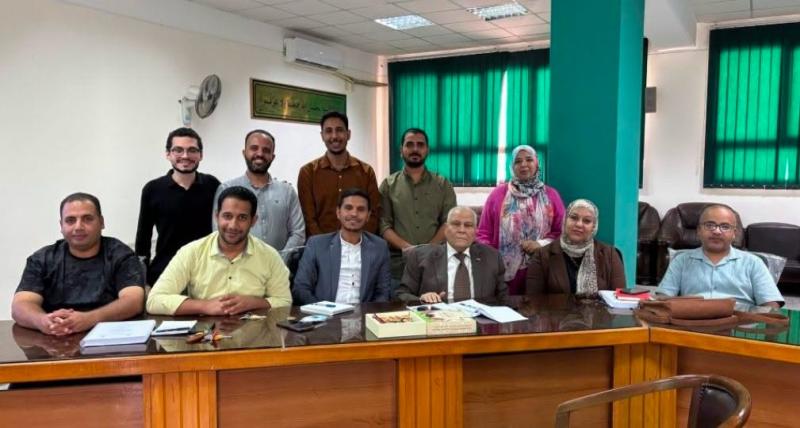

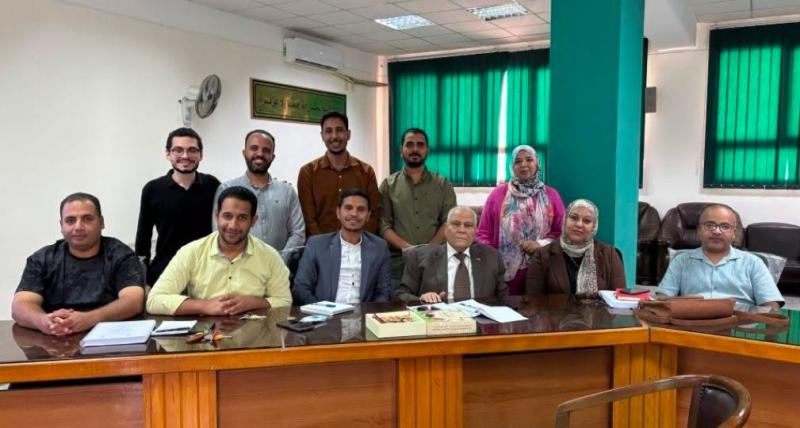
The Department of Civil Engineering at the Faculty of Engineering, Assiut University, organized a scientific seminar for postgraduate students specializing in irrigation engineering and hydraulic structures. The event was held at the invitation of Professor Mohamed Abdel-Salam Ashour, a specialist in the field.
This initiative aligns with the Egyptian state’s strategic vision to support scientific research and connect it to pressing societal issues.
The seminar featured discussions on four ongoing research projects by master’s and doctoral students. These studies address critical challenges within the water sector and infrastructure, integrating climate analysis, hydraulics, and field assessments.
Research studies presented at the seminar:
The negative impact of climate change on water resources in Upper Egypt, presented by Radwa Hassan Hashem (a doctoral candidate). This study examines the repercussions of climate change on available water resources across five governorates in Upper Egypt, with the aim of supporting water planning strategies, climate adaptation, and the achievement of water security. Another study, presented by master’s student Engineer Mahmoud Abu Al-Oyoun, examined the impact of canal bed slope on the efficiency of hydraulic energy dissipators. This research contributes to improving the design of energy-dissipating structures, mitigating the risks posed by high water velocities—such as bed erosion and scouring—and thereby enhancing the safety and operational efficiency of irrigation networks.
A third study, presented by master’s student Engineer Amr Ahmed Sherif, focused on the field evaluation of canal lining projects in Upper Egypt. The study assesses these lining efforts—part of a national initiative to develop and rehabilitate irrigation canals—to determine the extent to which they have met their objectives, with the aim of improving construction quality and maximizing the return on investment in water infrastructure.
The fourth study, by Engineer Yasser Khaled Sayed, investigated how the spacing between bridge piers affects flow characteristics and scouring. The research explores how the geometric configuration and the intervals between bridge supports influence water flow patterns and erosion rates, with the goal of protecting such structures and ensuring their structural integrity.
Professor Khaled Salah, Dean of the Faculty, emphasized the importance of holding such periodic seminars, noting their significant role in enhancing researchers' performance and fostering the integration of perspectives across various studies. This initiative is supported by the university administration, led by University President Professor Ahmed Abdel-Moula and Vice President for Postgraduate Studies and Research Professor Gamal Badr. Professor Salah also expressed his gratitude to Professor Mohamed Abdel-Salam Ashour—a specialist in irrigation and hydraulic structures and a former university vice president—for championing this approach several years ago. The seminar was attended and joined by a group of distinguished experts and specialists, including Dr. Ahmed El-Sayed El-Jaafari and Dr. Yusra Ahmed from the National Water Research Center, as well as Dr. Tarek Sayed Abu Zeid, Dr. Abdullah Atef, and Dr. Mahmoud Mustafa from the Department of Civil Engineering—an initiative aimed at fostering scientific and research collaboration between the Academy and applied research institutions.