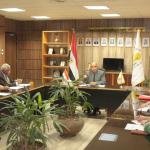
As part of Assiut University's strategy to strengthen digital capabilities and enhance staff competencies, and under the patronage of Professor Ahmed El-Minshawy, President of the University, the Community Service and Environmental Development Sector concluded, on Tuesday, June 30, 2026, a training program for its staff on Microsoft Word and Microsoft Excel, in support of the University's digital transformation efforts and institutional performance development.
The two-day training program was held on June 29–30, 2026, under the supervision of Professor Mohamed Adawy, Vice President for Community Service and Environmental Development; Professor Taysir Abdel Hamid, Dean of the Faculty of Computers and Information; and Professor Islam Ali Taj El-Din Fathallah, Assistant Professor at the Faculty of Computers and Information and Director of the University's Software Technology and Computing Unit.
The program was delivered by Dr. Ahmed Abdel Rahman, Assistant Lecturer in the Department of Information Systems at the Faculty of Computers and Information, with the participation of 20 staff members from the Community Service and Environmental Development Sector.
The training aimed to strengthen participants' digital competencies and improve their proficiency in using Microsoft Word and Microsoft Excel. The program focused on developing practical skills for preparing official correspondence, organizing and managing data, and producing reports with greater efficiency and accuracy, thereby supporting the modernization of administrative processes within the Sector.
Professor Ahmed El-Minshawy affirmed that organizing such training programs reflects the University's commitment to preparing qualified administrative personnel equipped with the technological skills needed to improve the speed and accuracy of task completion and enhance the quality of services provided across the University's various sectors. He added that the University will continue to support training initiatives that foster a more efficient work environment, advance digital transformation, and improve administrative performance.
For his part, Professor Mohamed Adawy explained that the program forms part of the Sector's ongoing plan for professional development and digital capacity building. He noted that the training enables employees to efficiently meet the demands of their daily work, including preparing official correspondence, tables, reports, and statistical data, in line with Egypt's national strategy for digital transformation and the automation of public services.
Professor Islam Ali Taj El-Din Fathallah emphasized that proficiency in Microsoft Word and Microsoft Excel has become essential for achieving efficiency, speed, and accuracy in administrative work. He explained that the training combined both theoretical and practical components, enabling participants to acquire hands-on skills that can be directly applied in the workplace, thereby contributing to improved institutional performance and supporting the University's vision of preparing administrative personnel capable of meeting the demands of the digital era.