Faculty Members and Teaching Assistants Surveys – Faculty of Pharmacy

Click

news category
خبر عام

 Do you have any questions? (088) 2080369 - 2345622 Pharmacy_QAAU@pharm.aun.edu.eg
Click
The continuous risk of antibiotic resistance development underscores the demand for new agents with mechanisms distinct from existing antibacterial drugs. Here, we investigated HSI#6, a small-molecule antibacterial previously identified as a SecA activator, using integrated omics and functional assays. HSI#6 exhibits a rapid, broad-spectrum bacteriostatic activity, and induces a distinct cell envelope-homeostasis stress signature accompanied by global stress reprogramming. Time-resolved transcriptomics and proteomics revealed early activation of envelope stress regulons and oxidative stress pathways, followed by suppression of ribosome biogenesis and central metabolism. Comparative analysis and biomarker-based principal component analysis (PCA) positioned HSI#6 within the envelope stress mechanistic space, closely aligned with membrane-active antibiotics yet displaying a distinct signature. Adaptive laboratory evolution (ALE) combined with whole-genome sequencing (WGS) revealed compensatory mutations in topoisomerase 1A gene (topA) and transcriptional regulators, without adaptive resistance emerged even under prolonged selection pressure. These findings establish HSI#6 as a mechanistically unique antibacterial agent with low resistance potential.
he Sec pathway is an essential protein secretion route for all organisms. In bacteria, the SecA ATPase peripherally associates with the SecYEG channel to form the translocase that mediates preprotein export. Activation of the translocase depends strictly on the synergy of signal peptide and mature domain binding. Thus, client selectivity, translocase activation and protein secretion are coupled by one mechanism. We show here that a previously identified small molecule (HSI#6) binds SecA, modulates its intrinsic dynamics and allosterically activates the translocase in the absence of clients. By uncoupling translocase activation from preprotein binding, HSI#6 transformed the translocase into a promiscuous nanomachine that lost client selectivity and secreted unfolded pre- mature- and cytoplasmic- proteins with high efficiency in vivo or in vitro. To our knowledge, HSI#6 is the first activator of the Sec pathway and might offer unique opportunities for the discovery of new antibacterials.
Nascent polypeptides selected for export are synthesized in the cytoplasm by ribosomes and inserted into or translocated across membranes to reach their correct location. Exported proteins delay their folding and remain soluble during their cytoplasmic transit to the membrane. In bacteria, most secretory proteins require additional support from cytosolic chaperones such as trigger factor (TF) and SecB to promote their translocation competence. Here, we investigate the effect of TF and SecB on the folding dynamics and in vitro translocation of secretory and cytoplasmic model proteins PpiA and PpiB, respectively. Global hydrogen—deuterium exchange mass spectrometry (HDX-MS) experiments reveal that SecB delays the folding of slow-folding PpiA proteins but has no effect on fast folders like PpiB. In vitro protein translocation results show that TF inhibits the Sec-dependent translocation of mature PpiA/B and derivative proteins, as well as some secretory preproteins carrying a signal peptide (SP), whereas SecB has no clear effect under the same conditions. However, SecB proves to be dominant over TF in protein translocation in vitro. Finally, for the secretory preprotein proPpiA, SecB prevents SP-induced aggregation. Our findings indicate that the combined properties of signal peptides and mature domains dictate chaperone specificity and translocation efficiency, with both TF and SecB acting in a substrate-specific manner.
Keywords: protein secretion, protein folding dynamics, chaperones, trigger factor, SecB

God willing, the 72th meeting of the Department of Pharmacognosy Council at the Faculty of Pharmacy This was on Tuesday, July 7, 2026., at 10:00 AM.
in the department council meeting room.

God willing, the laboratories and scientific equipment committee to be held on Monday, 7 July 2026, at 12:00 P.M. (noon)
And that in the office of the Prof. Dr. / Vice Dean for Graduate Studies and Research Affairs.
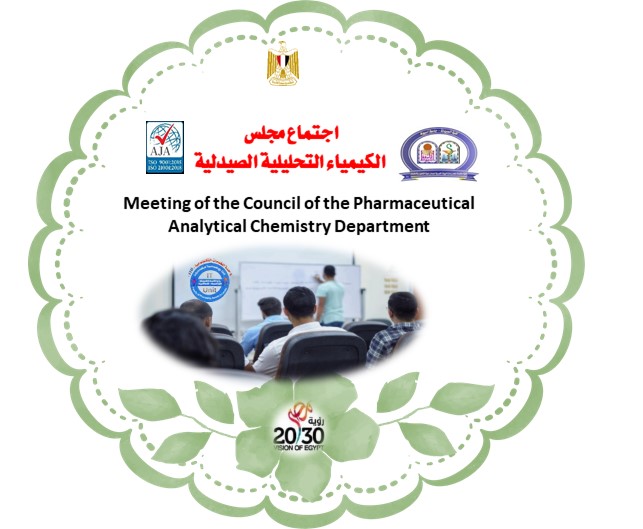
God willing, The Pharmaceutical Analytical Chemistry Department Council will hold its regular monthly meeting No. (540) to be held on Monday, 7 July 2026, at 11:00 AM
In the meetings Hall of the Department

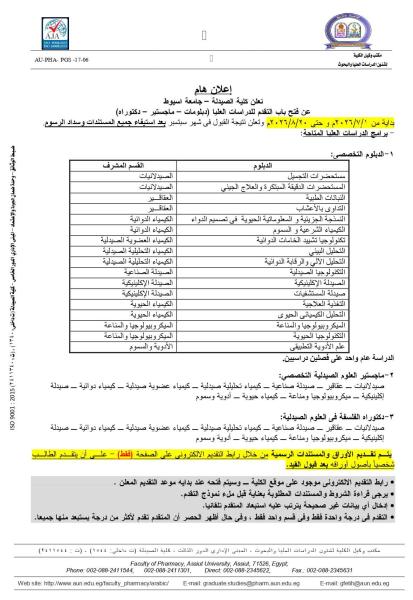
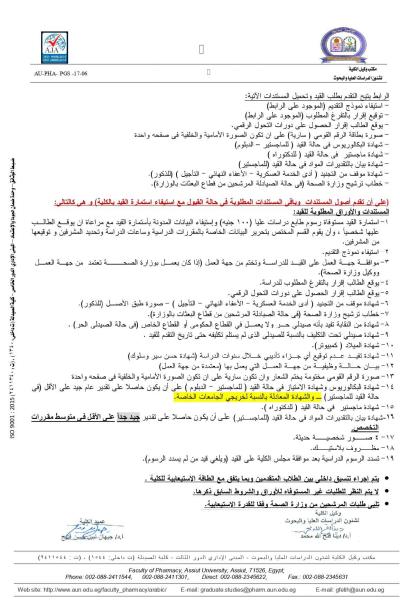
Click below to apply
?
?Diploma Application Link:
https://forms.gle/JSXvmcBQjvLFVJV3A
?Master's Degree Application Link:
https://forms.gle/4C5fpVXm78PsaUik7
?Ph.D. Degree Application Link:
https://forms.gle/NQvVjq3SDnscYDwM6