Important Announcement Postgraduate Students: Appeals and Grievances (Semester 1 Results) Academic Year 2025/2026

This is to announce the opening of the Appeals (Grievances) period for postgraduate students regarding the First Semester examination results.

  • Start Date: Tuesday, March 31, 2026.

  • End Date: Tuesday, April 7, 2026.

Students wishing to submit an appeal must visit the Postgraduate Affairs Office at the faculty to complete the necessary procedures.


news category
إعلانات الدراسات العليا

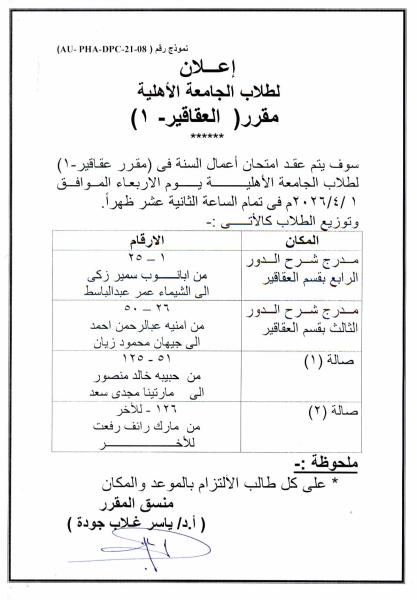
Announcement of the Midterm Exam for the Course (Pharmacognosy I) for Al Ahliyya University Students, to be held on Wednesday, April 1, 2026

The midterm exam for the course (Pharmacognosy I) will be held for Al Ahliyya University students on Wednesday, April 1, 2026, at 12:00 PM.

  • Student distribution is as follows:

Numbers

Location

1–25 From Ebanoub Samir Zaki To Elshaimaa Omar Abdelbaset

Lecture Hall, 4th Floor – Pharmacognosy Department

26–50 From Omnia Abdelrahman Ahmed To Gehan Mahmoud Zidan

Lecture Hall, 3rd Floor – Pharmacognosy Department

51–125 From Habiba Khaled Mansour To Martina Magdy Saad

Hall (1)

126–End From Mark Raef Refaat To End

Hall (2)


  • Note:
    All students must adhere to the assigned time and location.


news category
إعلانات الطلاب

Design, synthesis, and characterization of novel 5- ethylsulfonyl-indazole-3-carboxamides as dual VEGFR-2 and EGFR inhibitors: apoptotic antiproliferative and immunomodulatory evaluations

Research Abstract

This study focused on the design and synthesis of a novel series of 5-ethylsulfonyl-indazole-3-carboxamides (8a–l) as dual inhibitors of VEGFR-2 and EGFR. Compounds 8g and 8h emerged as the most efficient derivatives among all evaluated compounds against breast (MCF-7) and colorectal (HCT-116) cancer cell lines, exhibiting IC50 values of 24 and 28 nM for HCT-116 and MCF-7 cell lines, respectively, for 8g and 23 and 25 nM for the same cell lines for 8h. Compounds 8g and 8h exhibited a promising safety margin against normal cells (WI-38) (IC50 values > 150 nM). In vitro enzyme assays demonstrated that compounds 8g and 8h exhibited potent inhibition of VEGFR-2 and EGFR. Furthermore, compounds 8g and 8h induced apoptosis by activating Bax, p53, caspase-3, 8, and 9, as well as down-regulating Bcl-2. Compounds 8g and 8h reduced TNF-a and IL-6 levels compared to dexamethasone. The computational investigation of compound 8h, a novel indazole-based urea derivative, was undertaken to rationalize its potent dual inhibition of EGFR and VEGFR-2. Molecular docking studies revealed a high binding affinity and a favorable interaction profile with key kinases.
residues, particularly hinge-region contacts with Met769 (EGFR) and Glu885/Asp1046 (VEGFR-2). Follow-up molecular dynamics (MD) simulations confirmed the stability of the 8h–EGFR complex over 150 ns, characterized by persistent hydrogen bonding, low RMSF in the binding site, and consistent radius of gyration. Quantum mechanical (QM) analyses, including DFT and MEP mapping, revealed a HOMO–LUMO gap of 4.55 eV, high dipole moment (9.3 D), and distinct electron-rich/hydrogen-bonding regions, supporting strong molecular interactions. Additionally, SwissADME profiling
demonstrated acceptable drug-likeness, moderate solubility, and a low CYP-inhibition profile, suggesting favorable pharmacokinetics compared to the reference inhibitor erlotinib. These integrated computational findings align with experimental data on antiproliferative effects and kinase inhibition, reinforcing compound 8h as a promising dual-target anticancer candidate.

Research Authors
Lamya H. Al-Wahaibi, Shimaa A. Othman, Hesham A. Abou-Zied, Stefan Br¨ase, Bahaa G. M. Youssif and Safwat M. Rabea

Research Date
Research Journal
RSC Advances
Research Pages
47710
Research Publisher
Royal Society of Chemistry
Research Rank
Pharmaceutical Chemistry, Q2
Research Vol
15
Research Year
2025

Design, synthesis, antiproliferative activity, and molecular dynamics simulation of pyrazolinebased derivatives as dual EGFR and HER-2 inhibitors

Research Abstract

The dual targeting of EGFR and HER2 is an established anticancer strategy. A novel series including two distinct scaffolds, A (chalcone-based compounds, 4a–n) and B (pyrazoline-based compounds, 5a–n), was developed and synthesized. The antiproliferative efficacy of 4a–n and 5a–n was examined against a panel of four cancer cell lines. The findings indicated that pyrazoline derivatives 5a–n exhibited more efficacy than chalcone compounds 4a–n. Compounds 4n, 5d, and 5g were identified as the most effective antiproliferative derivatives. These compounds were further investigated as dual EGFR/Her2 inhibitors. Compound 5d inhibited EGFR-TK and HER2 significantly, with IC50 values of 0.126 and 0.061 mM, respectively. Moreover, compound 5d can induce a percentage of pre-G1 apoptosis by 78.53% in
cell cycle analysis and cause early apoptosis with a necrosis percentage of 5.28. Docking and MD simulation illustrated the significant cytotoxic activity of the 5d compound and how it can be a promising scaffold with anticancer activity.

Research Authors
Hani Mohamed Hafez, Basmat Amal M. Said, Ahmed M. Sayed, Eid Alatwi, Bahaa G. M. Youssif, Stefan Brase and Hany A. M. El-Sherief
Research Date
Research Journal
RSC Advances
Research Pages
9265
Research Publisher
Royal Society of Chemistry
Research Rank
Pharmaceutical Chemistry, Q2
Research Vol
15
Research Year
2025

Design, synthesis, and structural elucidation of ethyl 2-amino-5-oxo-4-aryl-4H-pyrano[3,2-c] quinoline-3-carboxylates as dual EGFR/HER-2 inhibitors endowed with antiproliferative activity

Research Abstract

A new series of quinoline-3-carboxylate derivatives 3a–k were developed as prospective dual inhibitors of EGFR and HER-2. Structural elucidation was accomplished via ¹H NMR, ¹³C NMR, DEPT NMR, elemental analysis, and mass spectrometry. The synthesized compounds were evaluated for antiproliferative activity against breast (MCF-7) and colon (HT-29) cancer cell lines. Compounds 3a and 3f had the highest antiproliferative efficacy, especially against HT-29 colon cancer cells (IC50 = 23 and 25 nM, respectively), surpassing erlotinib (IC50 = 30 nM). Kinase inhibition experiments further validated the dual action of 3a and 3f, yielding IC50 values of 68 nM and 30 nM against EGFR and HER-2, respectively, for 3a and IC50 values of 71 and 33 nM against the same two kinases for 3f. Compounds 3a and 3f induced apoptosis by the activation of caspases 3, 8, and 9, alongside the overexpression of Bax and the downregulation of Bcl-
2. In silico molecular docking studies were performed to investigate the binding interactions of the most active compound, 3a, with EGFR and HER-2 kinase domains. The compound showed strong binding affinities, forming critical hydrogen bonds and hydrophobic interactions with key active-site residues. Additionally, SwissADME analysis of 3a revealed full compliance with major drug-likeness filters, highlighting its potential as an orally available, dual EGFR/HER-2 inhibitor with favorable pharmacokinetic properties.

Research Authors
Lamya H. Al-Wahaibi, Hesham A. Abou-Zied, Aliaa M. Mohassa, Hazem M. Fathy, Abdullah Yahya Abdullah Alzahranie, Bahaa G. M. Youssif
Research Date
Research Journal
rsc medicinal chemistry
Research Pages
1039
Research Publisher
Royal Society of Chemistry
Research Rank
Pharmaceutical Chemistry, Q2
Research Vol
10
Research Year
2025

Design, synthesis, and computational studies of novel pyrazoline-based dual EGFR/HER-2 inhibitors with apoptotic antiproliferative activity

Research Abstract

The simultaneous targeting of EGFR and HER2 constitutes a legitimate anticancer strategy for the treatment of
solid tumors. In response, we developed and synthesized a new group of pyrazoline compounds that act as dualtarget
inhibitors for EGFR and HER-2. The structure of the newly synthesized compounds was validated with 1H NMR, 13C NMR, and elemental analysis. The novel compounds’ antiproliferative efficacy was evaluated against four cancer cell lines. All compounds showed GI50 values ranging from 23 to 66 nM, with the breast cancer cell line (MCF-7) showing the highest sensitivity. Compounds 7c, 7d, 7f, 7h, 7j, and 7l had the strongest antiproliferative activity, with derivatives 7d, 7h, and 7j outperforming erlotinib in all tested cancer cell lines. The study revealed that compounds 7d and 7h are the most  effective dual-target inhibitors of EGFR and HER-2, exceeding the reference EGFR inhibitor erlotinib and having comparable action to the clinically used HER-2 medication Lapatinib. We tested the apoptotic potential of 7d and 7h and found that both compounds cause apoptosis by turning on caspase-3, caspase-8, and Bax and decreasing the expression of Bcl-2, a protein that prevents apoptosis. Molecular docking studies revealed robust interactions of these compounds within the EGFR and HER-2 binding pockets, supported by molecular dynamics simulations that confirmed their stability. ADME profiling highlighted the pharmacokinetic advantages of these compounds, particularly 7h, as orally bioavailable and effective inhibitors. These findings suggest that pyrazoline-based inhibitors could serve as a foundation for future development of dual-targeted therapies to overcome resistance in cancer treatment.

Research Authors
Lamya H. Al-Wahaibi, Hani Mohamed Hafez, Fadwa H. Edrees, Hesham A. Abou-Zied, Bahaa G.M. Youssif , Stefan Brase
Research Date
Research Journal
Journal of Molecular Structure
Research Pages
142364
Research Publisher
Science direct
Research Rank
Pharmaceutical Chemistry, Q2
Research Vol
1339
Research Year
2025

Discovery of a novel 1H-pyrazole -[3,4-d] pyrimidine inhibitor based on phenotypic screening for esophageal cancer: Weak cardiotoxicity

Research Abstract

Phenotypic screening, a widely utilized technique in drug research and development, has the advantage of not
relying on specific molecular targets, enabling a more comprehensive evaluation of the potential efficacy of
drugs. Our group developed and synthesized a series of novel 1H-pyrazole [3, 4-d]pyrimidine derivatives. We
used the phenotypic screening method to assess their activities. The results showed that compound 8r had
excellent inhibitory activity against the esophageal cancer cell line KYS-30 (IC50 = 3.53 ± 0.04 μM), significantly
better than the positive control compound 5-Fu. Further activity studies indicated that 8r could not only
considerably inhibit the colony formation and invasion of KYS-30 but also showed excellent safety both in vitro
and in vivo. Subsequently, we treated rat cardiac muscle cells H9C2 with high concentrations (10 μM and 20 μM)
of 8r. Investigations revealed that cardiac muscle cells maintained a survival rate exceeding 80 %, verifying the
minimal cardiotoxicity of compound 8r. The research confirmed the technical benefits of phenotypic screening in
maintaining a balance between drug effectiveness and safety, while also offering a novel approach for creating
anticancer drugs with high efficacy and low toxicity

Research Authors
Yaquan Cao, Yunfei Li, Shuya Li, Hanqi Shui, Bahaa G.M. Youssif, Xinyan Wang, Yinghui Zhao, Jingxia Du, Gaofeng Liang
Research Date
Research Journal
Journal of Molecular Structure
Research Pages
143400
Research Publisher
Science direct
Research Rank
Pharmaceutical Chemistry, Q2
Research Vol
1348
Research Year
2025

Design, synthesis, antiproliferative assessments, and computational studies of new quinolin-2(1H)-ones as dual EGFR/HER-2 inhibitors

Research Abstract

Introduction: A novel series of quinolin-2(1H)-one derivative was rationally designed, synthesized, and characterized as potential dual inhibitors of EGFR and HER-2.
Methods: Structural elucidation was achieved through IR, NMR, mass spectrometry, elemental analysis, and single-crystal X-ray crystallography. The synthesized compounds were screened for antiproliferative activity against four
human cancer cell lines.
Results and Discussion: Compound 5a exhibited the most potent antiproliferative profile, particularly against MCF-7 breast cancer cells (IC50 = 34 nM), outperforming erlotinib (IC50 = 40 nM). Kinase inhibition assays further confirmed the dual activity of 5a, with IC50 values of 87 nM and 33 nM against EGFR and HER-2, respectively. Compound 5a induced apoptosis via activation of caspase-3, -8, and -9, along with upregulation of Bax, downregulation of Bcl-2, and increased cytochrome c release. Flow cytometry analysis demonstrated that 5a caused significant G0/G1 phase arrest in MCF-7 cells, indicating a cytostatic mechanism of action. Computational studies provided structural validation of the observed
biological activities. Molecular docking studies showed a strong binding affinity 5a within the ATP-binding pockets of EGFR and HER-2, supported by key hydrogen bonding and hydrophobic interactions. These findings were further
corroborated by 100 ns molecular dynamics simulations, which confirmed the structural stability and compactness of the 5a-HER-2 complex, as evidenced by low RMSD, consistent RMSF, and favorable radius of gyration and potential energy
profiles. Additionally, ADME predictions revealed that 5a possesses favorable physicochemical and pharmacokinetic properties. Density Functional Theory (DFT) calculations provided insights into the electronic structure of 5a, highlighting favorable HOMO–LUMO distribution and electrostatic potential surfaces that support its dual-binding behavior.

Research Authors
Lamya H. Al-Wahaibi, Hesham A. Abou-Zied, Martin Nieger, Stefan Bräse, Bahaa G. M. Youssif and Hendawy Tawfik
Research Date
Research Journal
Frontiers in Chemistry
Research Pages
1638489
Research Publisher
Frontiers
Research Rank
Pharmaceutical Chemistry, Q2
Research Vol
13
Research Year
2025
Subscribe to