Date of the Coursework Exam for the Drug Design Course – Fourth-Year Pharm D Students

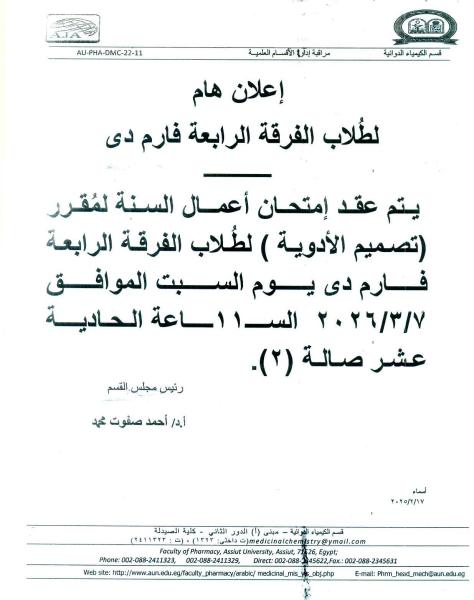
The coursework exam for the Drug Design course for fourth-year Pharm D students will be held on Saturday, March 7, 2026, at 11:00 a.m. in Hall (2).
Do you have any questions? (088) 2080369 - 2345622 Pharmacy_QAAU@pharm.aun.edu.eg

The coursework exam for the Drug Design course for fourth-year Pharm D students will be held on Saturday, March 7, 2026, at 11:00 a.m. in Hall (2).

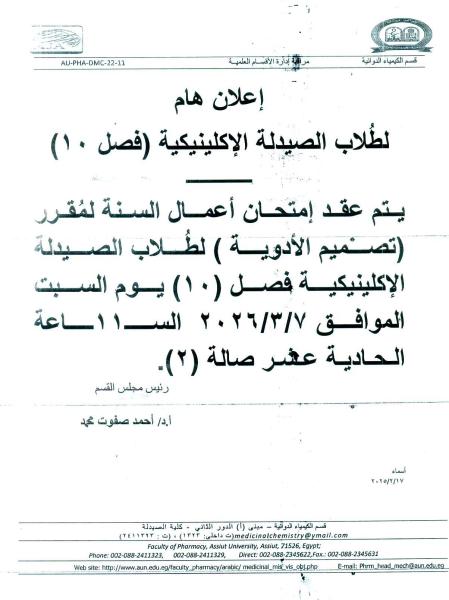
The coursework exam for the Drug Design course for Clinical Pharmacy students (Semester 10) will be held on Saturday, March 7, 2026, at 11:00 a.m. in Hall (2).

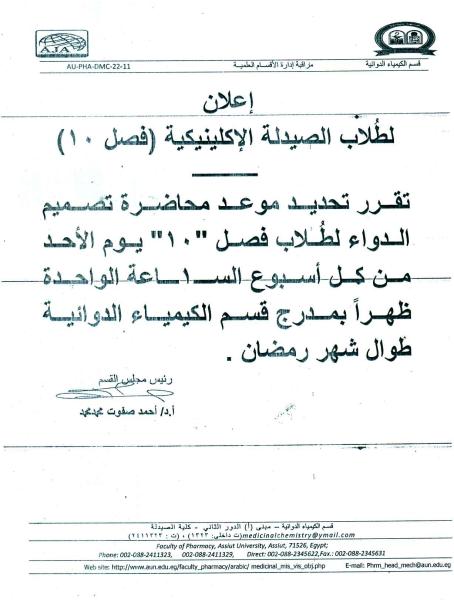
It has been decided that the Drug Design lecture for Clinical Pharmacy students (Semester 10) will be held every Sunday at 1:00 p.m. at the Medicinal Chemistry Department Lecture Hall throughout the month of Ramadan.

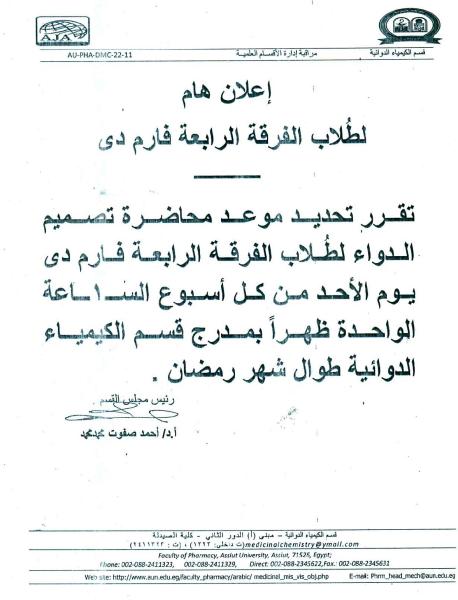
It has been decided that the Drug Design lecture for fourth-year Pharm D students will be held every Sunday at 1:00 p.m. at the Medicinal Chemistry Department Lecture Hall throughout the month of Ramadan.
God willing, the meeting of the Pharmaceutics Department Board of the Faculty of Pharmacy No. (548), at the Faculty of Pharmacy, on Monday, March 2, 2026, at 10:30 A.M
in the department board on the third floor under the chairmanship of the Faculty to discuss the topics that we will inform you later.
With deepest sorrow and heartfelt condolences
the Faculty of Pharmacy mourns the passing of
Prof. Dr. Mohamed Ali Attia
Emeritus Professor of Pharmaceutics,
husband of
Prof. Dr. Fawzia Habib
Emeritus Professor of Pharmaceutics.
May Allah grant the deceased His mercy and forgiveness,
and extend sincere condolences to the family.
The funeral prayer will be held after Friday prayer
at Omar Makram Mosque.
The development of a novel, highly sensitive electrochemical sensor for ASP based on an alizarin red S-functionalized zeolitic imidazolate framework-8 (ALZ@ZIF-8) nanocomposite. The nanocomposite was synthesized via a one-pot approach and fabricated on a carbon paste electrode (ALZ@ZIF-8/CPE). Its interaction with ASP was elucidated through density functional theory (DFT) calculations and electrochemical analysis, while its structure was confirmed using SEM, XRD, FT-IR, UV-Vis, and spectrofluorimetric techniques. Under optimized conditions, a square-wave voltammetric (SWV) method was developed and rigorously validated. The sensor demonstrated a wide linear range from 0.01 to 14.0 µM, with exceptional sub-micromolar sensitivity (detection limit: 3.45 nM; quantification limit: 10.46 nM). The method showed high accuracy (recoveries: 99.26–101.62%) and precision (relative standard deviation, RSD ≤ 1.01%). Successful application to spiked human plasma yielded recoveries ≥ 98.84% with RSDs ≤ 1.61%, confirming practical utility. This work presents the first application of the ALZ@ZIF-8 nanocomposite in analysis. The proposed sensor offers a promising and adaptable platform for the sensitive detection of ASP and other target molecules in complex biological media.
RNAs are known for versatile functions and therapeutic utility. They have gained significant interest since the approval of several RNA drugs, including COVID-19 mRNA vaccines and therapeutic agents targeting liver diseases. There are increasing expectations for a new class of RNA drugs for broader applications. Successful development of RNA drugs for new applications hinges on understanding their diverse functions and structures. In this review, we explore the last five years of literature to understand current approaches to formulate a spectrum of RNA drugs, focusing on new efforts to expand their applications beyond vaccines and liver diseases.
Melasma therapy remains challenging due to limited effectiveness, side effects, and relapses. Topical tranexamic acid (TXA) is promising but requires further research to optimize its formulation. Alongside the therapeutic benefit of fractional CO2 laser (FCL) in melasma, FCL and microneedling (MN) are recognized methods for transepidermal drug delivery. Nanotechnology-based topicals can enhance drug penetration and reduce side effects. Objectives were to evaluate and compare the effectiveness of combined FCL- or MN-assisted transepidermal delivery of TXA 3% gel and FCL monotherapy versus nanotechnology-based TXA 1% microemulsion monotherapy in melasma treatment. Fifty-two melasma females were divided randomly into three groups (A, B & C) for a five-month treatment. Group A (n = 20), using a split-face design, received FCL on the right side (A1) and MN on the left (A2), both with TXA 3% gel applied post-session and daily. Group B (n = 21), also with a split-face design, received FCL with TXA 3% gel post-session only on the right side (B1), while the left side (B2) received FCL alone. Group C (n = 11) received TXA 1% microemulsion daily for the whole face. Evaluations included clinical, dermoscopic, and immunohistochemical SOX10 assessments, with a three-month follow-up. All groups showed a significant reduction of Hemi Melasma Area and Severity Index (Hemi-MASI), dermoscopic, and SOX10 immunoreactivity scores. Groups A1, A2, and C exhibited greater improvement compared to B1 and B2. No recurrence occurred during follow-up. Concluding that TXA 1% microemulsion is effective and safe, procedure-free monotherapy with outcomes comparable to FCL- and MN-assisted TXA 3% gel delivery for melasma.
Atopic dermatitis (AD) is the most widespread chronic inflammatory skin disease characterised by impaired skin barrier, higher immunoglobulin E (IgE)-mediated sensitisation, and pronounced inflammatory and immune activity. In this study, mizolastine-loaded spanlastics (MZSPs) with edge activators (Brij 35, Tween 80, and Cremophor RH40) were formulated using ethanol injection method. Spanlastics were assessed for their average particle size, surface charge, encapsulation efficacy, morphology, in vitro drug release, and ex vivo skin permeation. MZSPs showed average particle size ranging from 186.2 ± 13.0 nm to 380.7 ± 25.9 nm and high MZ encapsulation efficiency percentage of (95.8 ± 0.68%-98.1 ± 0.86%). The prepared MZSPs were incorporated into 2.5% HPMC hydrogel base to facilitate its topical delivery. The in vitro release experiments showed a sustained release profile of MZ from MZSPs-hydrogel over 24 h with effective flux and permeation through rat skin compared to free drug. Additionally, the therapeutic efficacy of MZSPs-hydrogel in an AD model utilising seven-week-old male Balb/C mice outperformed the free drug in improving cytokine profiles, histopathological and immunohistochemical parameters, along with a quantitative analysis of mast cell immunostaining. These findings support the potential application of MZSPs for the transdermal delivery of MZ, offering enhanced management for AD.