

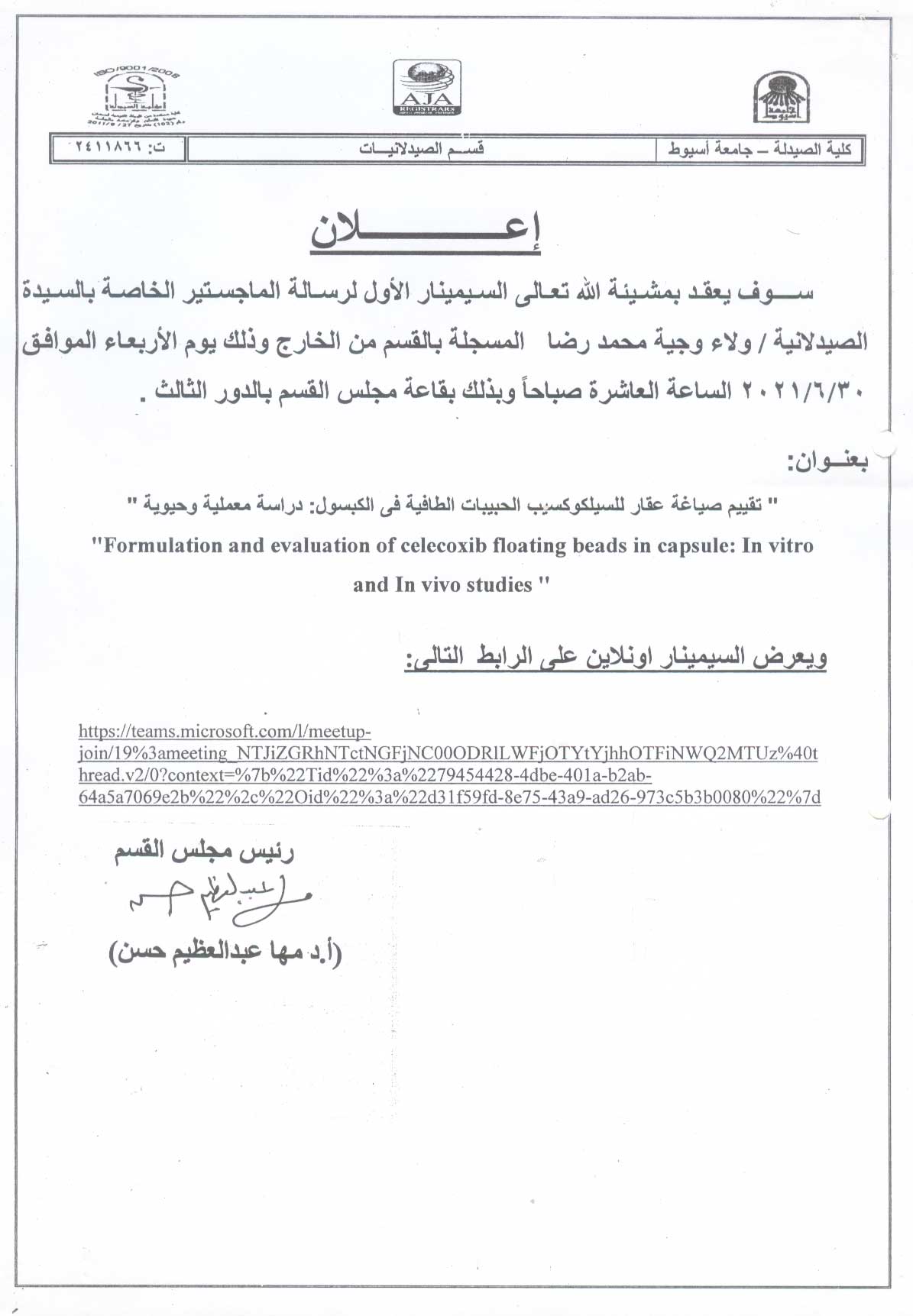
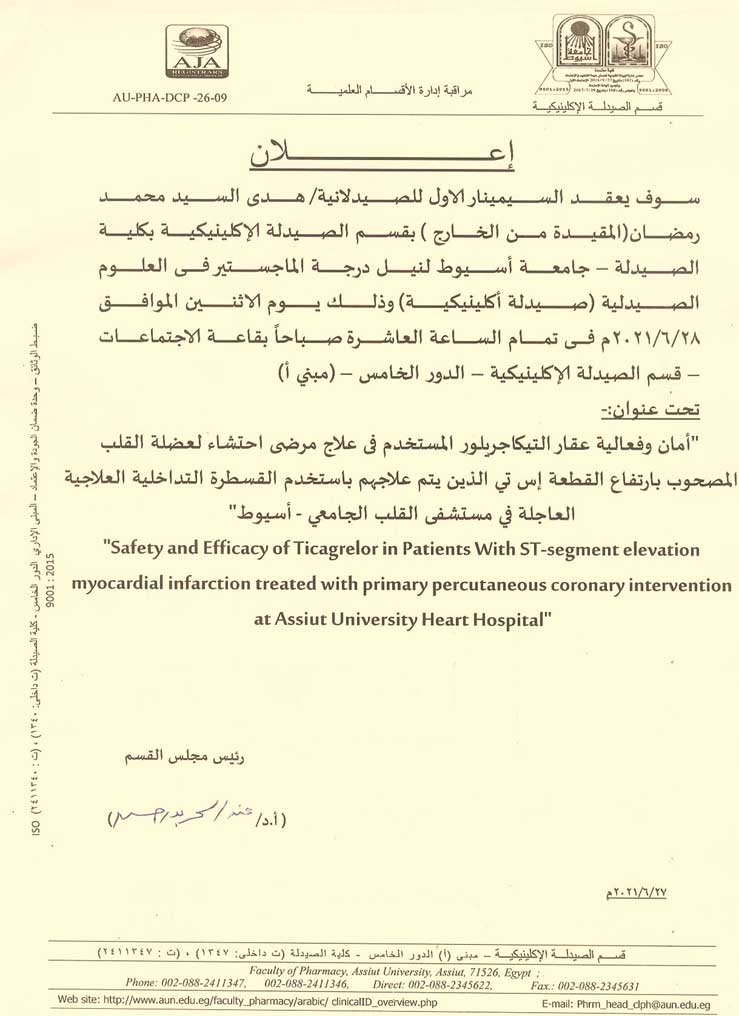
The first seminar for the master thesis of the pharmacist

news category
إعلانات الدراسات العليا

 Do you have any questions? (088) 2080369 - 2345622 Pharmacy_QAAU@pharm.aun.edu.eg
Ethnopharmacological relevance: Iris is the largest genus in the family Iridaceae. Iris plants are distributed in
tropical regions of the world. They are used as ornamentals and traditionally used to treat a variety of ailments.
Aim: This study aimed to evaluate the anti-inflammatory effect of flavonoids isolated from Iris spuria L.
Materials and methods: The isolated flavonoids (1-4) were identified on the basis of different spectroscopic
methods (1D- and 2D-NMR) and co-TLC with authentic samples. The anti-inflammatory effect was tested on
lipopolysaccharide (LPS)-induced nitric oxide (NO) production from rat-isolated peritoneal macrophages.
Modeling and docking simulations of the compounds were performed using Molecular Operating Environment
software and the crystal structure of the murine inducible nitric oxide synthase (iNOS).
Results: Four flavonoids (1-4) had been isolated from the rhizomes of Iris spuria L. (Hocka Hoona) for the first
time. They were characterized as 5,7,2’-trihydroxy-6-methoxyflavanone (1), tectorigenin 7-O-β-D-glucopyranoside
(2), tectorigenin 4’-O-β-D-glucopyranoside (3), and tectorigenin 4’-O-[β-D-glucopyranosyl(1 → 6)-β-Dglucopyranoside]
(4). The selective inducible NO synthase inhibitor; aminoguanidine was used as a positive
control. The production of nitric oxide (NO) was inhibited in a dose-dependent manner of the isolated compounds
along with isoflavonoids (5-9) previously isolated from Iris spuria L. (Calizona). A concentration of 60 μg/
ml of all tested compounds showed a significant inhibitory effect compared to media with LPS. Molecular
modeling experiments supported the obtained biological data.
Conclusion: Our results reveal that flavonoids isolated from I. spuria L. (Hocka Hoona) and I. spuria L. (Calizona)
appear to have a potential anti-inflammatory effect via inhibition of iNOS
COVID-19 is a global pandemic first identified in China, causing severe acute respiratory syndrome. One of the therapeutic strategies for combating viral infections is the search for viral spike proteins as attachment inhibitors among natural compounds using molecular docking. This review aims at shedding light on the antiviral potential of natural products belonging to the natural-products class of coumarins up to 2020. Moreover, all these compounds were filtered based on ADME analysis to determine their physicochemical properties, and the best 74 compounds were selected. Using virtual-screening methods, the selected compounds were investigated for potential inhibition of viral main protease (Mpro), viral methyltransferase (nsp16/10 complex), viral recognition binding domain (RBD) of S-protein, and human angiotensin-converting enzyme 2 (ACE2), which is the human receptor for viral S-protein targets, using molecular-docking studies. Promising potential results against SARS-CoV-2 RNA-dependent RNA polymerase (RdRp) and methyltransferase (nsp16) are presented

In this work, a fast, versatile, and convenient dispersive solid-phase micro-extraction (DSPME) method is combined with a spectro-densitometric technique for the analysis of zolmitriptan (ZOLM) in biologi- cal fluids. Fe 3 O 4 /FeOOH magnetic nanocomposites (MNCs) were prepared by a co-precipitation method in aqueous solutions and utilized subsequently as a sorbent in DSPME. By coupling DSPME with high- performance thin-layer chromatography (HPTLC) with fluorescence detection, the preconcentration and determination of (ZOLM) in presence of metoclopramide (MET) and paracetamol (PARA), which are pre- scribed as an adjuvant therapy with ZOLM, was accomplished. Adsorption capability was assessed using both Langmuir and Freundlich adsorption isotherm models. The adsorption data was fitted to Langmuir adsorption isotherm model as reflected by high determination coefficient (R 2 = 0.9944). Moreover, ad- sorption kinetics was assessed by pseudo-first and pseudo-second order kinetic models. The data was fitted to pseudo-second order kinetics, which proves that ZOLM interaction with the adsorbent is a chemisorption process. Surface complexation with MNCs was suggested to explain the pH dependence of ZOLM sorption. The key parameters of extraction and desorption steps (including pH, extraction time, sample volume, magnetic adsorbent amount, and desorption circumstances) were evaluated. Optimized conditions for solid phase microextraction of ZOLM were pH 2.9, 5.0 mg Fe 3 O 4 /FeOOH MNCs, 15 min vortex-assisted extraction time and 3 ×200 μL of methanol: 33% ammonia; 4:1 as eluent. The analysis was achieved using ACN: dichloromethane: 33% ammonia (22.5: 6.0: 1.5, v/v/v) as a mobile phase and the fluorescence detection was carried out at 223 nm. The proposed DSPME method was successfully ap- plied for trace quantification of ZOLM in rabbits’ plasma ( n = 6) after oral administration with a linearity range of 50.0 –400.0 ng mL −1 (R 2 = 0.9931), a detection limit of 12.0 ng mL −1 and extraction recovery of 97.27–99.89% with an RSD < 2% ( n = 9). Moreover, the selectivity of the proposed approach for analysis of ZOLM in the presence of MET and PARA is demonstrated
A selective and simple salting-out-assisted thin-layer chromatographic methodology
was developed for the simultaneous determination of two oral hypoglycemic drugs,
dapagliflozin (DAPA) and metformin (MET) in their pure forms, tablets and spiked
human plasma samples. Silica gel 60 F254 plates were used in the separation of the
two drugs using a mobile phase consisting of 0.5 M (NH4)2SO4 and methanol
(3:7, v/v). The plates were scanned in the reflectance mode at λmax = 237 nm. The
obtained retardation factor (Rf) values for DAPA and MET were 0.77 ± 0.02 and 0.25
± 0.02, respectively. The thin-layer chromatography method was validated according
to International Conference on Harmonization guidelines. The peak areas were linearly
increased with the increases in concentrations of 45–1,000 and 50–1,500 ng/band
for DAPA and MET, respectively. Moreover, the method was applied to estimate the
molecular lipophilicity parameters of DAPA and MET via retention data. The
suggested method was efficiently utilized for the analysis of DAPA and MET in
pharmaceutical tablets and plasma samples with recoveries 98.4–100.4 and RSDs in
the ranges of 1.4–2.6 and 2.2–3.0% for DAPA and MET, respectively.


تحت رعاية السيد الأستاذ الدكتور / أحمد محمد عبد المولى – عميد الكلية وبإشراف السيد الأستاذ الدكتور/ محمود البدرى عبد المطلب – وكيل الكلية لشئون خدمة المجتمع وتنمية البيئة - واصل قطاع خدمة المجتمع وتنمية البيئة خلال فرصة توقف الإمتحانات يوم الثلاثاء الموافق 15-6-2020م تنفيذ الخطة الخاصة بتطهير وتعقيم جميع مقار لجان الإمتحانات الفصل الدراسى الثانى من العام الجامعى 2020/2021 م وذلك متابعة لتنفيذ الإجراءات الإحترازية للحد من إنتشار فيروس كورونا.



رابط لينيك المناقشة اون لاين

