
بيان بأماكن ومواقع المقرر الأختيارى للفصل الدراسي الثانى للعام الجامعى 2020/2021م للفرقة الرابعة


news category
إعلانات الدراسات العليا

 Do you have any questions? (088) 2080369 - 2345622 Pharmacy_QAAU@pharm.aun.edu.eg
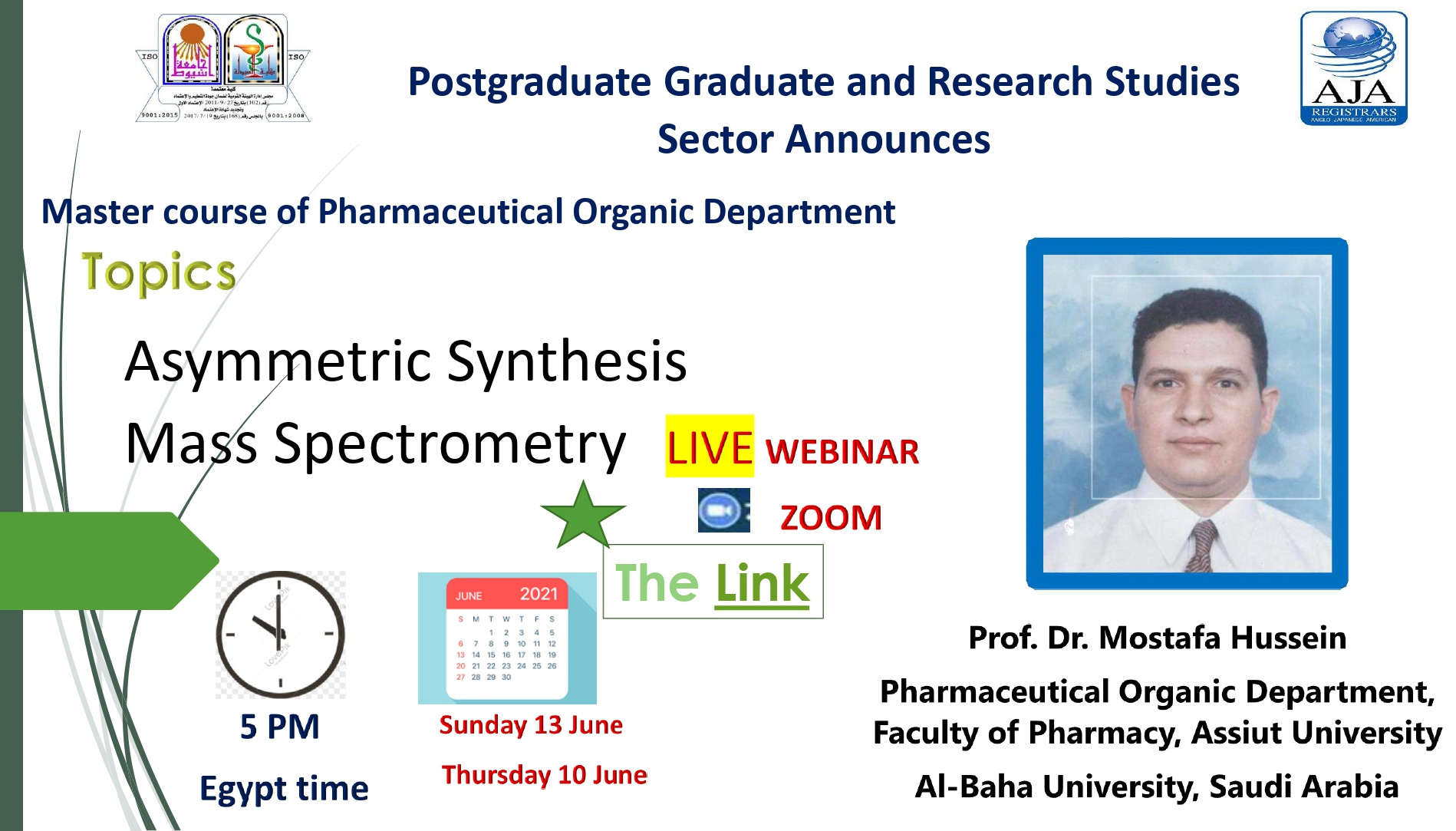
يقوم السيد الأستاذ الدكتور/ مصطفى حسين - بإلقاء محاضرة فى مقرر:
Master course of Pharmaceutical Organic Department
تحت عنوان
Asymmetric Synthesis Mass Spectrometry
رابط محاضرة ا. د/ مصطفى حسين - يوم الأحد الساعه الخامسه مساءا
Join Zoom Meeting
https://us05web.zoom.us/j/8374053123?pwd=NXVuYnM4N1NPNEZaSGhoK0xBLzVVQT09


The Medicinal Chemistry Department Council will hold its regular monthly meeting number (439) on Sunday 13-6-2021 at 12 PM online.

Co-administration of Glimepiride (GLIM), Empagliflozin (EMPA) and Linagliptin (LING) promote a preferred
glycemic control, besides additional benefits such as reduction of high blood pressure and weight loss. In the
present study a feasible TLC method with reflectance/ fluorescence mode for simultaneous determination of
GLM, EMPA and LING was established. Separation of the cited drugs was performed on aluminum plates precoated
with silica gel 60 F254 and developed with (toluene: methanol: ethyl acetate (4: 3: 2 v/v/v)) as a mobile
phase. The mentioned drugs were adequately detected after exposing the plate to concentrated (30–34%)
hydrochloric acid vapor for 15 min. The was scanned in the reflectance/fluorescence mode at 228 nm excitation
wavelength using 320 nm emission filter. The three drugs were well separated with Rf values of 0.73 ± 0.02,
0.59 ± 0.02 and 0.10 ± 0.02 for GLIM, EMPA and LING, respectively. The developed method was validated
according to ICH guideline with linearity (2.61–60, 5.53 –120 and 4.68–80 ng/band for GLIM, EMPA and LING,
respectively) and precision (% RSD was ± 2.98 for GLIM, 2.76 for EMPA, 2.41 for LING). The correlation coefficients
were 0.9915, 0.9940 and 0.9921 for GLIM, EMPA and LING, respectively. The developed method was
successfully applied for the analysis of the cited drugs in their tablets and real human plasma samples with good
accuracy and precision.
The Clinical Pharmacy Department Council will hold its regular monthly meeting number (62) on Sunday 6-6-2021 at 12 PM, in the meetings Hall of the Department - 5th floor (Building A).
Phytochemical investigation of Callistemon citrinus (Curtis) Skeels (syn. Callistemon lanceolatus (Sm.) Sweet and Melaleuca citrina (Curtis) Dum.Cours.) leaves resulted in the isolation of five undescribed compounds, including one acylphloroglucinol derivative and four monoterpene galloylglucosides, in addition to 29 known diverse secondary metabolites. Interestingly, this study reports chemosystematically significant isolation of the monoterpene galloylglucosides from the genus for the first time. Furthermore, exploration of the isolated compounds as inhibitors of inflammation-related molecular targets, molecular docking studies targeting human adipocyte lipid-binding protein FABP4 (3P6H) and human nitric oxide synthase (3E7G) were carried out in order with the in vitro evaluation of the isolated compounds for their anti-microbial and inhibitory of inducible nitric oxide synthase (iNOS) activities. Molecular docking studies revealed that eighteen compounds showed lower docking scores than ibuprofen, the native ligand in the crystal structure 3P6H, and nine compounds showed lower docking scores than AR-C95791, the native ligand in the binding site of 3E7G. Additionally, in vitro studies revealed that seven compounds showed moderate iNOS inhibitory activity. They also were moderately cytotoxic to HepG2, LLC-PK1 and Vero cells. Pulverulentone A showed moderate antibacterial activity against MRSA (IC50 22.2 μM) and antifungal activity against C. neoformans, while corosolic acid showed strong antibacterial activity against VRE (IC50 15.9 μM).Thus, the in silico and in vitro studies indicated that some isolated compounds hold potentials as inhibitors of iNOS activity and anti-microbial agents.
Introduction: Cancer is one of the leading causes of death worldwide. In many cases,
cancer is related to the elevated expression of a significant cytokine known as tumor
necrosis factor-α (TNF-α). Breast cancer in particular is linked to increased proliferation
of tumor cells, high incidence of malignancies, more metastases, and generally poor
prognosis for the patient. The research sought to assess the effect of silver nanoparticles
reduced with ethyl cellulose polymer (AgNPs-EC) on TNF-α expression in MCF-7
human breast cancer cells.
Methods: The AgNPs-EC were produced using the green synthesis reduction method, and
their formation was proofed via UV–VIS spectroscopy. Furthermore, AgNPs-EC were
characterized for their size, charge, morphology, Ag ion release, and stability. The MCF-7
cells were treated with AgNPs-EC. Then, the expression of TNF-α genes was determined
through PCR in real time, and protein expression was studied using ELISA.
Results: The AgNPs-EC were spherical with an average size of 150±5.1 nm and a zetapotential
of −41.4±0.98 mV. AgNPs-EC had an inhibitory effect on cytokine mRNA and
protein expression levels, which suggests that they could be used safely in the fight against
cancer. AgNPs-EC cytotoxicity was also found to be non-toxic to MCF-7.
Conclusion: Our data determined AgNPs-EC as a novel inhibitor of TNF-α production.
These results are promising for developing novel therapeutic approaches for the future
treatment of cancer with safe materials.
Keywords: silver nanoparticles, tumor necrosis factor-α, ethyl cellulose, MCF-7 cells

The Pharmaceutical Organic Chemistry Department Council will hold its regular monthly meeting number (429) on Tuesday 11-5-2021 at 11 AM online.

The Clinical Pharmacy Department Council will hold its regular monthly meeting number (61) on Sunday 9-9-2021 at 10 AM, in the meetings Hall of the Department - 5th floor (Building A).