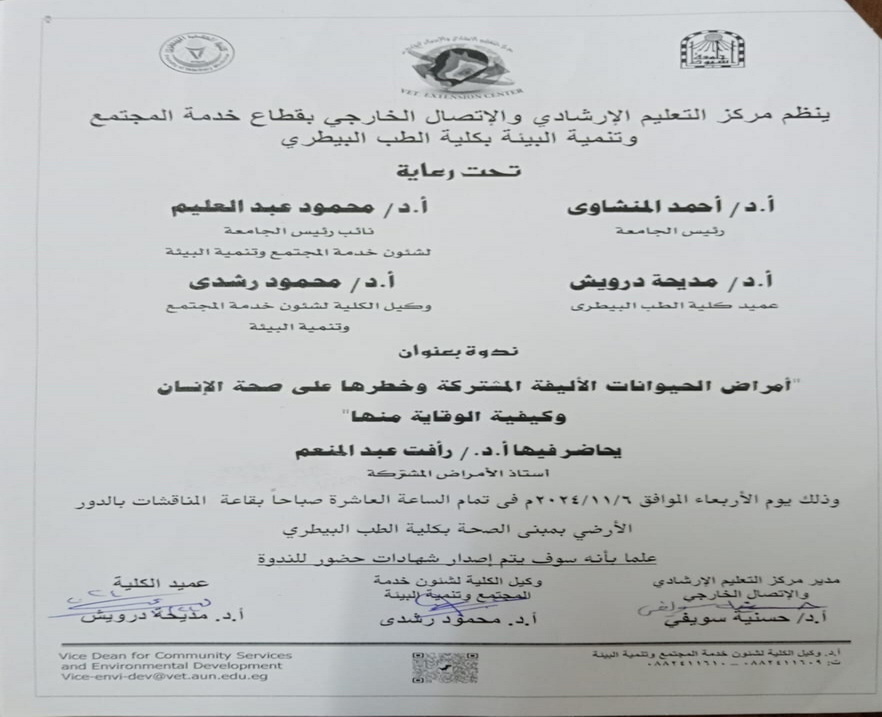
Invitation - Pets animals zoonoses and their danger to human health and how to prevent them
Evaluation of some commercial disinfectants against some pathogens in presence of interfering substances.
Research Date
Research Department
Research Journal
Assiut Veterinary Medical Journal
Research Member
Research Pages
147-158
Research Vol
43
Research Year
2000
Accumulation of Some Heavy Metals in Oreochromis niloticus from the Nile in Egypt: Potential Hazards to Fish and Consumers
Research Date
Research Department
Research Journal
Journal of Environmental Protection
Research Member
Research Pages
1001013
Research Vol
6
Research Year
2015
Impact of zinc oxide nanoparticles on the behavior and stress indicators of African catfish (Clarias gariepinus) exposed to heat stress
Research Abstract
This study was designed to assess the role of nano-zinc oxide in mitigating the deleterious effects of heat stress in African catfish (Clarias gariepinus) by evaluating parameters such as aggressive behavior (biting frequency and chasing duration), hematological indicators, and stress-related biochemical markers. A total of 96 catfish were divided into four distinct groups (24 fish/group): The first group (CON) served as the control group, receiving a diet free of nano-zinc oxide. The second group (HS) was exposed to heat stress at 35 °C±1 °C. The third group (ZN) was fed a diet containing nano-zinc oxide at 30 mg/kg of the diet, and the fourth group (ZHN) was exposed to heat stress (35 °C±1 °C) and fed a diet containing nano-zinc oxide at 30 mg/kg of the diet. The results clarified that the aggressive behavior and cortisol levels were significantly higher (P<0.05) in the HS group compared to the CON and ZHN groups. Additionally, the level of acetylcholinesterase (AChE) was significantly lower (P<0.05) in the HS group compared to the CON and ZHN groups. Meanwhile, a significant (P<0.05) decrease in red blood cells, hemoglobin, packed cell volume, white blood cells, alkaline phosphatase, and lymphocytes, was observed in fish belonging to the HS group, while the levels of alanine aminotransferase, aspartate aminotransferase, neutrophils, and monocytes showed a significant increase (P<0.05). Supplementation with nano-zinc oxide significantly recovered most hematological and biochemical parameters. In conclusion, nano-zinc oxide contributed significantly to the regulation of the negative impacts of heat stress on fish by reducing aggressive behavior and cortisol levels. Additionally, it improved the levels of AChE and certain hematological and biochemical parameters.
Research Date
Research Department
Research File
s12917-024-04302-6.pdf
(1.37 MB)
Research Journal
BMC Veterinary Research
Research Member
Research Pages
1-10
Research Vol
20:474
Research Website
https://doi.org/10.1186/s12917-024-04302-6
Research Year
2024
In vitro and In silico assessment of antischistosomal activities of ethanolic extract of Cornulaca monacantha
Research Abstract
Schistosomiasis is the second most prevailing parasitic disease worldwide. Although praziquantel is considered an effective drug in the treatment against schistosomiasis to some extent, there is an emerging drug resistance that widely recorded. Therefore, there is an urgent need to develop effective and safe anti-schistosomal drugs. In this study, Cornulaca monacantha (C. monacantha), a sub-saharan plant, was extracted using aqueous ethanol and characterized by High-Performance Liquid Chromatography (HPLC). Major constituents of the extract are belonging to flavonoids, tannins and phenolic glycosides. Worms’ viability and surface morphology of Schistosoma mansoni (S. mansoni) adult worms treated with the extract were assessed using in vitro viability assay, Scanning Electron Microscopy (SEM), and histological examination. The extract (80–350 μg/ml) reduced viability percentage of worms by 40–60% and caused degeneration of both oral and ventral suckers, tegumental, sub-tegumental and muscular damage. Molecular docking approach was utilized to assess the binding affinities of the extracted compounds with S. mansoni alpha-carbonic anhydrase (SmCA), an essential tegument protein. Pharmacokinetic analysis using SwissADME showed that 7 compounds have high drug similarity. This study confirms the in vitro schistomicidal activity of C. monacantha extract against S. mansoni adult worms and suggests potential SmCA inhibition.
Research Date
Research Department
Research Journal
Saudi Journal of Biological Sciences
Research Member
Research Publisher
Elseiver
Research Vol
254
Research Website
https://doi.org/10.1016/j.exppara.2023.108631
Research Year
2023
Plasma activated water effects on behavior, performance, carcass quality, biochemical changes, and histopathological alterations in quail
Research Abstract
Background Plasma-activated water (PAW) is an innovative promising technology which could be applied to improve poultry health. The current study investigated the effects of drinking water supply with PAW on quail behaviour, performance, biochemical parameters, carcass quality, intestinal microbial populations, and internal organs histopathology. A total of 54 twenty-one-day-old Japanese quail chicks were randomly allotted to three treatments provided with PAW at doses 0, 1 ml (PAW-1), and 2 ml (PAW-2) per one litter drinking water. Each treatment contained 6 replicates (3 birds/ cage; one male and two females).
Results The results clarified that there were no significant (P > 0.05) changes in behaviour, and performance. For the biochemical indicators, the PAW-1 group showed significantly higher serum H2O2, total protein and globulin levels compared with the other groups (P = 0.015, < 0.001, and 0.019; respectively). PAW groups had significantly lower serum creatinine and urea levels than the control (P = 0.003). For the carcass quality, the internal organs relative weight between different treatments was not changed. In contrast, there was a significant increase in the meat colour, taste, and overall acceptance scores in PAW groups compared with the control one (P = 0.013, 0.001, and < 0.001;
respectively). For the intestinal microbial population, lactobacilli count was significantly higher in PAW-2 compared with the control group (P = 0.014), while there were no changes in the total bacterial count between different treatment groups. Moreover, mild histological changes were recorded in the intestine, liver, and spleen of PAW groups
especially PAW-2 compared with the control one.
Conclusions PAW offered benefits, such as reducing creatine and urea levels, improving meat characteristics, and increasing lactobacilli count, all of which are crucial for sustainable quail farming. Therefore, further research is needed.
Research Date
Research Department
Research Journal
BMC Veterinary Research
Research Member
Research Pages
391
Research Vol
20
Research Website
https://doi.org/10.1186/s12917-024-04231-4
Research Year
2024
Neurobehavioral toxicity of Cold plasma activated water following oral gavage in mice
Research Abstract
Cold plasma-activated water (PAW) is a novel technology that was recently used in biomedical research; Despite its potential, PAW’s safety remains inadequately assessed. The study explores the impact of PAW on behavioral responses and brain tissue histopathology in mice. Ten-week-old female albino mice were divided into three
groups each containing 10 mice (5 replicates, 2 mice/cage) and received either distilled water (DW), or distilled water exposed to cold atmospheric plasma (CAP) for 3 min (PAW-3), or 15 min (PAW-15) by oral gavage in a dose of 200 μL/mice (3 times/week) for four weeks. PAW exhibited altered physicochemical properties compared to DW. Mice exposed to PAW demonstrated reduced burrowing activity, marble burying ability, and
novel object recognition compared to controls, indicating potential neurobehavioral alterations. PAW-treated groups displayed notable histological lesions in brain tissues, including nerve cell necrosis, vascular congestion, and Purkinje cell degeneration, confirming neurotoxic effects. Positive reactions for NF-κB and iNOS in brain tissues of PAW-treated mice corroborated the histopathological findings, suggesting neuroinflammation and oxidative stress. The study highlights the need for further investigation into PAW’s safety profile and optimal treatment protocols to mitigate potential neurobehavioral toxicity in biomedical research.
Research Date
Research Department
Research Journal
Neurotoxicology
Research Pages
45-57
Research Publisher
Elsevier B.V.
Research Vol
105
Research Year
2024
Exploring the efficacy of various wheat bran extracts in promoting burn wound healing: A comparative analysis
Research Date
Research Department
Research Journal
Journal of Ethnopharmacology
Research Member
Research Pages
117174
Research Publisher
Elsevier
Research Year
2024