
Engineering students successfully optimized the Vortex processor to be compatible with ASIC design in collaboration with Silicon Arts.
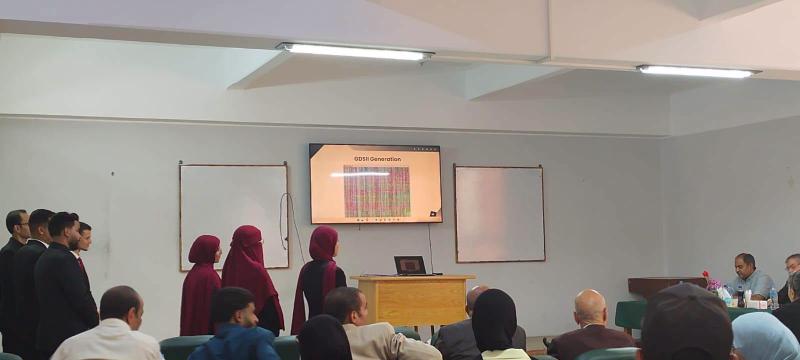
Engineering students successfully adapt and optimize a Vortex processor for ASIC design in collaboration with Silicon Arts.

As part of a collaboration between the Faculty of Engineering at Assiut University and Silicon Arts, and under the auspices of Professor Khaled Salah Saeed, Dean of the Faculty, and Professor Mohamed Safwat, Vice Dean for Education and Student Affairs, a team of students implemented a specialized project in the field of custom integrated circuit (ASIC) design. The project focused on adapting and optimizing the open-source Vortex processor, built on the RISC-V-based GPGPU architecture, to be compatible with the ASIC design flow. The project included modifying the source code to meet the requirements of custom ASIC design and completing the design flow stages, including preparation for physical implementation. The original project was intended for simulation and implementation on an FPGA. This project provides students with practical experience in converting open-source designs into manufacturable designs. The project was supervised by Professor Dr. Khalil Ismail Khalil Youssef and Professor Dr. Mohamed Abbas Abdel-Radi, Head of the Electrical Engineering Department at the college. Participating students included Mustafa Asran, Shahd Hossam, Manar Hamada, Basma Atef, Ibrahim Karam, Hassan Abdel-Rahman, and Fadi Raafat.

قد تكون صورة ‏‏شخص أو أكثر‏ و‏نص‏‏
 
لا يتوفر وصف للصورة.
 
قد تكون صورة ‏‏‏شخص أو أكثر‏، و‏أشخاص يدرسون‏‏ و‏مستشفى‏‏

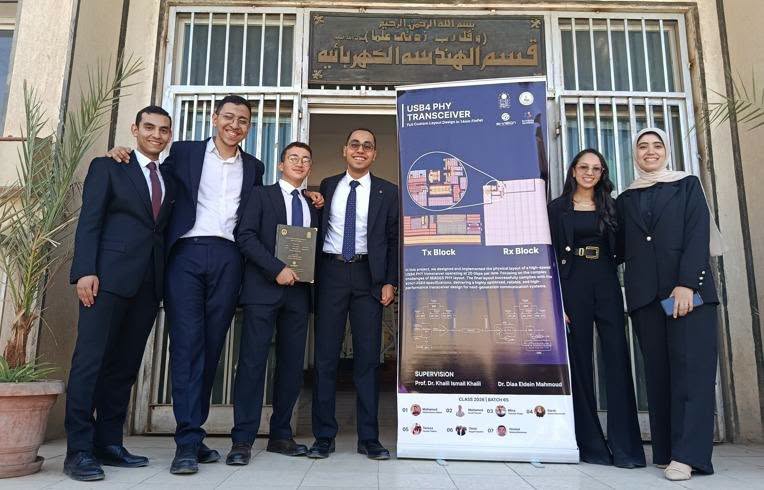
*In collaboration with Si-Vision, engineering students successfully designed the physical layout of a 20 Gbps USB4 PHY Transceiver using 14nm technology.*

*In collaboration with Si-Vision, engineering students successfully design the physical layout of a 20 Gbps USB4 PHY transceiver using 14nm technology.*

As part of the collaboration between the Faculty of Engineering at Assiut University and Si-Vision, and under the auspices of Professor Dr. Khaled Salah Saeed, Dean of the Faculty, and Professor Dr. Mohamed Safwat, Vice Dean for Education and Student Affairs, a team of students from the Electronics and Communications Engineering Department of the Electrical Engineering Division—Mohamed Ezzat, Mohamed Abdel Rahman, Omar Ragab, Mina Tharwat, Ahmed Walid, Sarah Ahmed Mahmoud, and Teresa Osama—developed a pioneering project in the field of microchip design, titled "Layout Design of USB4 PHY Transceiver."

The project focused on the fully customized design and physical layout of a high-speed data transmitter and receiver with a data transfer rate of up to 20 Gbps. This design was built using microchip technology. The advanced 14nm FinFET technology demonstrates the students' ability to work with cutting-edge global technologies in the semiconductor industry and develop circuits that meet the ultra-fast data transfer requirements of the modern USB4 standard.

This project is a significant step that showcases the students' skills in creating precise physical designs that meet industry standards and provides them with valuable practical experience, enabling them to compete in the complex electronic chip design market. The project was supervised by Professor Dr. Khalil Ismail Khalil Yousef and Dr. Diaa El-Din Mahmoud.


قد تكون صورة ‏نص‏
 
قد تكون صورة ‏نص‏قد تكون صورة ‏نص‏

Sustainable Hydraulic Design of Water Structures Through Optimal Technical Pairing of Upstream Wing-Wall Geometry and Canal Inside Slopes: HEC-RAS Numerical Investigation

Research Abstract
Hydraulic structures disturb natural flow patterns, reducing water conveyance efficiency and increasing hydraulic energy losses, thereby affecting the sustainable management of water structures. Entrance-zone geometry, particularly upstream wing-wall configuration and canal inside slope, plays a critical role in controlling flow behavior, energy dissipation, upstream afflux, and hydraulic performance. However, the coupled effects of these geometric parameters have not been systematically investigated. Therefore, this study employed a validated HEC-RAS model to evaluate the combined influence of canal inside slope and upstream wing-wall configuration on the hydraulic performance of irrigation water structures and to support sustainable hydraulic design. Four wing-wall configurations (box, broken, curved, and splayed) and three canal inside slopes (1:1, 3:2, and 2:1) were analyzed under a fixed contraction ratio of 0.6 and upstream Froude numbers ranging from 0.12 to 0.18 under steady subcritical flow conditions. The model was validated against measurements from a 1:10 laboratory flume, demonstrating excellent agreement, with an average variation of 5.75% and coefficients of determination (R2) ranging from 0.97 to 0.99. Gradual entrance transitions significantly improved hydraulic performance by reducing flow disturbances and enhancing flow uniformity. For a canal inside slope of 1:1, the curved wing-wall configuration reduced relative heading-up and energy loss by 18.02% and 46.83%, respectively, whereas the splayed configuration achieved the best overall performance, with corresponding reductions of 27.63% and 73.11% compared with the conventional box configuration. Furthermore, dimensionless predictive equations were developed for the principal hydraulic performance indicators, achieving R2 values of 0.96–0.99 and RMSE values of 0.001–0.01. The proposed framework improves water conveyance efficiency, minimizes hydraulic losses, and provides a validated, cost-effective numerical tool for evaluating alternative design scenarios, reducing reliance on extensive physical experimentation while supporting sustainable irrigation structures and long-term water resources management.


Research Authors
Mohamed A. Ashour, Tarek S. Abu-Zaid, M. Khairy Ali,Haitham M. Abueleyon,& Abdallah A. Abdou &
Research Date
Research Department
Research Journal
sustainability
Research Pages
https://doi.org/10.3390/su18168552
Research Publisher
MDPI
Research Rank
Q2
Research Vol
16
Research Website
https://doi.org/10.3390/su18168552
Research Year
2026

Ergonomic Assessment of Plastic Syringe Manufacturing Processes

Research Authors
Ahmed Nasser Ahmed, Mahmoud EL-Sharief, Mahmoud Heshmat
Research Date
Research Journal
JES. Journal of Engineering Sciences
Research Website
https://scholar.google.com/citations?view_op=view_citation&hl=en&user=LN8noO4AAAAJ&citation_for_view=LN8noO4AAAAJ:D03iK_w7-QYC
Research Year
2026

EFFECT OF THE GAP BETWEEN A CANTILEVERED RECTANGULAR PRISM AND A SPLITTER PLATE ON THE PERFORMANCE OF A MAGNETOSTRICTIVE FLOW INDUCED VIBRATION POWER GENERATOR

Research Abstract

The effects of the span length of the prism, and the gap between the splitter plate and the prism on the performance of the vibrational power generator by the flow induced vibration and the magnetostrictive material were investigated with the w ind tunnel experiment. The splitter plate was added to improve the performance of a vibrational power generator with a cantilevered rectangular prism and a side ratio D H of 0.4 (where D is the depth of the prism in the flow direction and H is the height o f the prism). The span length L of the rectangular prism was 200 mm and 300 mm. The high speed galloping vibration occurs in cases with a small gap. The vibration onset flow velocity and power generation are affected by the span length of the prism. As t he long span rectangular prism (i.e., L = 300mm) has a low characteristic frequency and starts to vibrate at a low wind velocity, this prism has a wide range of wind velocity for power generation as compared with the short span prism (i.e., L = 200 mm).

Research Authors
Takahito Hamano, Takahiro Kiwata, Takuma Shima, Sotaro Takeuchi, Mohamed Heragy, Toshiyuki Ueno
Research Date
Research Journal
Grand Renewable Energy proceedings GRE2022
Research Pages
4
Research Publisher
Japan Council for Renewable Energy
Research Website
https://www.jstage.jst.go.jp/article/gre/2/0/2_30/_article/-char/ja/
Research Year
2022

Experimental study of wind energy harvesting from flow-induced vibration of prisms using magnetostrictive material

Research Abstract

A vibration energy harvester was developed using a magnetostrictive material as a power generator and a prism as a wind receiver to harvest energy from low-speed wind by exploiting flow-induced vibration. The present cantilevered vibration power generator has originality for the structure which consists of a U-shaped unimorph beam of Galfenol (iron-gallium alloy). Wind tunnel experiments were conducted for prisms having circular, rectangular, filleted triangular, and V-shaped cross-sections. We focused on transverse vortex-induced vibration for a circular cylinder and low-speed galloping vibration for a rectangular prism with a depth-to-height ratio of 0.2, a filleted triangular prism, and a V-shaped prism. The effect of the width of prisms having a span length of L 200 mm on the transverse vibration characteristics and the power extracted from the vibration generator was investigated. The maximum power generated by cylindrical, rectangular, filleted triangular, and V-shaped prisms with heights of 50, 50, 60, and 50 mm was 1.28, 3.5, 7.83, and 5.02 mW, respectively. These maximum power levels are enough to run a wireless sensor. Moreover, the angle of the V-shaped prism having a width of 50 mm was varied (i.e., B= 60°, 90°, 120°, and 150°) and tested in wind tunnel experiments. The V-shaped prism with B= 120° was best from several viewpoints, including low excitation wind speed, safe operation at high wind speed, efficient operation in environmental conditions, and sustainability.

Research Authors
Mohamed Heragy, Takahiro Kiwata, Takahito Hamano, Takuma Shima, Toshiyuki Ueno, Takaaki Kono, Alis Ekmekci
Research Date
Research Journal
Journal of Fluids and Structures
Research Pages
15
Research Publisher
ELSEVIER
Research Rank
Q1
Research Vol
Vol. 119
Research Website
https://www.sciencedirect.com/science/article/abs/pii/S0889974623000786
Research Year
2023

Investigating the effects of wind concentrator on power performance improvement of crossflow wind turbine

Research Abstract

Small wind turbines are efficient for solving power supply problems in remote off-grid regions. A crossflow wind turbine is a drag-based small vertical axis wind turbine, which is suitable for small-scale power generation in the built environment because of its low aerodynamic noise. However, the power performance of a crossflow wind turbine is generally lower than that of a Savonius wind turbine. Aiming at improving the performance of a crossflow wind turbine, this study develops a wind concentrator by adding two parallel plates with flanges, which is based on the “wind lens” concept, to an arc-shaped windshield, which is based on an existing concept of a flow deflection device for a crossflow wind turbine. The effects of adding two parallel plates with flanges to the windshield (i.e., the effects of the wind concentrator) on the performance of the crossflow wind turbine are quantified with wind tunnel experiments and analyzed based on the flow field characteristics obtained by computational fluid dynamics simulations. The experimental results show that the wind concentrator enhances the maximum power coefficient of the crossflow wind turbine by 108% from 0.12 (without wind concentrator/windshield) to 0.25 (with the wind concentrator), whereas the arc-shaped windshield improves it by 48% from 0.12 to 0.17 (with the windshield). The numerical simulations reveal that the main cause for the power performance enhancement is a downward deflection of the approaching flow to the upper part of the rotor because of a significant increase in the pressure level on the upwind side of the upper flange and an overall decrease in the pressure level in the wake of the wind concentrator. In conclusion, adding two parallel plates with flanges to an arc-shaped windshield is effective for significantly enhancing the power performance of a crossflow wind turbine.

Research Authors
Mohamed Heragy, Takaaki Kono, Takahiro Kiwata
Research Date
Research Journal
Energy Conversion and Management
Research Pages
21
Research Publisher
ELSEVIER
Research Rank
Q1
Research Vol
Vol. 255
Research Website
https://www.sciencedirect.com/science/article/abs/pii/S0196890422001224
Research Year
2022

Geophysical characterization of subsurface structures for optimal planning in the Abu Tartur phosphate mine

Research Authors
Gehad Mostafa Kamel, Mahmoud Mohamed Senosy Khalil, Gamal Yehia Boghdady Shoeib, Mosaad Ali Hussien
Research Journal
Scientific Reports
Research Member
Research Rank
Q1
Research Vol
(2026) 16:13006
Research Website
https://doi.org/10.1038/s41598-026-48186-y
Research Year
2026
Subscribe to