Important announcement

Students who have submitted appeals in the fourth year of the Electrical Engineering Department must go to the office of the Vice Dean for Education and Student Affairs to review their answer booklets within one week of this announcement.

August 16, 2026

Open circuit fault localization in dual active bridge based simultaneous battery charging systems using multi label classification

Research Abstract

This paper presents a multi-label fault localization framework for open-circuit fault diagnosis in a three-port Dual Active Bridge (DAB) converter using deep learning. The proposed method leverages time-frequency features extracted from midpoint voltage signals through the continuous wavelet transform (CWT) to generate multi-channel scalogram images. These images are then used to train a ResNet-18 convolutional neural network (CNN) for simultaneous detection and localization of single and multiple switch faults. The dataset was generated under various state-of-charge (SOC) and fault timing conditions to ensure comprehensive coverage of the converter. Simulation results demonstrate high diagnostic accuracy, with both micro- and macro-F₁ scores exceeding 99% on unseen test data. Compared to an equivalent multi-class ResNet-18 classifier, the proposed multi-label network achieved approximately 3% higher macro-F₁ score and better generalization to simultaneous fault conditions. Moreover, the model generalizes effectively to three-switch faults, achieving a micro-F₁ score of approximately 85% despite being trained only on single- and two-switch cases. Robustness analyses further confirm stable performance under dead-time variations, measurement noise, and sensor reduction, maintaining over 92% F₁-score accuracy with only two voltage sensors. In addition, real-time performance evaluation shows that the proposed framework achieves an online diagnosis latency of 136.8 ms. These findings highlight the model’s effectiveness for fault diagnosis in multi-port power converters.

Research Authors
Khaled Sayed Abd El-Naeem, Mohamed A. Nayel, Mohamed Abdelrahem, Islam Alkabbany
Research Date
Research Department
Research Journal
Scientific Reports
Research Website
https://www.nature.com/articles/s41598-026-52101-w
Research Year
2026

The Faculty Council approves the Advisory Council for the Civil Engineering Department programs at the Faculty of Engineering, Assiut University.

The Faculty Council approves the Advisory Board for the Civil Engineering Department programs at the Faculty of Engineering, Assiut University.

The Faculty Council, in its 1159th session held on July 15, 2026, approved the formation of the Advisory Board, comprised of representatives from engineering, industrial, and professional bodies in the field of civil engineering. This approval followed the Civil Engineering Department Council's ratification of the proposed board.

Professor Dr. Mohamed Abdel-Basset Abdo, the outgoing Head of the Civil Engineering Department, explained that the board approved by the Faculty Council consists of 16 members. Twelve of these members are from various engineering institutions relevant to the department's areas of specialization, in addition to four members from the department council, as follows:

* Mr. Eng. Haitham Abdel-Hamid Nasr, General Manager of the General Administration for Horizontal Expansion and Projects in Upper Egypt.

* Mr. Eng. Essam Abdel-Zaher El-Qarn, Undersecretary of the Ministry of Housing in Assiut Governorate.

* Mr. Eng. Mustafa Mohamed Abdel-Maqsoud, General Manager of the Arab Contractors branch in Assiut.

* Mr. Eng. Hatem Mokhtar Abdel Sabour, Head of the Central Administration for Water Resources and Irrigation in Assiut Governorate.

* Ms. Eng. Doaa Awad Riad, Director General of the Assiut Reconstruction Zone – Central Agency for Reconstruction.

* Mr. Eng. Ahmed Mounir, Director of Projects Department, Seventh Region – General Authority for Roads and Bridges.

* Mr. Eng. Ahmed Salah Fakhry, Director General of the Assiut Roads and Transportation Directorate.

* Mr. Eng. Nader Fawzy Samuel, Head of the Central Administration for Central Region Affairs – Egyptian National Railways.

* Mr. Eng. Mohamed Mahmoud Adawy Mohamed, Director of the Upper Egypt Branch of Misr Petroleum Maintenance Company.

* Mr. Eng. Safwat Farag Morcos, Executive Director at the Engineering Office for Contracting and Road Paving.

* Mr. Eng. Amr Ibrahim Mostafa Hassan, General Manager of Barah Real Estate Investment Company in Assiut.

* Mr. Eng. Sayed Hassan Sayed Ahmed, General Manager of Engineers Real Estate Investment and Contracting Company in Assiut.

The four members of the Civil Engineering Department Council are:

* Prof. Dr. Mohamed Abdelbaset Abdo, Head of the Civil Engineering Department Council

* Prof. Dr. Hassan Younis Ahmed, Professor of Highway and Traffic Engineering

* Prof. Dr. Shehata El-Dabaa Abdel-Rahim, Professor of Structural Engineering – Vice Dean of the Faculty of Engineering for Graduate Studies – Civil Engineering Department

* Assoc. Prof. Dr. Tarek Sayed Abouzi, Assistant Professor of Irrigation and Hydraulics Engineering

Professor Dr. Khaled Salah, Dean of the Faculty, explained that advisory councils play a pivotal and essential role in linking the academic aspect with the requirements of the local and international labor market, and ensuring the quality and accreditation of educational outcomes. The council's most prominent roles and functions include contributing to the development of curricula and study plans, ensuring quality and academic accreditation, developing and providing field training and professional opportunities for students and graduates, and supporting graduation projects and student activities. The council also contributes to establishing partnerships and applied scientific research to address the needs of society.

* He also explained that advisory councils are being formed for all the programs within the various departments of the college, and these will be announced after their approval by the college council.

Regarding the mechanism of these councils, he clarified that the council will meet at least once per semester, or whenever necessary. Departments will present topics they wish to discuss with the council for its guidance, in addition to exploring various other areas in which the council or its members can contribute.


"Discover the excellence of the colleges and institutes of Assiut University" initiative.

Assiut University Continues its "Discover the Excellence of Assiut University's Faculties and Institutes" Initiative... Faculty of Engineering Highlights its Distinction with 7 Scientific Departments and 4 Outstanding Academic Programs

From Assiut University Media:

As part of Assiut University's media initiative, "Discover the Excellence of Assiut University's Faculties and Institutes," under the slogan "Build Your Future," the university continues to showcase the academic and scientific strengths of its faculties and institutes, highlighting the advanced educational programs, training opportunities, and research capabilities that prepare students for the job market. This initiative is under the patronage of Dr. Ahmed Abdel-Mawla, President of Assiut University, and the supervision of Dr. Rehab El-Dakhly, Media Advisor to the University President, and Mr. Gharib Zaki, Director General of the Public Relations and Media Department.

Dr. Ahmed Abdel-Mawla affirmed that the Faculty of Engineering enjoys a distinguished scientific and academic standing, being one of the oldest engineering faculties in Egypt and one of the colleges that has contributed for decades to preparing generations of engineers and supporting Egypt's development. He pointed to the faculty's outstanding record in engineering education and scientific research, and its prominent presence in international rankings across several engineering disciplines.

He noted that the Faculty of Engineering's esteemed position reflects its academic and scientific expertise, diverse specializations and study programs, and training and research capabilities. He emphasized the university's commitment to continuing to support the faculty and develop its system to maintain its standing and enhance its competitiveness both locally and internationally.

The Faculty of Engineering at Assiut University is one of the oldest engineering faculties in Egypt. It began offering studies in 1957 with the establishment of Assiut University and has contributed over the decades to preparing generations of engineers in various engineering disciplines. It was also the first engineering faculty in Egypt to receive accreditation from the National Authority for Quality Assurance and Accreditation of Education in 2011.

Dr. Khaled Salah, Dean of the Faculty of Engineering, explained that the faculty comprises seven academic departments: Mechatronics Engineering, Mechanical Power Engineering, Mechanical Design and Production Engineering, Mining and Metallurgical Engineering, Civil Engineering, Architectural Engineering, and Electrical Engineering. This provides students with diverse fields of specialization across various engineering disciplines.

The faculty also offers four distinguished academic programs: Mechatronics and Robotics Engineering, Interior Architecture Engineering, Construction Engineering and Project Management, and Biomedical Engineering. These programs keep pace with modern developments in engineering and technology and support students' preparation for specialization in emerging engineering fields and the needs of the job market.

For his part, Dr. Mohamed Safwat Abu Raya, Vice Dean of the Faculty of Engineering for Education and Student Affairs, explained that the faculty possesses a state-of-the-art infrastructure that supports the educational, training, and research processes. This infrastructure includes a range of production, educational, and research workshops across various engineering disciplines, such as machining, lathe, blacksmithing, welding, and carpentry workshops. These workshops provide students with a comprehensive training environment that helps them acquire practical skills and apply theoretical knowledge.

He added that the faculty also houses the Center for Engineering Studies and Consultations, which offers consulting and technical services in various engineering fields. In addition, the faculty boasts modern laboratories equipped with the latest equipment and technologies, supporting education and scientific research, enhancing the faculty's role in providing engineering consultations and services, and contributing to the implementation of development projects and community service.

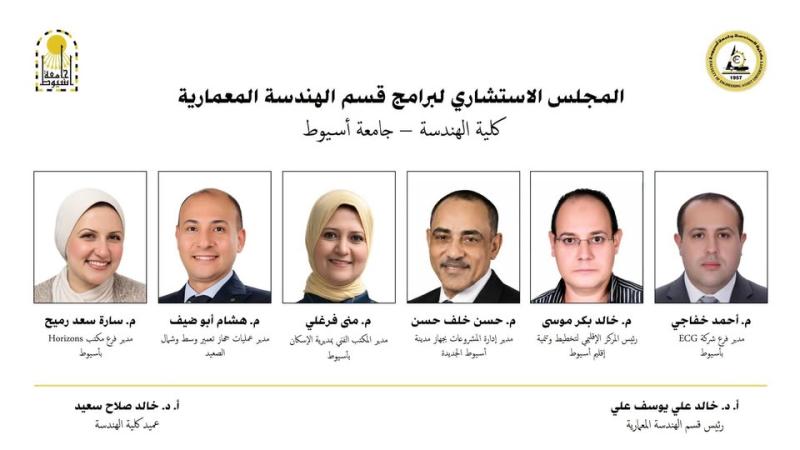
The College Council approves the Advisory Council for the programs of the Department of Architectural Engineering at the Faculty of Engineering, Assiut University.

The Faculty Council approves the Advisory Board for the Architecture Department programs at the Faculty of Engineering, Assiut University.

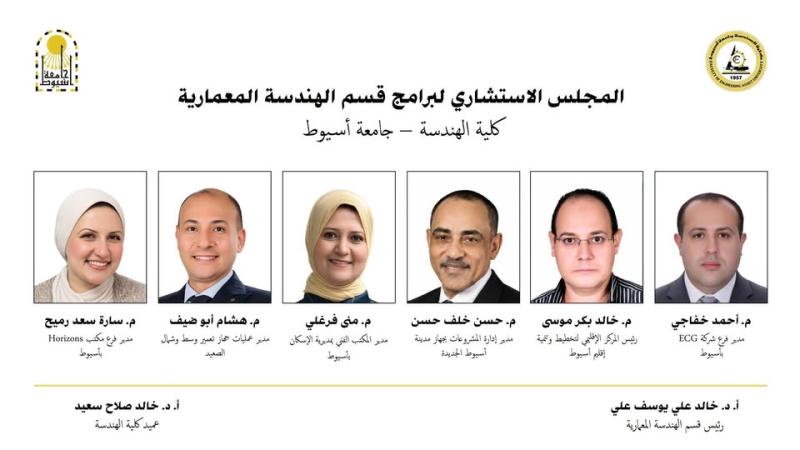
The Faculty Council, in its 1159th session held on July 15, 2026, approved the formation of the Advisory Board, comprised of representatives from industry and professional bodies in the field of architecture and urban planning. This followed the approval of the Architecture Department Council in its 646th session held on July 5, 2026, of the proposed board.

Professor Dr. Khaled Ali Youssef, Head of the Architecture Department, explained that the board approved by the Faculty Council consists of:

• Eng. Khaled Bakr Moussa, Head of the Regional Center for Planning and Development of the Assiut Region

• Eng. Mona Farghali Mohamed Moussa, Director of the Technical Office at the Assiut Housing Directorate

• Eng. Hassan Khalaf Hassan Abdel-Magid, Director of the Projects Department at the New Assiut City Authority

• Eng. Hesham Ahmed Abu Deif Hamouda, Operations Manager at the Central and Northern Upper Egypt Development Authority

• Eng. Ahmed Khafagy, Director of the ECG Company branch in Assiut

• Eng. Sarah Saad Rumeih, Director of the Horizons Office branch in Assiut

Professor Khaled Salah, Dean of the College, explained that the advisory councils play a pivotal and essential role in linking the academic aspect with the requirements of the local and international labor market, and in ensuring the quality and accreditation of educational outcomes. The council's most prominent roles and functions include contributing to the development of curricula and study plans, ensuring quality and academic accreditation, developing and providing field training and professional opportunities for students and graduates, and supporting graduation projects and student activities. The council also contributes to establishing partnerships and conducting applied scientific research that responds to the needs of the community.

1
Subscribe to