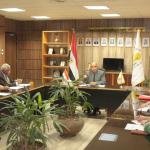
Professor Ahmed El-Minshawy, President of Assiut University, affirmed that improving the quality of administrative performance across the University's various sectors is a fundamental pillar in supporting digital transformation and advancing the implementation of the smart university concept. He noted that these efforts contribute to enhancing institutional efficiency, improving the speed and accuracy of administrative processes, elevating the quality of services provided to stakeholders, strengthening transparency, and supporting evidence-based decision-making through accurate and up-to-date data.
These remarks came during a workshop organized by the Community Service and Environmental Development Sector, headed by Professor Mohamed Ahmed Adawy, Vice President for Community Service and Environmental Development Affairs, under the title: "Mechanisms for Improving the Quality of Administrative Performance for the Digital Platform Team of the Supreme Council of Universities." The workshop forms part of the Sector's ongoing efforts to advance the digitalization of its activities and enhance administrative efficiency.
Professor Mohamed Ahmed Adawy explained that the workshop reflects the Sector's commitment to supporting digital transformation by developing the capabilities of administrative staff across the University's faculties and centers. He noted that the initiative aims to improve workflows related to the Supreme Council of Universities' digital platform, ensure the accuracy and quality of uploaded reports, identify challenges encountered by platform teams, and develop practical solutions to address them.
The workshop featured a lecture delivered by Professor Mohamed Mostafa Hamad, Professor at the Faculty of Education and General Supervisor of the digital platform on behalf of the Community Service and Environmental Development Sector. During his presentation, he discussed the key challenges encountered by administrative team members while using the platform, explained the concepts underlying data entry templates, outlined the mechanisms used to evaluate activities, and reviewed the timeline established for uploading reports.
The workshop also highlighted best practices for accurately documenting activities to enhance the transparency and credibility of the data submitted to the platform and maximize its value in supporting informed institutional decision-making.
The event concluded with the distribution of roles and responsibilities among the working teams representing the Sector's faculties and centers, ensuring coordinated efforts toward achieving the University's digital transformation objectives.