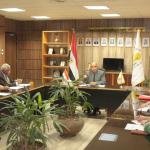
Assiut University organized an awareness seminar on Sunday, 3 May, for university leaders and faculty members on hybrid warfare and security measures related to international scholarships and academic cooperation. The event was held in collaboration with the National Center for Studies, under the patronage of Professor Ahmed El-Minshawy, President of Assiut University, and under the supervision of Major General Ahmed El-Shahaby, President of the National Center for Studies, and Professor Mohamed Ahmed Adawy, Vice President for Community Service and Environmental Development Affairs. The seminar was attended by Professor Gamal Badr, Vice President for Graduate Studies and Research, along with a number of deans, vice deans, faculty members, and researchers.
Professor Gamal Badr emphasized the importance of adopting a comprehensive strategy for the internationalization of higher education as a national priority. He stressed the need to enhance faculty members' awareness of the security considerations associated with academic work abroad, noting that preparing academic and research professionals capable of working effectively in diverse international environments requires comprehensive awareness to maximize the benefits of scholarship opportunities and international collaboration.
For his part, Professor Mohamed Ahmed Adawy explained that the seminar aimed to enhance the awareness of faculty members and researchers in the areas of decision-making and internal environmental analysis. The program also addressed several topics related to Egyptian foreign policy and hybrid warfare, as well as the challenges these issues present in different international contexts. He underscored the importance of preparing academic professionals capable of understanding and responding effectively to rapidly evolving global developments, thereby strengthening the role of universities in supporting sustainable development and promoting intellectual and societal security.
During his lecture, entitled "Security Measures to Be Observed Outside the Country," Major General Ahmed El-Shahaby, President of the National Center for Studies, discussed the nature of contemporary Egyptian overseas scholarship missions. He highlighted the strategic importance of individuals representing Egypt abroad, emphasizing that scholarship recipients and international delegates constitute valuable national assets and must therefore remain aware of potential challenges and be well prepared to respond appropriately to various situations.
Major General Dr. Ahmed Farouk, Advisor to the National Center for Studies, presented an overview of the concept of hybrid warfare and related phenomena, including gray-zone conflicts, psychological warfare, cognitive warfare, and cyber warfare. He explained that such forms of warfare seek to undermine family and societal cohesion, and outlined their objectives, stages, and defining characteristics. He also discussed strategies for countering these threats, both at the individual level—through preserving national identity without extremism, developing critical thinking skills, and choosing positive role models—and at the institutional level through monitoring, awareness, and education.
Mr. Hany El-Aasar, Executive Director of the National Center for Studies, highlighted the Egyptian state's commitment to maintaining a coherent and balanced foreign policy toward regional and international issues. He noted that Egypt adopts a balanced approach that effectively employs its various capabilities to advance its foreign policy objectives while safeguarding the nation's interests and protecting its national security.