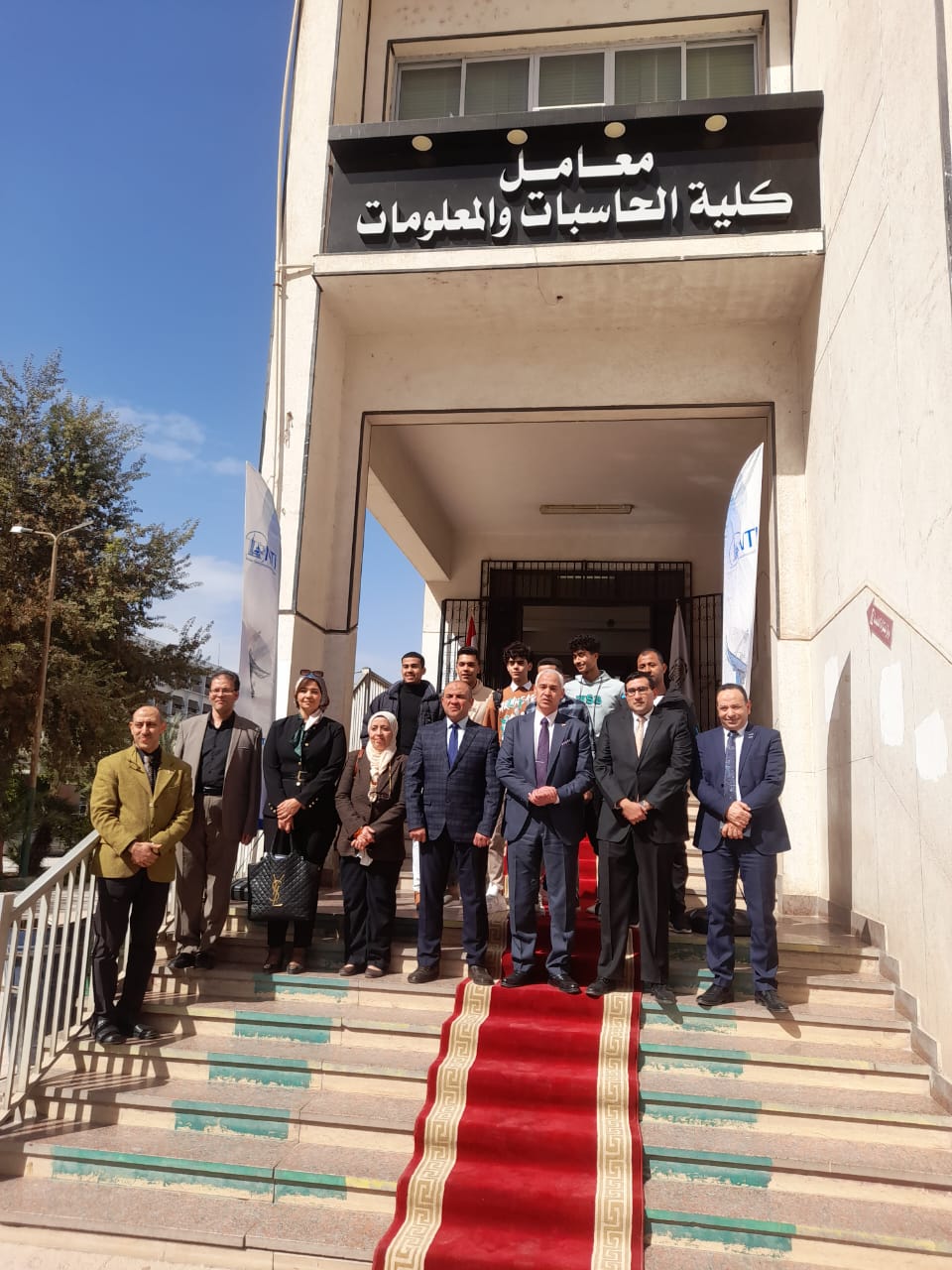
An introductory symposium for the National Institute of Communications at the Faculty of Computers and Information
under the care of
Prof. Dr. Ahmed El-Menshawy, President of the University
Dr. Ahmed Abdel Mawla, Vice President of the University for Education and Student Affairs
Dr. Mahmoud Abdel Aleem / Vice President of the University for Community Service and Environmental Development Affairs
The Faculty of Computers and Information organized the symposium
under the care of
Prof. Dr. Tayseer Hassan Abdel Hamid, Dean of the College
Prof. Dr. Khaled Fathi Hussein, Vice Dean of the College for Education and Student Affairs
Within the framework of the cooperation protocol concluded between Assiut University and the National Institute of Communications
And who is present in it
Prof. Dr. Ahmed Khattab, Director of the National Institute of Communications
Which aims to introduce the institute and the services it provides by qualifying human cadres at Assiut University for the labor market through field training, capacity building, and supervision of scientific research and student projects, in addition to many training programs and initiatives in various specializations under the supervision of students caring for the college’s youth.
This will be on Wednesday, February 14, 2024, in the laboratory building at the college
Robust zero-watermarking is a protection of copyright approach that is both effective and distortion-free, and it has grown into a core of research on the subject of digital watermarking. This paper proposes a revolutionary zero-watermarking approach for color images using convolutional neural networks (CNN) and a 2D logistic-adjusted Chebyshev map (2D-LACM). In this algorithm, we first extracted deep feature maps from an original color image using the pre-trained VGG19. These feature maps were then fused into a featured image, and the owner's watermark sequence was incorporated using an XOR operation. Finally, 2D-LACM encrypts the copyright watermark and scrambles the binary feature matrix to ensure security. The experimental results show that the proposed algorithm performs well in terms of imperceptibility and robustness. The BER values of the extracted watermarks were below 0.0044 and the …
The tertiary structures of proteins play a critical role in determining their functions, interactions, and bonding in molecular chemistry. Proteins are known to demonstrate natural dynamism under various physiological conditions, which enables them to adjust their tertiary structures and effectively interact with the surrounding molecules. The present study utilized the remarkable progress made in Generative Adversarial Networks (GANs) to generate tertiary structures that accurately mimic the inherent attributes of actual proteins, which includes the backbone conformation as well as the local and distal characteristics of proteins. The current study has introduced a robust model, ROD-WGAN hybrid, that is able to generate large-scale tertiary protein structures that greatly mimic those found in nature. We have made several noteworthy contributions in pursuit of this objective by integrating the ROD-WGAN model with
Research Authors
Mena Nagy A Khalaf, Taysir Hassan A Soliman, Sara Salah Mohamed
Revealing the tertiary structure of proteins holds huge significance as it unveils their vital properties and functions. These intricate three-dimensional configurations comprise diverse interactions including ionic, hydrophobic, and disulfide forces. In certain instances, these structures exhibit missing regions, necessitating the reconstruction of specific segments, thereby resulting in challenges in protein design, which encompasses loop modeling, circular permutation, and interface prediction. To address this problem, we present two pioneering models: pix2pix generative adversarial network (GAN) and PLM-GAN. The pix2pix GAN model is adept at generating and inpainting distance matrices of protein structures, whereas the PLM-GAN model incorporates residual blocks into the U-Net network of the GAN, building upon the foundation of the pix2pix GAN model. To bolster the models’ performance, we introduce a novel loss function named the “missing to real regions loss” (LMTR) within the GAN framework. Additionally, we introduce a distinctive approach of pairing two different distance matrices: one representing the native protein structure and the other representing the same structure with a missing region that undergoes changes in each successive epoch. Moreover, we extend the reconstruction of missing regions, encompassing up to 30 amino acids and increase the protein length by 128 amino acids. The evaluation of our pix2pix GAN and PLM-GAN models on a random selection of natural proteins (4ZCB, 3FJB, and 2REZ) demonstrated promising experimental results. Our models constitute significant contributions to addressing intricate challenges in protein structure design. These contributions hold immense potential to propel advancements in protein–protein interactions, drug design, and further innovations in protein engineering. Data, code, trained models, examples, and measurements are available on https://github.com/mena01/PLM-GAN-A-Large-Scale-Protein-Loop-Modeling-Using-pix2pix-GAN_.
Research Authors
Mena Nagy A. Khalaf 1, Taysir Hassan A Soliman 2, and Sara Salah Mohamed 3
The optimal requirements selection set aims primarily at careful search for the best requirements set of the next release of software during development process. This procedure is widely defined as the next release problem (NRP), which is also classified as NP-hard dilemma. Several techniques, in literature, have been proposed to tackle NRP. However, in real examples, the earlier studies still immature as NRP still suffers interactions and restrictions that makes the problem more complicated. Although few interesting works have been presented, yet NRP, based on our study, could be further investigated and effectively tackled. In this research, therefore, NRP is devised as a multi-objective optimisation problem. Two clashing objectives (satisfaction and cost) and two constraints (interactions forms) are formulated. To tackle NRP effectively, a new hybrid genetic and artificial bee colony algorithm (HGABC) is introduced. HGABC combines features of genetic and artificial bee colony algorithms. Experimental study, using case studies and three criteria, have been conducted to show HGABC's power of generating non-dominated effective Pareto solutions versus the state-of-the-art algorithms. Results indicate that HGABC does not just outperform its rivals, yet also gives better Pareto solutions in terms of diversity and quality for almost all the instances of
Research Authors
Marghny H. Mohamed, Ali A. Amer, Elnomery Allam Zanaty, Omar Reyad