
Transductive Transfer Learning for Domain Adaptation in Brain Magnetic Resonance Image Segmentation

Research Abstract

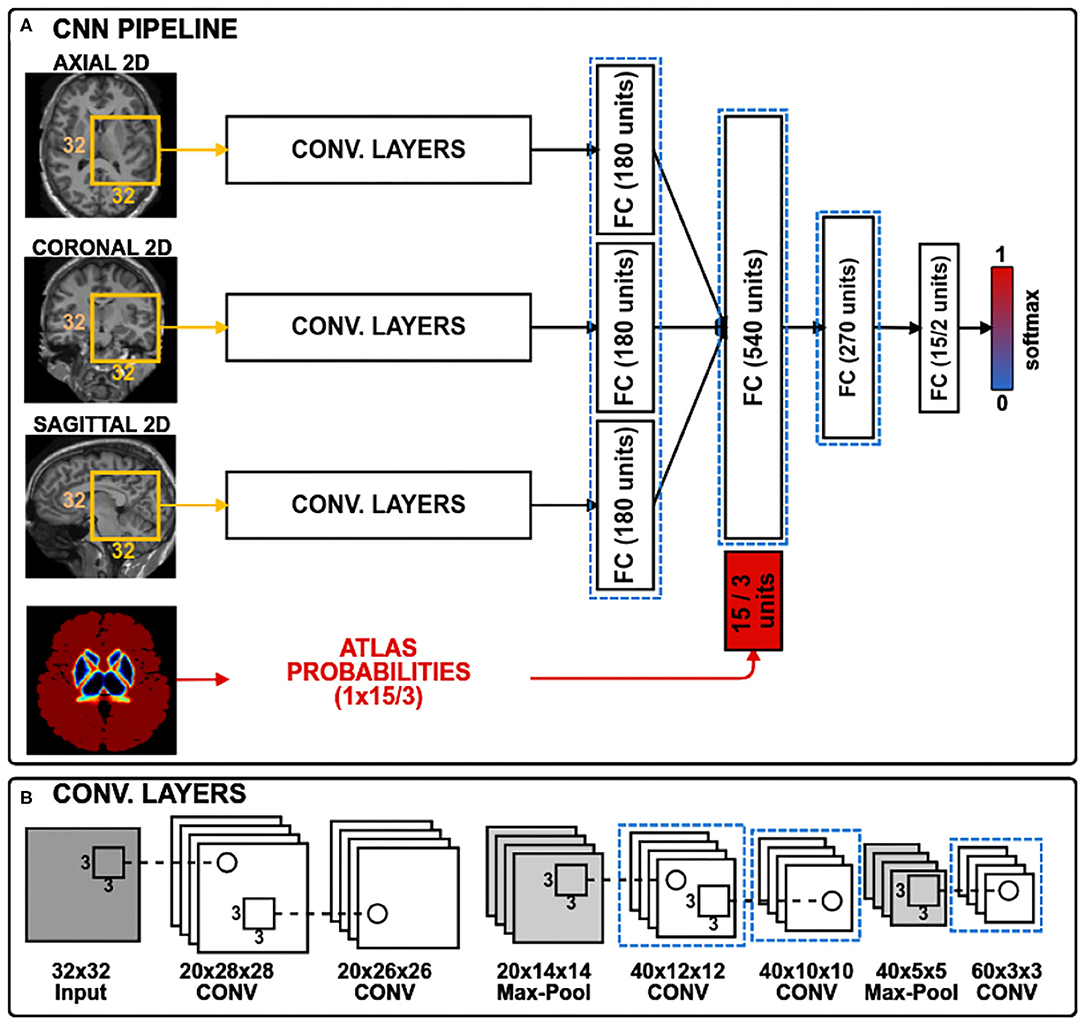
Segmentation of brain images from Magnetic Resonance Images (MRI) is an indispensable step in clinical practice. Morphological changes of sub-cortical brain structures and quantification of brain lesions are considered biomarkers of neurological and neurodegenerative disorders and used for diagnosis, treatment planning, and monitoring disease progression. In recent years, deep learning methods showed an outstanding performance in medical image segmentation. However, these methods suffer from generalisability problem due to inter-centre and inter-scanner variabilities of the MRI images. The main objective of the study is to develop an automated deep learning segmentation approach that is accurate and robust to the variabilities in scanner and acquisition protocols. In this paper, we propose a transductive transfer learning approach for domain adaptation to reduce the domain-shift effect in brain MRI segmentation. The transductive scenario assumes that there are sets of images from two different domains: (1) source—images with manually annotated labels; and (2) target—images without expert annotations. Then, the network is jointly optimised integrating both source and target images into the transductive training process to segment the regions of interest and to minimise the domain-shift effect. We proposed to use a histogram loss in the feature level to carry out the latter optimisation problem. In order to demonstrate the benefit of the proposed approach, the method has been tested in two different brain MRI image segmentation problems using multi-centre and multi-scanner databases for: (1) sub-cortical brain structure segmentation; and (2) white matter hyperintensities segmentation. The experiments showed that the segmentation performance of a pre-trained model could be significantly improved by up to 10%. For the first segmentation problem it was possible to achieve a maximum improvement from 0.680 to 0.799 in average Dice Similarity Coefficient (DSC) metric and for the second problem the average DSC improved from 0.504 to 0.602. Moreover, the improvements after domain adaptation were on par or showed better performance compared to the commonly used traditional unsupervised segmentation methods (FIRST and LST), also achieving faster execution time. Taking this into account, this work presents one more step toward the practical implementation of deep learning algorithms into the clinical routine.

Research Authors
Kaisar Kushibar, Mostafa Salem, Sergi Valverde, Àlex Rovira, Joaquim Salvi, Arnau Oliver, XavierLlado
Research Date
Research Department
Research Image
Research Journal
Frontiers in Neuroscience.
Research Pages
444
Research Publisher
Frontiers
Research Rank
1
Research Vol
15
Research Website
https://www.frontiersin.org/articles/10.3389/fnins.2021.608808/full
Research Year
2021

COVID-19 diagnosis from CT scans and chest X-ray images using low-cost Raspberry Pi

Research Abstract

The diagnosis of COVID-19 is of vital demand. Several studies have been conducted to decide whether the chest X-ray and computed tomography (CT) scans of patients indicate COVID-19. While these efforts resulted in successful classification systems, the design of a portable and cost-effective COVID-19 diagnosis system has not been addressed yet. The memory requirements of the current state-of-the-art COVID-19 diagnosis systems are not suitable for embedded systems due to the required large memory size of these systems (e.g., hundreds of megabytes). Thus, the current work is motivated to design a similar system with minimal memory requirements. In this paper, we propose a diagnosis system using a Raspberry Pi Linux embedded system. First, local features are extracted using local binary pattern (LBP) algorithm. Second, the global features are extracted from the chest X-ray or CT scans using multi-channel fractional-order Legendre-Fourier moments (MFrLFMs). Finally, the most significant features (local and global) are selected. The proposed system steps are integrated to fit the low computational and memory capacities of the embedded system. The proposed method has the smallest computational and memory resources,less than the state-of-the-art methods by two to three orders of magnitude, among existing state-of-the-art deep learning (DL)-based methods.

Research Authors
Khalid M Hosny, Mohamed M Darwish, Kenli Li, Ahmad Salah
Research Date
Research Department
Research Journal
Plos one
Research Publisher
Public Library of Science
Research Year
2021

Schedule of the Second Semester Exams for the Academic Year 2020/2021

The schedule of the second semester exams for the academic year 2020/2021 has been published on the college website under the link (Undergraduate Students> Calendar and Examination Schedules), for all teams, departments, special programs and those who are left behind due to the Corona pandemic and the Sohag train accident.

exam-schedule-2ndTerm-all-2020-2021


exam-schedule-2ndTerm-scientificPrograms-2020-2021


exam-schedule-2ndTerm-old4-2020-2021


exam-schedule-2ndTerm-extraordinary-2020-2021

Distributed List Hub Polling and Light Robust Super-Poll MAC Protocols for WLAN

Research Abstract
This paper presents two hub polling medium access control protocols for wireless local area networks based on the robust super poll protocol. The proposed protocols decrease the overhead and increase the throughput through eliminating broadcasting the polling list every super frame and eliminating the use of the chaining mechanism that is utilized in the robust super poll protocol in which all the remaining polling list is appended to every data frame that is sent by every station. The performance analysis of the two proposed protocols is introduced to evaluate their performance compared with Robust Super Poll protocol. The mathematical analysis and the experimental results show that the proposed protocols give higher throughput and lower overhead than Robust Super Poll protocol.
Research Authors
Mahmoud Abd El-sattar, Nagwa M Omar, Hosny M Ibrahim
Research Department
Research Journal
Applied Mathematics & Information Sciences
Research Member
Research Pages
pp. 873-889
Research Publisher
Natural Sciences
Research Rank
1
Research Vol
Vol. 14, No. 5
Research Website
http://www.naturalspublishing.com/show.asp?JorID=1&pgid=0
Research Year
2020

Distributed List Hub Polling and Light Robust Super-Poll MAC Protocols for WLAN

Research Abstract
This paper presents two hub polling medium access control protocols for wireless local area networks based on the robust super poll protocol. The proposed protocols decrease the overhead and increase the throughput through eliminating broadcasting the polling list every super frame and eliminating the use of the chaining mechanism that is utilized in the robust super poll protocol in which all the remaining polling list is appended to every data frame that is sent by every station. The performance analysis of the two proposed protocols is introduced to evaluate their performance compared with Robust Super Poll protocol. The mathematical analysis and the experimental results show that the proposed protocols give higher throughput and lower overhead than Robust Super Poll protocol.
Research Authors
Mahmoud Abd El-sattar, Nagwa M Omar, Hosny M Ibrahim
Research Department
Research Journal
Applied Mathematics & Information Sciences
Research Pages
pp. 873-889
Research Publisher
Natural Sciences
Research Rank
1
Research Vol
Vol. 14, No. 5
Research Website
http://www.naturalspublishing.com/show.asp?JorID=1&pgid=0
Research Year
2020

Developing an Efficient Spectral Clustering Algorithm on Large Scale Graphs in Spark

Research Abstract
Recently, most of the data can be represented by graph structures, such as social media, Protein-Protein Interaction, transportation system, systems biology,..., etc. Many researches have been achieved to cluster very large graphs but more efficient algorithms are required since such a process takes a long time and requires more memory. In this paper, we propose an Efficient Spectral Clustering Algorithm on Large Scale Graphs in Spark (ESCALG), using map reduce function and shuffling phases in Dijkstra's algorithm. In addition, ESCALG depends mainly on a sparse matrix as a data structure, which less time in execution. Then, GraphX is applied to deal with graph data processing and in GraphX used Pregel in computing shortest path. To test the performance of ESCALG, it is compared with Large-Scale Spectral Clustering on Graphs and Standard Spectral Clustering Algorithms using seven datasets, where ESCALG proved high efciency in terms of memory and time performance.
Research Authors
Ahmed I. Taloba
Marwan R. Riad
Taysir Hassan A. Soliman
Research Department
Research Journal
2017 Eighth International Conference on Intelligent Computing and Information Systems (ICICIS)
Research Pages
292-298
Research Publisher
IEEE
Research Rank
4
Research Vol
NULL
Research Website
cairo , egypt
Research Year
2017

Developing an Efficient Spectral Clustering Algorithm on Large Scale Graphs in Spark

Research Abstract
Recently, most of the data can be represented by graph structures, such as social media, Protein-Protein Interaction, transportation system, systems biology,..., etc. Many researches have been achieved to cluster very large graphs but more efficient algorithms are required since such a process takes a long time and requires more memory. In this paper, we propose an Efficient Spectral Clustering Algorithm on Large Scale Graphs in Spark (ESCALG), using map reduce function and shuffling phases in Dijkstra's algorithm. In addition, ESCALG depends mainly on a sparse matrix as a data structure, which less time in execution. Then, GraphX is applied to deal with graph data processing and in GraphX used Pregel in computing shortest path. To test the performance of ESCALG, it is compared with Large-Scale Spectral Clustering on Graphs and Standard Spectral Clustering Algorithms using seven datasets, where ESCALG proved high efciency in terms of memory and time performance.
Research Authors
Ahmed I. Taloba
Marwan R. Riad
Taysir Hassan A. Soliman
Research Department
Research Journal
2017 Eighth International Conference on Intelligent Computing and Information Systems (ICICIS)
Research Member
Research Pages
292-298
Research Publisher
IEEE
Research Rank
4
Research Vol
NULL
Research Website
cairo , egypt
Research Year
2017

Developing an Efficient Spectral Clustering Algorithm on Large Scale Graphs in Spark

Research Abstract
Recently, most of the data can be represented by graph structures, such as social media, Protein-Protein Interaction, transportation system, systems biology,..., etc. Many researches have been achieved to cluster very large graphs but more efficient algorithms are required since such a process takes a long time and requires more memory. In this paper, we propose an Efficient Spectral Clustering Algorithm on Large Scale Graphs in Spark (ESCALG), using map reduce function and shuffling phases in Dijkstra's algorithm. In addition, ESCALG depends mainly on a sparse matrix as a data structure, which less time in execution. Then, GraphX is applied to deal with graph data processing and in GraphX used Pregel in computing shortest path. To test the performance of ESCALG, it is compared with Large-Scale Spectral Clustering on Graphs and Standard Spectral Clustering Algorithms using seven datasets, where ESCALG proved high efciency in terms of memory and time performance.
Research Authors
Ahmed I. Taloba
Marwan R. Riad
Taysir Hassan A. Soliman
Research Department
Research Journal
2017 Eighth International Conference on Intelligent Computing and Information Systems (ICICIS)
Research Pages
292-298
Research Publisher
IEEE
Research Rank
4
Research Vol
NULL
Research Website
cairo , egypt
Research Year
2017

Towards Transforming Natural Language Queries into SPARQL Queries

Research Abstract
NULL
Research Authors
Majid Askar
Research Department
Research Journal
Baltic DB&IS 2020: 14th International Baltic Conference on Databases and Information
Systems
Research Pages
NULL
Research Publisher
NULL
Research Rank
3
Research Vol
NULL
Research Website
https://dbis.ttu.ee/
Research Year
2020
Subscribe to