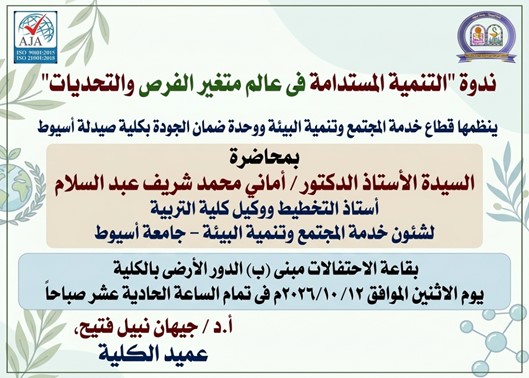
Meeting of the committee for community and environmental development at the Faculty of Pharmacy on Monday, October 12, 2026

God willing, a meeting of the committee for community and environmental development of the Faculty will hold a meeting on Monday, October 12, 2026, at 11:00 AM

This will take place in the office of Professor Dr./ Vice Dean of the Faculty for Community Service and Environmental Development to discuss the topics outlined in the agenda that will be presented at that time.

news category
خبر عام

Community Service and Environmental Development Sector and the Quality Assurance Unit at the Faculty of Pharmacy, Assiut University, organize a seminar entitled 'Sustainable Development in a Changing World: Opportunities and Challenges'

  • Seminar Title: “Sustainable Development in a Changing World: Opportunities and Challenges.”

  • Organizing Body: Faculty of Pharmacy, Assiut University, as part of the activities of the Quality Assurance and Accreditation Unit and the Community Service and Environmental Development Sector at the Faculty.

  • Speaker: Prof. Dr. Amani Mohamed Sherif Abdel Salam, Professor of Planning and Vice Dean of the Faculty of Education for Community Service and Environmental Development, Assiut University.

  • Date and Time: Monday, October 12, 2026, at 11:00 a.m.

  • Venue: Celebration Hall, Building (B), Ground Floor, Faculty of Pharmacy.

Turn this into a formal announcementImprove the headline and event details

news category
خبر عام

Expanding the “Terpenome”: Diterpene Synthases Accept GGPP-Ether Substrates

Research Authors
Viktoria Ravkina, Gerald Dräger, Jörn Droste, Svenja Schwörer, Ahmed Hassanin, Mehdi D Davari, Andreas Kirschning
Research Date
Research Department
Research Journal
ACS catalysis
Research Year
2025

Reprogramming the Cyclization of the Sesquiterpene Synthase BcBOT2 Using 2,3-Z-Configured FPP Derivatives and by Means of “Methyl Mapping”

Research Authors
Jan Luca Budde, Muhammed-Yasin Cay, Gerald Dräger, Jörn Droste, Ahmed Hassanin, Mehdi D Davari, Andreas Kirschning
Research Date
Research Department
Research Journal
ACS catalysis
Research Year
2025

Chapter 7 Autoimmune Disorders Tailored Phyto-Therapeutic Approaches

Research Authors
Mahmoud A. H. Mostafa, Ammar A. Bahauddin, Ahmed AH Abdellatif, and Shaymaa M.M. Mohamed
Research Date
Research Department
Research Journal
CRC Press
Research Year
2026

Unveiling the anticancer activity of Fujairah honey via bioactivity-guided fractionation and metabolomics

Research Abstract

Fujairah honey, collected from the mountainous regions of the United Arab Emirates, represents promising natural sources of functional food and pharmacological potential. This study aimed to characterise the functional food properties of crude Fujairah honey and to employ fractionation approaches to identify constituents with anticancer potential. Twenty Fujairah honey samples (Samar and Sidr) obtained from distinct locations of Fujairah Emirate were evaluated and compared with Manuka honey. The relationship between cytotoxicity, physicochemical properties, and underlying molecular mechanisms including antioxidant capacity, anti-inflammatory, and antimetastatic effects was investigated. Among the samples, Sample 6 (Samar honey derived from Acacia species) demonstrated selective cytotoxic activity following fractionation. While the crude honey promoted cell proliferation, its dichloromethane (DCM) fraction induced a 20% reduction in Michigan Cancer Foundation-7 (MCF-7) cell viability. Sample 6 DCM exhibits strong antioxidant activity (92.47% 2,2-diphenyl-1-picrylhydrazyl-hydrate radical scavenging), antimetastatic effects, and significant anti-inflammatory effects through Interleukin-6 (IL-6) downregulation (p < .0001) without excessive immune stimulation. Metabolomics profiling revealed elevated levels of fatty acids and monoacylglycerides, and succinic acid (with 28% enhanced cytotoxicity), supporting the unique activity of Samar (particularly Sample 6) honey. Driven by Fujairah’s arid climate and unique flora, Fujairah honey emerges as a promising source of novel pharmaceutical and
nutritional applications, offering distinctive anticancer and immunomodulatory properties.

Research Authors
Eman J. Abuzaid, Khawla Mohammed Alyammahi, Attiat Elnaggar, Rania Hamdy, Alshaimaa M. Hamoda, Doha H. Aboubaker, Shaymaa Mohamed, Hamza Mohammad Al-Hroub, Nashwa Ahmed Mohamed, Fouad Lamghari, Ali El-Keblawy, Sameh S.M. Soliman
Research Date
Research Department
Research File
Research Journal
International Journal of Food Science and Technology
Research Year
2026

Calquiquelignan D from Attalea butyracea Exhibits Selective Cytotoxicity Against Prostate and Skin Cancer Cells with Dual ERK2/PI3Kα Inhibitory Activity

Research Abstract

Skin and prostate cancers pose therapeutic challenges due to drug resistance. Attalea butyracea, a Neotropical palm with pro￾found ethnobotanical significance, remains largely unexplored for anticancer constituents. This study aimed to isolate bioactive metabolites from A. butyracea, assess their selective cytotoxicity against A-431 and PC-3 cancer cells relative to normal cells, and explore their potential molecular targets. High-Resolution Electrospray Ionization Mass Spectrometry (HR-ESI/MS) and one- and two-dimensional nuclear magnetic resonance (1D/2D NMR) spectroscopy provided structural confirmation. Cytotoxic activity was assessed using the 3-(4,5-dimethylthiazol-2-yl)-2,5-diphenyltetrazolium bromide (MTT) assay. Computational inverse docking and molecular dynamics simulations identified probable kinase targets, which were subsequently confirmed through enzyme inhibition assays. Phytochemical investigation yielded 17 compounds, including two previously undescribed glycosides, one megastigmane, and one flavonolignan. This marks the first report of flavonolignans within Attalea. Among isolated metabolites, calquiquelignan D showed notable activity, with CC50 values of 14.9 μM (A431) and 22.5 μM (PC3), comparable to those of cisplatin. Within the ATP pockets of oncogenic kinases, this compound demonstrated stable binding patterns as determined by computational analysis. Enzyme inhibition assays confirmed dual inhibition of ERK2 and PI3Kα at nanomolar concentrations.These findings suggest potential dual-pathway modulation of survival signaling. As chemotaxonomic markers with structurally distinct scaffolds, these metabolites merit further kinase-targeted drug development.

Research Authors
Rofida Wahman, Anber F. Mohammed, Claire Simons, Islam El-Awaad, Shaymaa M. M. Mohamed
Research Date
Research Department
Research Journal
Planta Medica
Research Year
2026

Design, synthesis, and antiproliferative activity of novel thiazole-based derivatives as tubulin polymerization inhibitors targeting the colchicine binding site

Research Abstract

The development of novel microtubule-targeting medicines (MTAs) remains a crucial strategy in cancer treatment, as they combat drug resistance and systemic toxicity. A novel series of thiazole-based derivatives was synthesized, characterized, and evaluated as antitubulin agents endowed with antiproliferative action. An IC50 experiment was performed to assess the efficacy of novel compounds 9a–o in suppressing tubulin activity. The antiproliferative effects of the most potent compounds were evaluated. The levels of initiator caspases (Caspase-8 and Caspase-9) and executioner caspase (Caspase-3) were examined to ascertain the degree of apoptosis. Additionally, the expression levels of the mitochondrial regulatory proteins Bax and Bcl-2 were examined to ascertain the importance of the intrinsic apoptotic pathway. Compound 9k exhibited significant inhibition of tubulin with an IC50 of 1.56 mM and showed potent activity against HeLa (cervical), HCT-116 (colorectal), and A-549 (lung) cancer cell lines. The apoptotic assays revealed that 9k effectively triggered the apoptotic cascade, leading to a ninefold increase in Caspase-3 and a significant twenty-onefold rise in Caspase-9, surpassing the effects of the reference Staurosporine. Caspase-8 was activated by an elevenfold increase, primarily via the intrinsic pathway. This was confirmed by a substantial change in the mitochondrial “rheostat”: 9k induced a 38-fold increase in pro-apoptotic Bax and a 5-fold decrease in anti-apoptotic Bcl-2. Molecular docking studies showed that 9k exhibited a favorable binding mode consistent with its tubulin-inhibition profile. In silico ADMET predictions further supported 9k as a drug-like lead with acceptable oral exposure and a beneficial P-gp–related transporter profile. The enhanced apoptotic effects of 9k compared with Staurosporine make 9k an attractive lead candidate for further development as an anti-cancer drug targeting the colchicine-binding site.

Research Authors
Lamya H. Al-Wahaibi, Ali M. Elshamsy, Taha F. S. Ali, Bahaa G. M. Youssif, Stefan Bräse, Mohamed Abdel-Aziz and Nawal A. El-Koussi
Research Date
Research Journal
RSC Advances
Research Pages
13
Research Publisher
The Royal Society of Chemistry
Research Year
2026

Development of a novel series of thiazole-based compounds with enhanced antiproliferative properties as tubulin polymerization inhibitors

Research Abstract

Introduction: In cancer therapy, inhibiting tubulin polymerization is a key approach for modifying microtubule dynamics required for cell survival and proliferation. Microtubule destabilizing agents (MDAs), also known as tubulin polymerization inhibitors, prevent tubulin heterodimers from forming microtubules, resulting in catastrophic cellular collapse. Methods:A novel series of thiazole-based compounds 8a-o was developed to inhibit tubulin polymerization and assess for its antiproliferative efficacy against the NCI 60 cell line. The structures of the newly synthesized compounds were confirmed using 1H NMR, 13C NMR, and elemental microanalyses. All 15 compounds (8a-o) were assessed for antiproliferative action at a single dosage (10 µM) and analyzed against the comprehensive 60-cell panel at five concentrations (0.01, 0.1, 1, 10, and 100 µM). Results and Discussion:The results from the one-dose and five-dose studies demonstrate that 8b, 8c, 8d, 8m, and 8o are the most prominent antiproliferative agents, exhibiting the most favourable low-micromolar GI50 values across various cell lines, frequently advancing to low-micromolar TGI, and, in numerous sensitive cell lines, achieving LC50 values within the single-digit micromolar range. Compounds 8b, 8d and 8m showed significant anti-tubulin activity, with IC50 values ranging from 3.86 to 7.19 µM, compared to the reference CA-4 (IC50 = 2.40 µM). In the MCF-7 breast cancer cell line, compound 8m drove a significant accumulation of cells in the G2/M phase, increasing from 13.74% to 45.35%. G2/M arrest is frequently associated with DNA damage or the inhibition of microtubule dynamics, which aligns with Western blot results demonstrating a decrease in tubulin (50 kDa) expression following treatment with 8m. Apoptotic and necrotic experiments indicate that 8m stimulates a defined programmed cell death pathway rather than inducing non-specific toxic necrosis. Molecular docking corroborated their binding at the colchicine site, while in silico ADMET profiling indicated a promising drug-like profile for compound 8m

Research Authors
Lamya H. Al-Wahaibi, Ali M. Elshamsy, Taha F. S. Ali, Bahaa G. M. Youssif, Stefan Bräse, Mohamed Abdel-Azizand Nawal A. El-Koussi

Research Date
Research Journal
Frontiers in Chemistry
Research Pages
21
Research Year
2026
Subscribe to