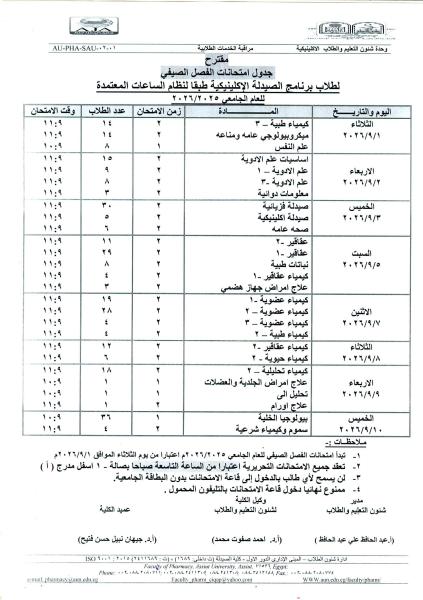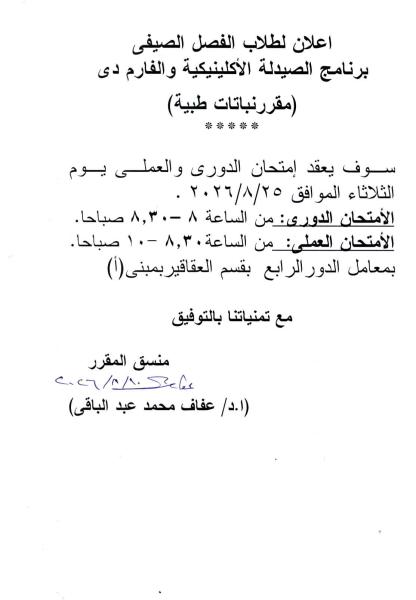



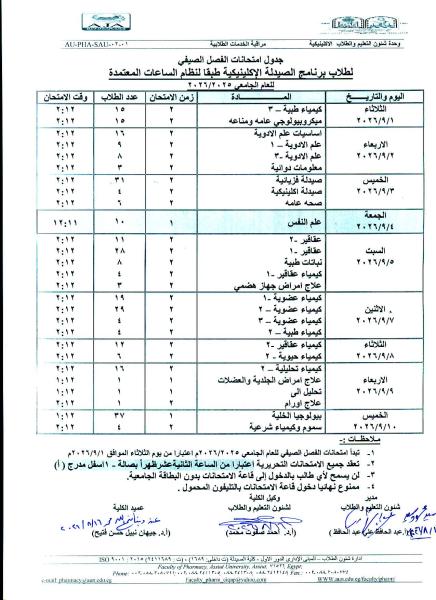

Lecture Schedule for the Cosmetic Preparations Diploma Program – Second Semester, Academic Year 2025–2026.

Do you have any questions? (088) 2080369 - 2345622 Pharmacy_QAAU@pharm.aun.edu.eg


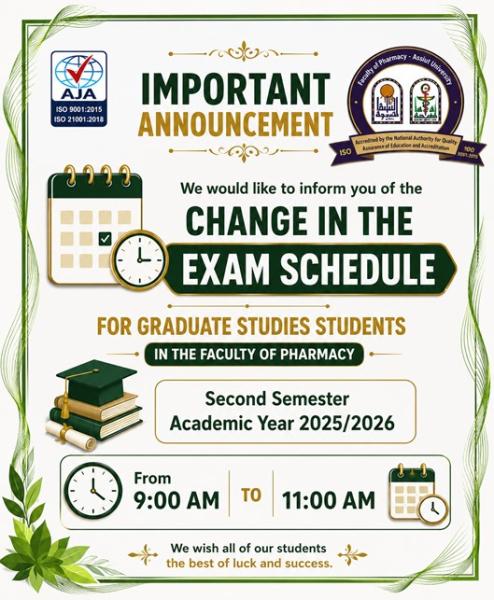
Students who wish to submit a request for a review of their practical examination grade should register their names with the department secretary, starting from Monday, June 1, 2026, until Thursday, June 4, 2026.

Salicylic acid (SA) derivatives are widely used for treatment of various diseases. Acetylsalicylic acid represents the most widely used drug in the world, 4-Aminosalicylic acid (4-ASA) was historically used as a systemic antituberculosis drug as well as diflunisal is a strong pain killer and antipyretic. 5-Aminosalicylic acid (5-ASA) which had been synthesized at the end of 19th century and employed first for the production of azo dyes, was then identified as a very valuable medicinal agent as well as part of many biologically active agents. 5-ASA is not metabolized to salicylic acid for pharmacological activity. It is not considered a true salicylate. In contrary to other salicylates, 5-ASA doesn’t induce upper gastrointestinal (GI) side effects. Moreover, It was found, especially, useful for treatment of inflammatory bowel diseases (IBD). It is unique among salicylates and has a broad specrum of biological activities including, anti-inflammatory, analgesic, neuroprotective and antitumor. Since we are interested in this compound and its derivatives, we prepared this review to give insight into its chemistry, anti-inflammatory activity, in particular, for treatment of IBD. Different approaches for colonic targeting of 5-ASA w ill be covered with emphasis on chemical methods as well as its proposed mechanisms of action.
In this study, hexahydro-6H-indolo[2,3-b]quinoxaline (1) was synthesized by condensation of isatin with 1,2- diaminocyclohexane. It was then reacted with methyl bromoacetate, hydrazine and finally condensed with selected carbonyl compounds to give the hydrazones 4-23. The new compounds have been characterized, screened for biological activity. Some of them showed significant antibacterial and anti-inflammatory activities. In particular, compound 20 showed interesting activities as anti-inflammtory and antibacterial.
In the title compound, C17H17N5, the dihedral angle between the 1H-pyrazolo[3,4-b]pyridine ring system (r.m.s. deviation = 0.001 Å) and the attached phenyl group is 2.56 (6)°. The propylamino side chain has a contorted conformation [Car—N—C—C = −77.97 (16)° and N—C—C—C = −57.37 (17)°]. An intramolecular C—H⋯N interaction closes an S(6) ring. In the crystal, inversion dimers linked by pairs of N—H⋯N hydrogen bonds generate R 2 2(12) loops. Aromatic π–π stacking interactions [centroid–centroid distance = 3.5726 (8) Å] are also observed.
To explore the contribution of the carboxylic group to the antiproliferative activity of 5-aminosalicylic-4-thiazolinone-based hybrids, multiple derivatives were synthesized, including free carboxylic, hydroxamic acid, and amidation with glycine or 2-amino-5-nitrothiazole. The antiproliferative activity of these derivatives was compared with that of methyl ester, aliphatic, and aromatic amides of the hybrid against eight cancer cell lines and one normal cell line using the sulforhodamine B (SRB) assay. Among the newly synthesized compounds, glycinate amide 9b exerted good to moderate antiproliferative activity against five cancer cell lines., It displayed superior activity against the Jurkat and Lymphoma cell lines with IC50 values of 4.74 µM and 7.16 µM, The overall results show that the methyl ester derivative of the hybrids is the most active among the tested derivatives against all tested cell lines with low micromolar to nanomolar potency. While hybrids with free or amidated carboxylic groups are much less potent. ADME study revealed that the difference in physicochemical properties might rationalize the activity pattern. This study demonstrates that the nature of the carboxylic group in these hybrids critically influences their antiproliferative activity. The findings pave the way for developing optimized anticancer salicylate drugs by focusing on modifications that improve key physicochemical properties.