


Postgraduate Examination Schedule - Ph.D

An entertaining scientific day full of surprises and fun for the first level

رحبا بكم في كلية الطب البيطري، حيث تنتظركم مغامرة علمية وترفيهية لا تنسى ?. ندعوا سنة أولى لحضور يوم علمي ترفيهي مليء بالمفاجآت والمتعة يوم السبت الموافق ٢١/١٠/٢٠٢٣ من الساعة العاشرة صباحا حتى الرابعة مساء ?. ستكون هذه فرصتكم للتعرف على كلية الطب البيطري وأقسامها وبرامجها وأنشطتها ?. وستلقون الترحيب من أ.د/ مؤمن عبد العظيم محمد وكيل الكلية لشئون الطلاب بالكلية، الذي سيشرح لكم نظام الكلية ونظام الساعات المعتمدة (GPA) وسيجيب على كل استفساراتكم ?♂️. ستستمعون أيضا إلى شروحات مفصلة عن مجالات مختلفة من مجالات الطب البيطري، مثل طب الحيوانات الأليفة، وطب الحيوانات المزرعية، وطب الحيوانات البرية، والأمراض المعدية، والأمراض المشتركة، والأدوية البيطرية، وغيرها ?????. ستستمتعون بالألعاب في الملاعب وصالة الأنشطة الرياضية ?.
لا تضيعوا هذه الفرصة الذهبية، فهذا اليوم سيكون بداية مشواركم المهني في عالم الطب البيطري، عالم المعرفة والإبداع والخدمة ?. انضموا إلينا في هذا [الحدث]وسجلوا أسماءكم فى الفورم لتأكيد الحضور ?. نحن ننتظركم بشغف ?.
https://docs.google.com/forms/d/e/1FAIpQLScsaIHmGhFpuWx4m-zou5xiW2N8dx-LSI7bKbMwoVS2coNkOw/viewform
news category
student
An invitation to discuss the master’s thesis of a veterinarian/Rehab Ali Abdel Hamid Mousa

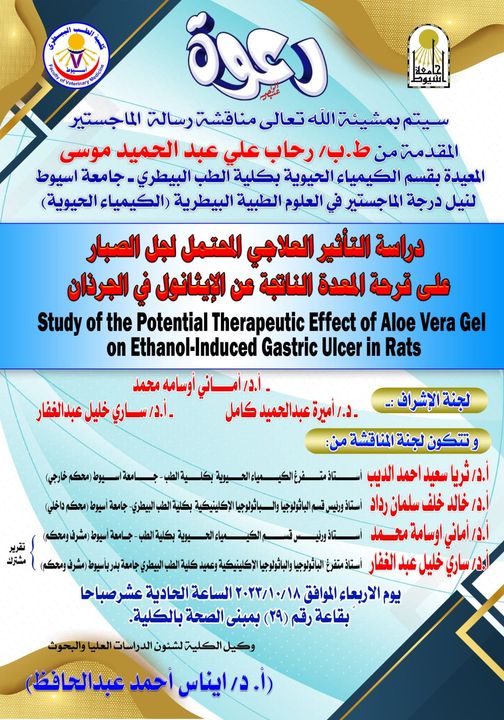
Invitation to discuss the master’s thesis of a veterinarian/Mohamed Hashem Mohamed Ahmed
Invitation to discuss the master’s thesis of veterinarian/Armia Naguib Motamed Ghaly

- Read more about Invitation to discuss the master’s thesis of veterinarian/Armia Naguib Motamed Ghaly
Invitation for workshop 2
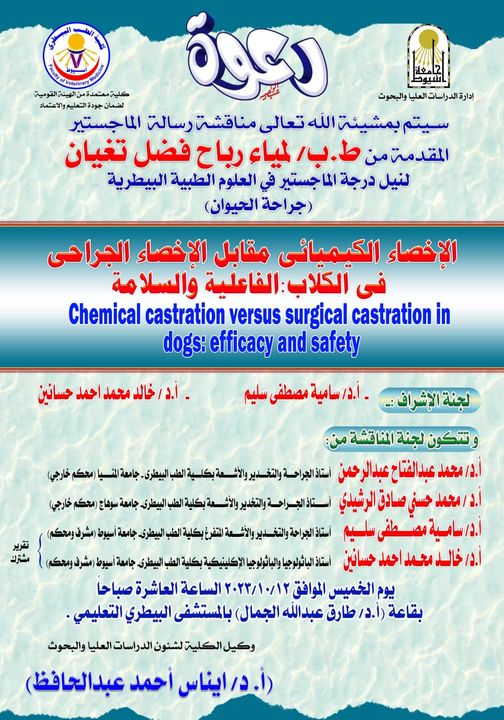
An invitation to discuss the master’s thesis of veterinarian Lamia Rabah Fadel Taghian
Obligatory condolences

Rapid One-Step Test for detection of Feline and Canine Parvoviruses in Cats
Research Abstract
Feline parvovirus infection (FPV) is one of the serious diseases in Kittens that causes substantial morbidity and death. For the treatment of affected cats and the prevention of disease spread, early diagnosis of FPV infection is critical. To our knowledge, there have been no reports about the disease’s situation in Egypt’s Assiut province. As a result, the goal of this study was to find out how common FPV infection is among ill cats in this province. A total of 30 cats suspected of being infected with FPV were screened using an antigen rapid test to determine whether they were clinically suspicious. To determine the prevalence of FPV, each investigated cat’s age, sex, breed, season, lifestyle (whether kept indoors or outdoors), and immunization were all documented. Overall, 26.7% of examined cats were affected. FPV infection was more common in young, unvaccinated cats who lived outdoor. Epizootiological monitoring of the prevalence rate based on cat breeds and sex revealed no statistically significant differences. In terms of season, spring had the highest infection rate (57.1%), followed by winter (33.3%), and autumn (7.69%). The rapid one-step test is a useful diagnostic tool for detecting FPV, which was found in the research area’s cats.
Research Date
Research Department
Research Journal
Journal of Advanced Veterinary Research
Research Member
Research Pages
148-152
Research Publisher
Journal of Advanced Veterinary Research
Research Vol
Volume 12, Issue 2
Research Website
https://www.advetresearch.com/index.php/AVR/article/download/925/511
Research Year
2022
Clinico-epidemiological survey of feline parvovirus circulating in three Egyptian provinces from 2020 to 2021
Research Abstract
Feline parvovirus infection, caused by feline parvovirus and canine parvovirus 2, is a highly contagious, life-threatening disease affecting cats. The available epidemiological data on parvovirus infection in cats in Egypt is limited. Therefore, the aim of the current study was to provide data concerning the epidemiological profile of cats infected with parvovirus, including the prevalence of parvovirus infection in cats in three Egyptian provinces (Sohag, Assiut, and Cairo) and the associated risk factors. Using rapid antigen tests of fecal samples and conventional PCR, the overall prevalence of parvovirus infection in cats was found to be 35% (35/100) and 43% (43/100), respectively. Anorexia, bloody diarrhea, severe dehydration, hypothermia, and vomiting were the most common clinical findings significantly associated with parvovirus-infected cats. The geographical location (Sohag) and the season (winter) were both statistically significant risk factors for parvovirus infection. These findings indicate that parvoviruses are circulating in different regions of Egypt. Our study provides baseline epidemiological data for future preventive and control measures against parvovirus infection, as well as highlighting the need for future genomic surveillance studies involving a large study population from various parts of Egypt in order to better shape the epidemiological picture of parvovirus infection.
Research Date
Research Department
Research Journal
Archives Of Virology
Research Member
Research Pages
168(4): 126
Research Publisher
Springer
Research Website
https://www.ncbi.nlm.nih.gov/pmc/articles/PMC10060273/
Research Year
2023