
An overview of the structural and functional aspects of immune cells in teleosts

Research Abstract

The immune system of fish consists of two
main components, innate and adaptive immunities.
Innate immunity is non-specific and acts as the primary
line of protection against pathogen invasion, while
adaptive immunity is more specific to a certain
pathogen/following adaptation. The adaptive immune
system consists of the humoral and cellular components.
Cytotoxic T-lymphocyte cells are the major component
of the cellular immunity that frequently kills viral-,
bacterial- or parasitic-infected cells. According to the
anatomical location, the mucosal-associated lymphoid
tissue (MALT) in teleost fish subdivides into gutassociated
lymphoid tissue (GALT), gill-associated
lymphoid tissue (GIALT), and skin-associated lymphoid
tissue (SALT). The MALTs contain various leukocytes;
including, but not limited to, lymphocytes (T and B
cells), plasma cells, macrophages, and granulocytes.
Macrophages are multifunctional cells that are mainly
involved in the immune response, including;
phagocytosis and degradation of foreign antigens, tissue
remodeling, and production of cytokines, chemokines
and growth factors. An interesting feature of teleost
macrophages is their ability to form melanomacrophage
centers (MMC) in the hemopoietic tissues. Dendritic
cells, rodlet cells, mast cells, eosinophilic granular cells
(ECGs), telocytes, osteoclasts, club cells, as well as,
barrier cells have been recorded in many fish species and
have many immunological roles. This paper aims to
summarize the current knowledge of the immune cells
present in fish tissues serving as anatomical and
physiological barriers against external hazards. Increased
knowledge of fish immune systems will facilitate the
development of novel vaccination strategies in fish.
Research Authors
Doaa M. Mokhtar and Enas A. Abdelhafez
Research Date
Research Journal
Histology and Histopathology
Research Rank
Q4
Research Website
DOI: 10.14670/HH-18-302
Research Year
2021

Fish Histology: From Cells to Organs''. 2nd ed.

Research Abstract

This book will provide the readers with the most contemporary and
useful text possible. The book describes the most important recent developments
in sciences of fish histology. I am also recognizing that the readers
are faced with the tasks of learning an ever-increasing number of facts in
an ever-decreasing period of time. Because of this, every attempt has been
made to shorten the text wherever possible and to organize information in
a way that will facilitate learning.
Fish constitute nearly 60% of all vertebrate species and are economically
of major importance. The reporting of normal histology of fish
tissues and organs serves as a foundation upon which to gather and build
our ichthyopathology knowledge base.
The aim has been to present a general reference guide providing an
extensive set of histological images of fishes. Although several studies
treat histological aspects in relation to pathology, no recent synthesis on
the normal histology of fish is available. Therefore, I believe that this
textbook will be a main contribution to this field. The book is designed
to provide students with a foundation in understanding and interpreting
histologic and cytologic preparations and normal tissue components.
A text and colored atlas of histology of fish is designed for use by
students and researchers, biologists, ichthyologists, fish farmers, veterinarians
working in fisheries and, of course, by comparative histologists
who want to learn more about the fish world. As a further aid to learning,
numerous photomicrographs and electron micrographs amplify the text
in addition to particular emphasis on diagrams and tables to summarize
morphologic and functional features of cells, tissues, and organs.
All photomicrographs are original. Light microscopy has been illustrated
with color photomicrographs. Tissue and organ samples chosen to
illustrate this work have been selected from reared food fish, as well as
from species in the aquarium and in the wild.
 

Research Authors
Doaa M Mokhtar
Research Date
Research Journal
Apple Academic press
Research Publisher
Apple Academic Press, Canada
Research Rank
international book
Research Website
http://www.appleacademicpress.com/fish-histology-2nd-edition-from-cells-to-organs/9781771889452
Research Year
2021

Structural, ultrastructural, and functional aspects of the skin of the upper lip of silver carp (Hypophthalmichthys molitrix)

Research Abstract

This study was carried out to analyze the architecture of the skin of the upper lip
region in silver carp fishes using light, scanning, and transmission electron microscopies.
The skin was composed of epidermis, dermis, and hypodermis. The epidermis of the
upper lip was characterized by the presence of large number of metachromatic mucous
goblet cells, which showed positive reaction with Periodic Acid–Schiff (PAS), Alcian
blue (AB), and toluidine blue. The electroreceptive lateral line system was organized
into ampullary and tuberous organs. The scanning electron microscopy showed that
the surface of the skin of upper lip was covered by microridges and characterized by
the presence of taste buds and openings of lateral line system. As observed by transmission
electron microscopy, the cytoplasm of the epidermal layers appeared electrondense
except for the superficial layer, where the cytoplasm was electron-lucent and
contained many vacuoles and few profiles of rER. Moreover, the epidermis contained
rodlet cells and stem cells. Few organelles were found within the cytoplasm of club
cells. Neutrophils and eosinophilic granular cells were also demonstrated as important
immune cells in the epidermis of the upper lip. Furthermore, lymphocytes and basophils
could be identified with macrophage in the epidermal layer of the upper lip. Numerous
telocytes were demonstrated between the collagen fibers of the dermis and bundles of
myelinated nerve fibers. In conclusion, the skin of the upper lip region of silver carp displayed
many sensory and immunological characteristic features.

Research Authors
Ramy K. A. Sayed | Nora A. Abd-El Aziz| Ismail A. Ibrahim| Doaa M. Mokhtar
Research Date
Research Journal
Microscopy Research and Technique
Research Publisher
Wiley online Library
Research Rank
Q1
Research Website
DOI: 10.1002/jemt.23741
Research Year
2021

Preemptive Stem Cells Ameliorate Neuropathic Pain in Rats: A Central Component of Preemptive Analgesia

Research Abstract

The present study aims to investigate the efficacy of intravenously injected mesenchymal stem cells (MSCs) in treating neuropathic pain
either before or after its induction by a chronic constriction injury (CCI) model. Rats were divided into four groups: control group, neuropathic
group, and treated groups (pre and postinduction) with i.v. mononuclear cells (106 cell/mL). For these rats, experimental testing for
both thermal and mechanical hyperalgesia was evaluated. The cerebral cortex of the rats was dissected, and immunohistochemical analysis
using anti-proliferating cell nuclear antigen (PCNA), CD117, nestin, and glial fibrillary acidic protein was performed. Our results showed
that a single injection of MSCs (either preemptive/or post-CCI) produced equipotent effects on allodynia, mechanical hyperalgesia, and
thermal response. Immunohistochemical analysis showed that the stem cells have reached the cerebral cortex. The injected group with
MSCs before CCI showing few stem cells expressed PCNA, CD117, and nestin in the cerebral cortex. The group injected with MSCs
after CCI, showing numerous recently proliferated CD117-, nestin-, PCNA-positive stem cells in the cerebral cortex. In conclusion, our
findings demonstrate that the most probable effect of i.v. stem cells is the central anti-inflammatory effect, which opens concerns about
how stem cells circulating in systemic administration to reach the site of injury.

Research Authors
Hassan I. Kotb1, Abualauon M. Abedalmohsen, Ahmed F. Elgamal, Doaa M. Mokhtarand Rasha B. Abd-ellatief
Research Date
Research Journal
microscopy and microanalysis
Research Publisher
Cambridge University
Research Rank
Q1
Research Year
2021

Developmental morphological analyses on the preglottal salivary gland in Japanese quails (Coturnix japonica)

Research Abstract

Abstract

To understand the development of the mucous preglottal salivary gland in Coturnix japonica (Japanese quail), morphological and histochemical studies were performed on 20 healthy Japanese quail embryos (aging from 10th to 17th incubation days) and 25 healthy quail chicks (aging from 0th to 60th days). The primordia of preglottal salivary gland were observed as an epithelial bud at the early embryonic stage, which then elongated and differentiated into secretory units by the end of this stage. In Japanese quails, the preglottal salivary gland was a mucous polystomatic tubuloalveolar unpaired gland composed of two lateral portions and a middle one embedded into the submucosa of the lingual root. The gland openings accompanied taste pore (8.17 μm) of taste buds associated salivary glands type; some skeletal muscle fibers embedded among secretory lobules extended from muscle cricohyoideus at 14th day-old quail chick. Also, both herbts corpuscles and secretory motor plexus could be detected among secretory lobules. Based on our investigations, the development of the preglottal salivary gland could clearly be distinguished in the embryonic stage into pre bud and bud stages at 10th day old, cord and branching stages ended by cavitation at 11th day old, canalization stage at 13th day old, lobulation and secretory stages by the 17th day old. The secretory materials showed different histochemical reactions ended with highly alcinophilic mucous indicated highly sialomucin (acidic) content. Myoepithelial cells could be demonstrated at a 17-day old quail embryo and thereafter surrounded the secretory endpieces of the preglottal salivary gland.

Keywords: myoepithelial cells; preglottal salivary gland; quails; sialomucin; tubuloalveolar.

Research Authors
Mahmoud Osman Khalifa , Mahmoud Abd-Elkareem , Wafaa Gaber , Tao-Sheng Li , Abdelmohaimen Mostafa Saleh
Research Date
Research Journal
Microscopy Research & Technique
Research Pages
1-13
Research Publisher
Wiley
Research Rank
Q1
Research Vol
84
Research Website
https://analyticalsciencejournals.onlinelibrary.wiley.com/doi/10.1002/jemt.23892
Research Year
2021

Oxidative stress associated with canine Leishmaniosis with special reference to haemobiochemical changes

Research Abstract

The aim of this study is to identify the causative protozoan parasites infecting dogs in Egypt by discussing the
clinical signs, hemato-biochemical, oxidative stress, and the pro-inflammatory markers alterations in Canine leishmaniosis
(CanL). A total of 100 dogs of different breeds were collected from January to December 2020. The age of the dogs
ranged between 3and 10 years. All the 100 dogs suffered from signs compatible with vector-borne diseases. Only one
reported case was recorded for infection with CanL from 100 examined dogs (1% infection rate). The dog was 7 years
old female German Sphered dog with significant weight loss, depression, pyrexia (temp=40º), lameness on hind limbs,
severe respiratory manifestations, and skin ecchymosis in the ventral abdomen, tail, and hind leg with lymphadenopathy.
It had marked leukocytosis, neutrophilia, and monocytosis. Normocytic normochromic anemia and thrombocytopenia
were also observed. The most important biochemical changes in the serum were mild hyperproteinemia, hypoalbuminemia,
hyperglobulinemia, elevated liver and kidney function, elevation in C-reactive protein and malondialdehyde level
and reduction in total antioxidant capacity.

Research Authors
Mousa S.A, Attia M.M., Khalphallah A., Salem N.Y.
Research Date
Research Department
Research Journal
Advances in Animal and Veterinary Sciences
Research Pages
1504-1510
Research Publisher
Nexus academic publishers (NAP)
Research Rank
q3
Research Vol
9 (10)
Research Website
http://nexusacademicpublishers.com/table_contents_detail/4/1888
Research Year
2021

Developmental morphological analyses on the preglottal salivary gland in Japanese quails (Coturnix japonica)

Research Abstract

To understand the development of the mucous preglottal salivary gland in Coturnix japonica (Japanese quail), morphological and histochemical studies were performed on 20 healthy Japanese quail embryos (aging from 10th to 17th incubation days) and 25 healthy quail chicks (aging from 0th to 60th days). The primordia of preglottal sali- vary gland were observed as an epithelial bud at the early embryonic stage, which then elongated and differentiated into secretory units by the end of this stage. In Japanese quails, the preglottal salivary gland was a mucous polystomatic tubuloalveolar unpaired gland composed of two lateral portions and a middle one embedded into the submucosa of the lingual root. The gland openings accompanied taste pore (8.17 μm) of taste buds associated salivary glands type; some skeletal mus- cle fibers embedded among secretory lobules extended from muscle cricohyoideus at 14th day-old quail chick. Also, both herbts corpuscles and secretory motor plexus could be detected among secretory lobules. Based on our investigations, the devel- opment of the preglottal salivary gland could clearly be distinguished in the embry- onic stage into pre bud and bud stages at 10th day old, cord and branching stages ended by cavitation at 11th day old, canalization stage at 13th day old, lobulation and secretory stages by the 17th day old. The secretory materials showed different histochemical reactions ended with highly alcinophilic mucous indicated highly sialomucin (acidic) content. Myoepithelial cells could be demonstrated at a 17-day old quail embryo and thereafter surrounded the secretory endpieces of the preglottal salivary gland.

Research Authors
Mahmoud Osman Khalifa, Mahmoud Abd-Elkareem, Wafaa Gaber, Tao-Sheng Li, Abdelmohaimen Mostafa Saleh
Research Date
Research Journal
Microscopy reserch and technique
Research Pages
1-13
Research Publisher
Wiley
Research Rank
Q1
Research Website
https://analyticalsciencejournals.onlinelibrary.wiley.com/doi/10.1002/jemt.23892
Research Year
2021

Absence of Detectable Radionuclides in Breast Milk in Sendai, Japan in 2012 Even by High-Sensitivity Determination: Estimated Dose among Infants after the Fukushima Nuclear Disaster

Research Abstract

The aim of this study was to estimate radionuclide levels in breast milk and the transferred dose to their infants in Sendai (100 km from Fukushima), Japan after the 2011 Fukushima nuclear disaster. Radionuclide concentrations were analyzed in 101 specimens of breast milk collected in 2012. Median values for minimum detectable activities were 0.39, 0.34, 1.1, 1.89, and 17.1 Bq/kg for 137Cs, 134Cs, 131I, 110mAg, and 40K, respectively. Only radionuclides from 40K were detected. To estimate potential exposure and radiocesium dose, we assumed that the samples contained each minimum detectable activity level. The mean minimum detectable activity concentrations (standard deviation) of 137Cs and 134Cs were 0.42 (0.15) and 0.37 (0.14) Bq/kg, respectively. Means of estimated dietary intakes of 137Cs and 134Cs among infants were 0.35 (0.12) and 0.31 (0.11) Bq/day, respectively. The committed effective doses of radiocesium in infants aged 3 and 12 months via breastmilk were estimated at 5.6 (2.1) and 3.3 (1.2) μSv/year, respectively. Dietary intakes of 137Cs and 134Cs in breastfeeding mothers were back-calculated at 1.9 (0.71) and 1.7 (0.65) Bq/day, respectively. The study verified no discernible exposure to radionuclides among infants. The most conservative estimates were below the Japanese internal exposure limit of 1 mSv/year. 

Research Authors
Zhaoqing Lyu, Sani Rachman Soleman, Tomoko Fujitani, Yukiko Fujii, Manal AM Mahmoud, Kouji H Harada
Research Date
Research Department
Research Journal
International Journal of Environmental Research and Public Health
Research Pages
5825
Research Rank
1
Research Website
https://doi.org/10.3390/ijerph18115825
Research Year
2021

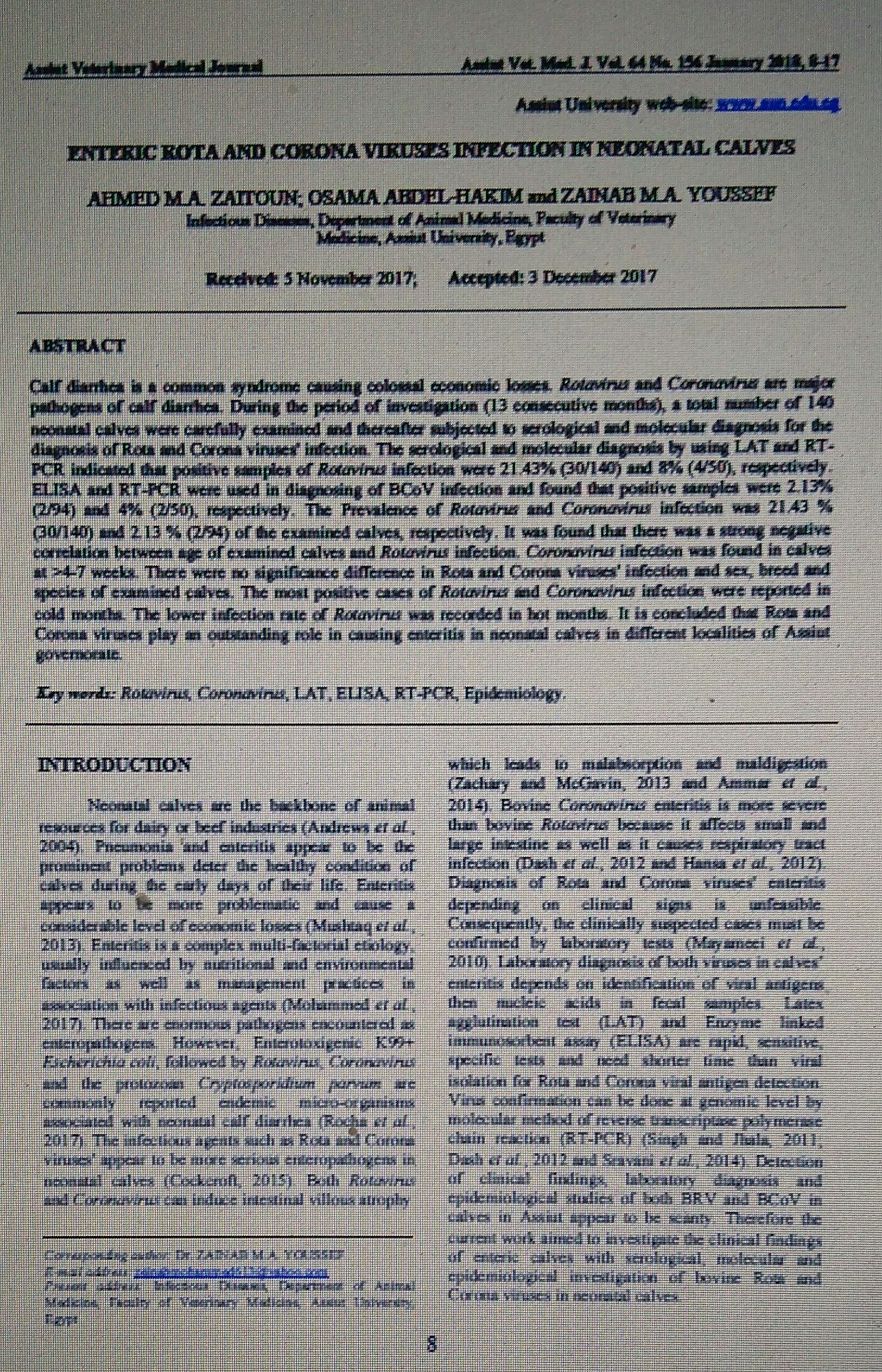
ENTERIC ROTA AND CORONA VIRUSES INFECTION IN NEONATAL CALVES

Research Abstract

calf diarrhea is a common syndrome causing colossal economic losses.Rotavirus and Coronavirus are major pathogens of calf diarrhea. During the period of investigation (13 consecutive months), a total number of 140 neonatal calves were carefully examined and thereafter subjected to serological and molecular diagnosis for the diagnosis of Rota and Corona viruses' infection. The serological and molecular diagnosis by using LAT and RT-PCR indicated that positive samples of Rotavirus infection were 21.43% (30/140) and 8% (4/50), respectively. ELISA and RT-PCR were used in diagnosing of BCoV infection and found that positive samples were 2.13% (2/94) and 4% (2/50), respectively. The Prevalence of Rotavirus and Coronavirus infection was 21.43 % (30/140) and 2.13 % (2/94) of the examined calves, respectively. It was found that there was a strong negative correlation between age of examined calves and Rotavirus infection. Coronavirus infection was found in calves at >4-7 weeks. There were no significance difference in Rota and Corona viruses' infection and sex, breed and species of examined calves. The most positive cases of Rotavirus and Coronavirus infection were reported in cold months. The lower infection rate of Rotavirus was recorded in hot months.It is concluded that Rota and Corona viruses play an outstanding role in causing enteritis in neonatal calves in different localities of Assiut governorate.

Research Authors
AHMED MA ZAITOUN, OSAMA ABDEL-HAKIM, ZAINAB MA YOUSSEF
Research Date
Research Department
Research Image
ENTERIC ROTA AND CORONA VIRUSES INFECTION IN NEONATAL CALVES
Research Journal
Assiut veterinary Journal
Research Pages
8-17
Research Publisher
Zainab M.A.Youssef
Research Rank
Assiut University web-site: www.aun.edu.eg
Research Vol
64
Research Website
Assiut University web-site: www.aun.edu.eg
Research Year
2018

Evaluation of blood parameters, serum minerals profiles and rumen fermentation in dairy cows with foreign body syndrome in subtropics

Research Abstract

This study was conducted to evaluate some blood parameters, serum minerals profile and rumen liquor properties in dairy cows with foreign body syndrome and healthy ones. The present work was conducted as a retrospective cohort study for the cases admitted to Veterinary Teaching Hospital, Assiut University. Based on clinical, radiographic, ultrasonographic and post-operative findings, A total number of 37 dairy cows were classified into 3 groups, healthy dairy cows as a control (n = 10), cows with metallic foreign bodies (n = 15) and cows with non-metallic foreign bodies (n = 12). Blood samples were collected from each animal to determine some hematology, biochemical parameters and some minerals of serum. Rumen liquor samples were collected once from each cow, at the surgery to measure the rumen pH, NH3-N, total VFAs and total protozoa count. The results revealed no significant variations in hematological and biochemical indices among diseased groups as compared with control one. Serum concentrations of Mg and Fe were decreased (P<0.05) in dairy cows with metallic and non-metallic foreign. The concentrations of Cu and Zn decreased (P<0.05) in cows with metallic foreign bodies as compared with non-metallic foreign group and healthy dairy cows. Serum concentrations of Mg and Fe were decreased (P<0.05) in dairy cows with metallic and non-metallic foreign. The concentrations of Cu and Zn decreased (P<0.05) in cows with metallic foreign bodies as compared with non-metallic foreign group and healthy dairy cows. There was a decrease (P<0.05) in the rumen pH, NH3-N and total protozoa count in diseased cows when compared with healthy cows. However, the total VFAs was higher (P<0.05) in diseased cows than control one. In conclusion, some blood constants, serum minerals profiles and rumen fermentation properties are greatly disturbed in dairy cows with foreign body syndrome. Therefore, mineral therapy may be recommended alongside surgical management of diseased cows and buffaloes with foreign body syndrome.

Research Authors
H. A. Hussein, E. H. Hassan, A. Ibrahim, A. A. Sadek, A.-E. Müller, R. Staufenbiel
Research Date
Research Department
Research Journal
Egyptian J. Nutrition and Feeds
Research Publisher
The Egyptian Society of Nutrition and Feeds
Research Rank
2
Research Vol
24
Research Year
2021
Subscribe to