



Professor Dr. Tayseer Hassan Abdel Hamid, Dean of the College, congratulates her outstanding students on their innovative graduation project "HACK TO RANK" on their well-deserved victory in the BUILDX HACKATHON competition.

The college is proud of you and wishes you continued progress and success in your academic and professional journeys

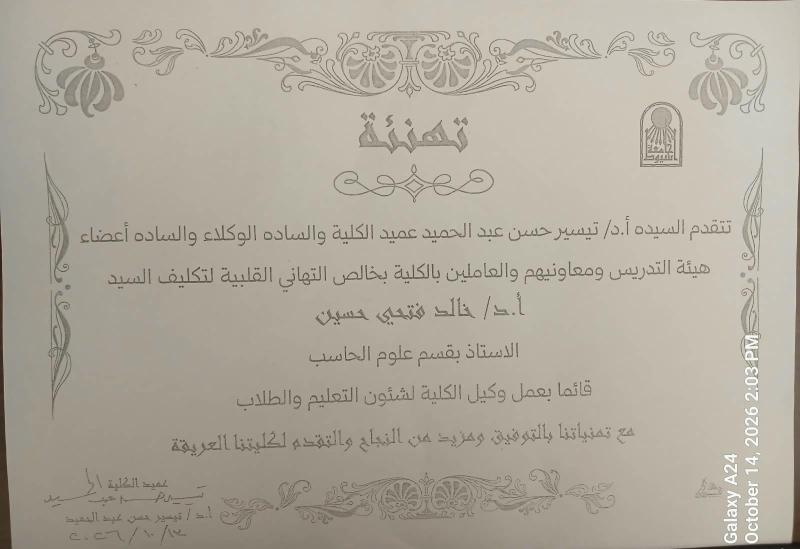
Under the patronage of Professor Dr. Tayseer Hassan Abdel Hamid (Dean of the Faculty) and Professor Dr. Khaled Fathi Hussein (Vice Dean for Education and Student Affairs), the Faculty of Computers and Information at Assiut University extends its warmest and most heartfelt congratulations, filled with pride and admiration, to its distinguished students for their innovative graduation project, "Hack to Rank."

This project was supervised by Dr. Fatima Abdel Halim (Lecturer in the Information Technology Department and supervisor of the student project) and was presented as one of the main events of Techora ICT Campus 2026, organized by GDG On Campus Assiut University in partnership with Etisal Assiut.

This congratulation is in recognition of the students' efforts and technical excellence in providing innovative and intelligent solutions to address real-world problems. They excelled before a distinguished judging panel comprised of experts in software development and entrepreneurship.

Our students have demonstrated their high level of competence in innovation, teamwork, and their ability to transform ideas into projects with a tangible societal impact. The students' names are as follows

* Ali Salman Mehran Salman
* Mahmoud Salah Mahmoud Abdelmalek
* Mahmoud Abdelnasser Mohsen Abdeen
* Mahmoud Rashad Mahmoud Mohamed

We also thank all the partners and sponsors who supported the event, such as Petra Software, Eduzah, AI Robotics Academy, TIEC, Step Workspace, and IndexHub, for providing this fertile environment for creativity

Our dear students, this victory is your first step towards entrepreneurship and shaping the future of technology

PySOA: a novel bio-inspired python snake optimization algorithm

Research Abstract

This study proposes a novel bio-inspired meta-heuristic algorithm, the Python Snake Optimization Algorithm (PySOA), that mimics the hunting behavior of the python snake. These reptiles are not poisonous, but they hunt their prey through ambushes. They can detect their prey using senses such as smell, eyesight, and infrared vision. The hunting mechanism consists of three major phases: searching for prey, scanning for prey, and attacking the prey. The searching-for-prey step contributes to exploration, while attacking prey is dedicated to exploitation, and scanning for attack enhances the balance between the two. The mathematical model of the method improves convergence precision and global search capability by capturing the behavioral dynamics of Pythons. PySOA’s performance was assessed on 23 classical benchmark functions, 29 CEC-2017 benchmark functions, 10 CEC-2019 composite functions, and three real-world engineering problems. The outcomes were confirmed by 14 popular meta-heuristic algorithms (MAs). With an average improvement of 39.2%, the PySOA outperformed the compared algorithms across all 62 test functions, achieving the best mean fitness rank in 43% of test cases. By successfully balancing exploration and exploitation, these findings demonstrate that PySOA is both resilient and competitive in addressing unimodal and multimodal optimization problems. The composite CEC-2019 test fitness functions demonstrated PySOA’s ability to explore and exploit simultaneously. The outcomes of the CEC-2017 benchmark tests show that PySOA has a shortcoming in local search exploration. Based on PySOA’s performance on real-world engineering problems, it is a practical algorithm for achieving optimal results and can be applied to real-world problems. The source code of the PySOA is publicly available at https://www.mathworks.com/matlabcentral/fileexchange/175654-a-novel-bio-inspired-python-snake-optimization-algorithm.

Research Authors
Mohamed M. Darwish
Research Date
Research Department
Research Journal
Cluster Computing The Journal of Networks, Software Tools and Applications
Research Year
2026

Secure medical image encryption for healthcare applications: A fractional 4D chaotic system and symmetry-matrix-based approach

Research Abstract

Safeguarding medical images against unauthorized access and alteration during storage and transmission is a critical challenge in modern telemedicine systems. This paper introduces a robust method to encrypt medical images in which the confusion stage is driven by a four-dimensional (4D) fractional-order chaotic system, and the diffusion process utilizes a symmetric matrix integrated with a one-dimensional (1D) chaotic map. The fractional 4D chaotic system reveals intricate dynamic behavior and is extremely sensitive to initial conditions, which enhances the confusion capability by thoroughly scrambling pixel positions. The symmetry matrix is combined with a generated chaotic sequence from a 1D chaotic map during the diffusion process that ensures strong pixel intensity diffusion and key dependence. Numerous experiments carried out on a variety of medical images confirm the outstanding performance of the suggested method. The suggested method features a key space exceeding 2¹⁰⁰, exhibiting significant robustness to brute-force attacks. It achieves unified average changing intensity (UACI) values above 33% and number of pixels change rate (NPCR) values exceeding 99.6%, confirms robustness to differential attacks, and successfully resists chosenplaintext and known-plaintext attacks. Additionally, the low pixel correlation and uniform histograms, along with average values of information entropy of 7.9973 and 7.9993 for 256×256 and 512×512 images, respectively, demonstrate strong resilience to statistical attacks. Furthermore, robust evaluations against cropping and noise attacks demonstrate the scheme’s practical security, highlighting its suitability for the safe storage and transmission of medical images in healthcare applications. Compared with related methods, the suggested method offers superior security performance. 

Research Authors
Mohamed M. Darwish
Research Date
Research Department
Research Journal
AIMS Mathematics
Research Year
2026

Zero-watermarking of light field images using fractional-order radial harmonic fourier moments and chaotic logistic-may map

Research Abstract
Unlike traditional images, light field images capture comprehensive scene information, enabling novel post-capture manipulations. However, this very richness makes them vulnerable to tampering. This paper proposes lossless copyright protection of light-field images based on a robust zero-watermarking algorithm without modifying the original image. First, the fractional-order radial harmonic Fourier moments (FrRHFMs) for light-field images were computed accurately. The FrRHFMs and chaotic Logistic and May maps (LOMAS) were combined to produce a light-field images robust zero-watermarking algorithm. Due to the excellent geometric invariance of FrRHFMs and the chaotic system's initial value sensitivity, the proposed algorithm's robustness to geometric attacks and security was improved. The experiments' results demonstrated that this algorithm outperformed other algorithms and was resilient to conventional image processing and geometry attacks.


Research Authors
Mohamed M. Darwish
Research Date
Research Department
Research Journal
Alexandria Engineering Journal
Research Website
https://www.sciencedirect.com/science/article/pii/S111001682500715X
Research Year
2025
Subscribe to