




Learning to remove occlusions in light field images using multiscale receptive fields and feature pyramid networks

Research Abstract

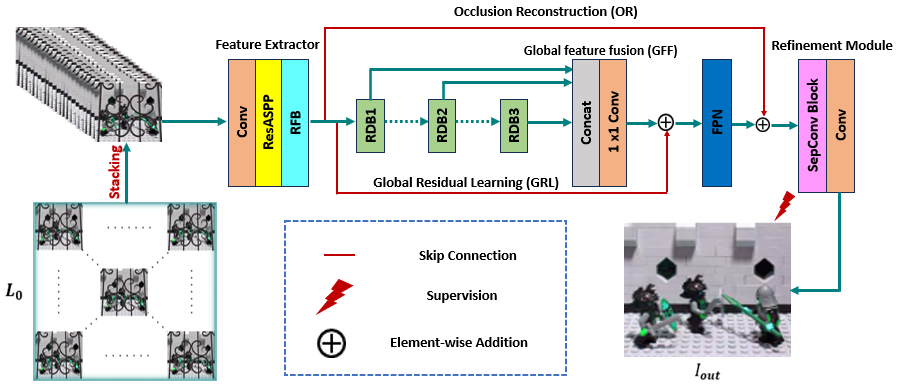
Removal of occlusions in light-field (LF) images is strongly influenced by the receptive field of the neural network. Existing methods often suffer from limited receptive fields, restricting their ability to capture long-range dependencies and recover occluded regions effectively. To overcome this, we propose LF-PyrNet, a novel end-to-end deep learning model that enhances occlusion removal through multi-scale receptive field learning and hierarchical feature pyramid-based refinement. Our model consists of three key components. First, the feature extractor expands the receptive field by integrating Residual Atrous Spatial Pyramid Pooling (ResASPP) and a modified receptive field block (RFB). These components allow the model to capture broader context and multi-scale spatial dependencies. Next, the core occlusion reconstruction network consists of three cascaded Residual Dense Blocks (RDBs). Each block contains four densely connected layers. A Feature Pyramid Network (FPN) then performs multi-scale feature fusion and refines the representations effectively. Finally, the refinement module, which incorporates both separable and standard convolutions, enhances detailed structural consistency and improves texture restoration in occluded regions. Experimental results show that expanding the receptive field significantly enhances the occlusion removal performance, making LF-PyrNet a reliable solution for reconstructing occluded regions in LF images.

Research Authors
Mostafa Farouk Senussi, Mahmoud Abdalla, Mahmoud SalahEldin Kasem, Mohamed Mahmoud, Hyun-Soo Kang
Research Date
Research Department
Research File
Research Image
Overall Architecture of LF-PyrNet for Occlusion Removal in Light Field Images, Consisting of Feature Extraction, Reconstruction, and Refinement.
Research Journal
Scientific Reports
Research Pages
36978
Research Publisher
Nature Publishing Group UK
Research Vol
15
Research Website
https://doi.org/10.1038/s41598-025-20786-0
Research Year
2025
A comprehensive review on light field occlusion removal: Trends, challenges, and future directions

Research Abstract

Overcoming occlusions in light field (LF) imaging is a challenging yet complex task crucial for scene understanding, image quality enhancement, and restoring visual details in obstructed scenes. This review examines contemporary occlusion removal methods, spanning from classical techniques to advanced deep learning approaches that leverage LF data’s spatial and angular dimensions. We categorize these methods into two domains: (1) single-view inpainting methods often adapted for LF contexts, and (2) specialized LF occlusion removal techniques that exploit multi-view data. The review explores how these methods mitigate occlusion artifacts and also investigates LF acquisition technologies, representations, and the role of loss functions in optimizing model performance. A discussion of publicly available datasets and performance evaluation metrics addresses the challenges of handling large occlusions. The review concludes with future research directions, emphasizing hybrid approaches, refined loss functions, and scalable solutions for LF occlusion removal.

Research Authors
Mostafa Farouk Senussi, Mahmoud Abdalla, Mahmoud Salaheldin Kasem, Mohamed Mahmoud, Bilel Yagoub, Hyun-Soo Kang
Research Date
Research Department
Research Image
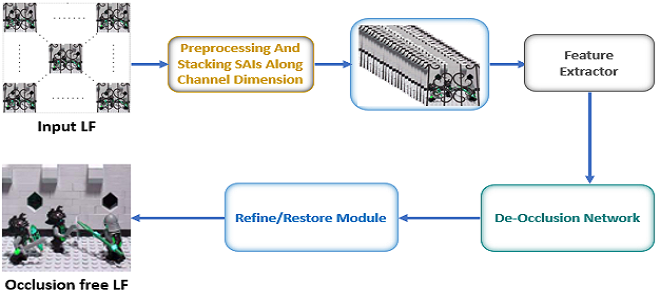
The Basic Paradigms for Occlusion Removal in Light-Field Imaging. To overcome occlusion challenges in LF imaging, advanced methods exploit 4D LF data, combining spatial and angular information. We conduct a comprehensive survey of LF occlusion removal technology and focus on the current significant research progress in fusing multi-view data for accurate reconstruction of hidden regions, enhancing image quality and scene understanding, far beyond single-view inpainting techniques.
Research Journal
IEEE Access
Research Pages
42472-42493
Research Publisher
IEEE
Research Vol
13
Research Website
https://doi.org/10.1109/ACCESS.2025.3548133
Research Year
2025

Attention-guided hybrid learning for accurate defect classification in manufacturing environments

Research Abstract

Industrial defect classification remains a crucial challenge due to the visual complexity, rarity, and diversity of defect types encountered in manufacturing. In this paper, we present a hybrid deep learning framework that integrates YOLOv11 and EfficientNet-B7 to perform robust multi-class defect classification. Our model combines the semantic richness of YOLO’s spatial features with the fine-grained representation power of EfficientNet, further enhanced by a Convolutional Block Attention Module (CBAM) and a lightweight Feature Pyramid Network (FPN) for attention-guided multi-scale refinement. Unlike conventional anomaly detectors or class-specific models, our framework supports unified classification across diverse object categories and defect types. We evaluate the proposed model on two datasets: the MVTec-FS benchmark, which includes 46 defect types across 14 industrial categories, and our proprietary Window dataset, which comprises three real-world defect classes under variable conditions. The model achieves a state-of-the-art accuracy of 91.90% on MVTec-FS and 96.13% on the Window dataset, outperforming existing CNN, transformer, and ensemble baselines. Ablation studies further demonstrate the incremental contribution of each module to the overall performance. These results validate our model’s ability to generalize across domains and offer practical utility in industrial quality control pipelines.

Research Authors
Mahmoud SalahEldin Kasem, Mohamed Mahmoud, Mostafa Farouk Senussi, Mahmoud Abdalla, Hyun-Soo Kang
Research Date
Research Department
Research File
Research Image
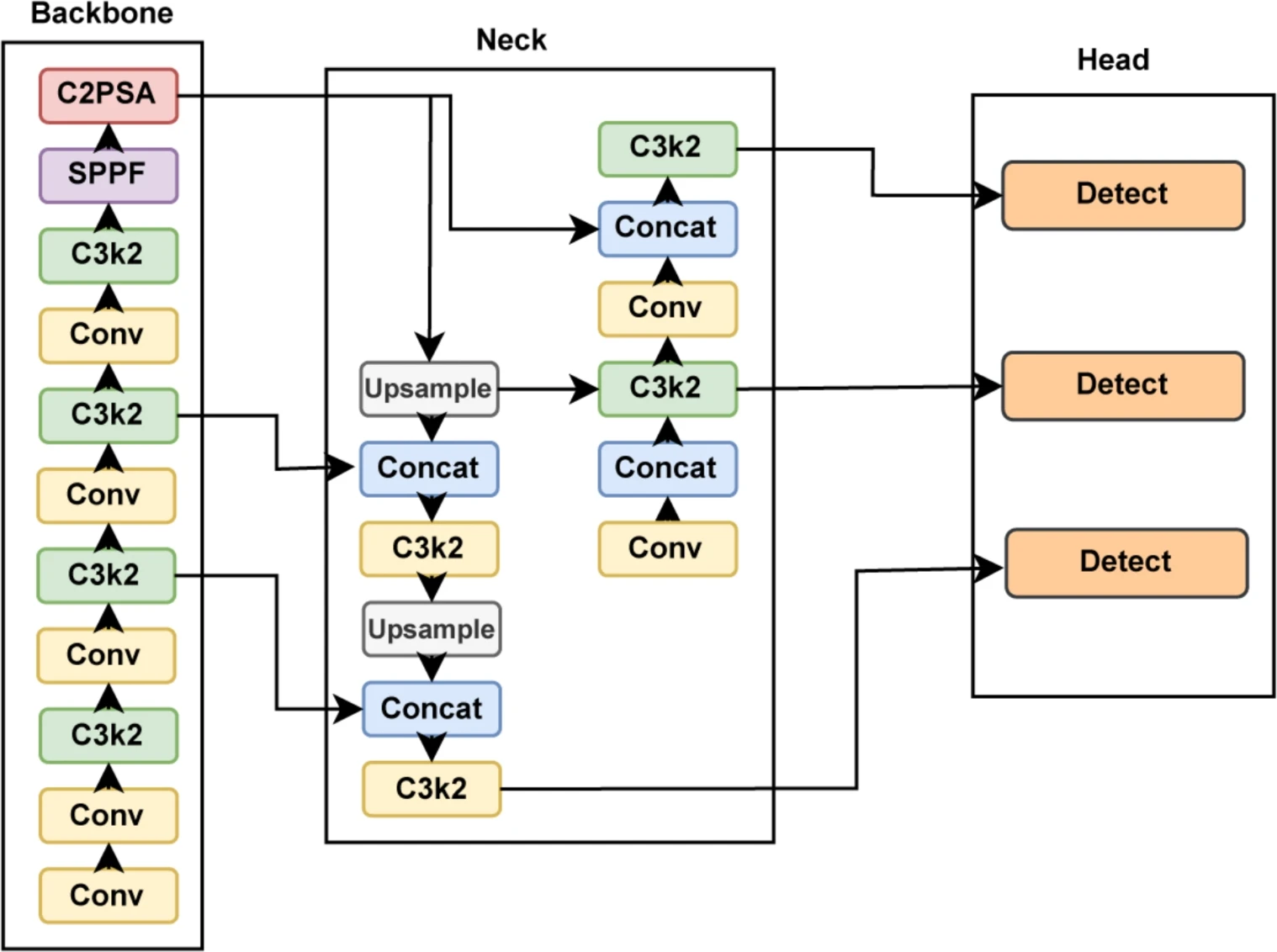
The YOLOv11 network architecture
Research Journal
Scientific Reports
Research Pages
2018
Research Publisher
Nature Publishing Group UK
Research Vol
16
Research Website
https://doi.org/10.1038/s41598-025-31654-2
Research Year
2025

Think-to-detect: Rationale-driven vision–language anomaly detection

Research Abstract

Large vision–language models (VLMs) can describe images fluently, yet their anomaly decisions often rely on opaque heuristics and manual thresholds. We present ThinkAnomaly, a rationale-first vision–language framework for industrial anomaly detection. The model generates a concise structured rationale and then issues a calibrated yes/no decision, eliminating per-class thresholds. To supervise reasoning, we construct chain-of-thought annotations for MVTec-AD and VisA via synthesis, automatic filtering, and human validation. We fine-tune Llama-3.2-Vision with a two-stage objective and a rationale–label consistency loss, yielding state-of-the-art classification accuracy while maintaining a competitive detection AUC: MVTec-AD—93.9% accuracy and 93.8 Image-AUC; VisA—90.3% accuracy and 85.0 Image-AUC. This improves classification accuracy over AnomalyGPT by +7.8 (MVTec-AD) and +12.9 (VisA) percentage points. The explicit reasoning and calibrated decisions make ThinkAnomaly transparent and deployment-ready for industrial inspection.

Research Authors
Mahmoud Abdalla, Mahmoud SalahEldin Kasem, Mohamed Mahmoud, Mostafa Farouk Senussi, Abdelrahman Abdallah, Hyun-Soo Kang
Research Date
Research Department
Research File
Research Image
Illustration of ThinkAnomaly synthetic training data generation. The system generates structured reasoning explanations followed by binary classification decisions for industrial anomaly detection. Context information about object type and defect characteristics guides the reasoning generation process.
Research Journal
Mathematics
Research Pages
3920
Research Publisher
MDPI
Research Vol
13
Research Website
https://doi.org/10.3390/math13243920
Research Year
2025
Subscribe to