

Anticoagulant Treatment Satisfaction among Elderly Patients with Deep Vein Thrombosis at Sohag University Hospital: A Descriptive Cross-Sectional Study

Research Abstract

A Background: Elderly patients are at higher risk of developing deep vein thrombosis compared to younger patients. Patients with multiple risk factors often demonstrate a lower level of self-efficacy, which influences the ability to manage the condition and medication adherence and satisfaction. Aim: to assess anticoagulant treatment satisfaction among elderly patients with deep vein thrombosis at Sohag  University Hospital. Research design: An descriptive cross-sectional research design was used. Setting: This study was conducted in the Vascular Surgical Department and outpatient clinics at Sohag University Hospital. Sample: A purposive sample involved 193 elderly patients. Tools: Two tools were used. 1st tool: Structured interview questionnaire; consisted of 2 parts.  Part (1): demographic data of elderly patients. Part(2): Clinical data. 2nd tool: Anti-Coagulant Treatment Satisfaction Scale (ACTS). Result: 56,5 
Research Authors
Zainab Khalaf Abd Ellatif, Saieda Abdelhamed Abd Elaziz, Shimaa Hassan Abd El-fatah
Research Date
Research Department
Research Journal
Sohag Journal of Nursing Science
Research Pages
160-168
Research Publisher
Sohag University, Faculty of Nursing
Research Vol
5
Research Year
2026

Relationship between Risk Factors and Self-Efficacy among Elderly Patients with Deep Vein Thrombosis

Research Abstract
Background
Elderly patients are a higher risk of developing deep vein thrombosis compared to younger patients. Patients with multiple risk factors often demonstrate a lower level of self-efficacy, which influences the ability to manage the condition and medication adherence. Aim: To identify the relationship between risk factors and self-efficacy among elderly patients with deep vein thrombosis. Research design:An exploratory descriptive  research design was used. Setting:This study was conducted in the Vascular Surgical Department and outpatient clinics at Sohag University Hospital. Sample: A purposive sample involved 193 elderly patients.Tools: Two tools were used. 1st tool: Structured interview questionnaire; consisted of 2 parts.  Part (1): Demographic data of elderly patients. Part (2): Self-efficacy for managing chronic disease 6-item scale. 2nd tool: Deep vein thrombosis risk factor assessment scale. Result: 53.9% of the studied elderly patients were males, 26.4% of them in minor risk factors were obesity, 92.2% of them in mild risk factors were age between 60-74 years, and the majority of the studied elderly patients had low risk factor levels, less than two-thirds of them had low levels of self-efficacy. Conclusion: There was a highly statistical significant negative correlation between total self-efficacy level and total risk factor level with (r=-0.402) at p value =(0.001**).Recommendation: Develop and implement an exercise program to improve physical activity and maintain normal body weight.
 
Research Authors
Zainab Khalaf Abd Ellatif* 1; shimaa hassan Abd El-fatah2; Saieda Abd El-hamed AbdelAziz3
Research Date
Research Department
Research Journal
Assiut Scientific Nursing Journal
Research Pages
Pages 189-199
Research Publisher
Faculty of Nursing , Assiut Scientific Nursing Journal
Research Vol
Volume 13
Research Year
2025

Effect of Organizational Agility and Ambidextrous Leadership on Nurses’ Readiness for Change

Research Abstract

Organizational agility and ambidextrous leadership foster flexibility, creativity, and collaboration, which are essential for preparing nurses to embrace change. This study aimed to examine the impact of organizational agility and ambidextrous leadership on nurses’ readiness for change. Using a descriptive correlational design, data were collected from 348 nurses at Al-Rajhi and Heart Hospitals affiliated with Assiut University through validated scales on organizational agility, ambidextrous leadership, and readiness for change. Results showed that ambidextrous leadership had the strongest positive effect on nurses’ readiness for change (β = 0.570, p < 0.001), followed by organizational agility (β = 0.205, p < 0.001). In conclusion, this study underscores the pivotal role of ambidextrous leadership and organizational agility in enhancing nurses’ readiness for change. By fostering adaptive leadership behaviors and agile organizational practices, healthcare institutions can cultivate environments that promote innovation and facilitate effective change implementation. Therefore, strengthening these dimensions among nursing leaders is essential to sustain continuous improvement and ensure the success of healthcare reform initiatives. Training programs to enhance ambidextrous leadership skills among nurse leaders are recommended to balance exploratory and exploitative behaviors and drive readiness for change.

Research Authors
Eman Kamel Hossny, Hanan Sayed Younes, Hammad S Alotaibi, Mohammed Musaed Al-Jabri, Aml Mahmoud Moubark, Aya Kamal Sayed, Heba Mostafa Ali
Research Date
Research Journal
Nursing Forum
Research Year
2025

The relationship between emotional intelligence, internet addiction, and psychological well-being among university nursing students

Research Abstract

Abstract
Background Internet addiction (IA) is a behavioral condition characterized by impaired impulse control. Although it
does not involve substances, it shares features with other behavioral addictions such as pathological gambling. This
study aimed to examine the relationships among emotional intelligence (EI), internet addiction, and psychological
well-being (PWB) among university nursing students.
Methods A descriptive correlational research design was employed with a stratified sample of 335 students from
the Faculty of Nursing at Assiut University. Ethical approval was obtained from the Faculty’s Ethics Committee (IRB
number: 1120250980). Data were collected using a demographic questionnaire, the Trait Meta-Mood Scale, the
Internet Addiction Test, and Ryff’s Psychological Well-Being Scale.
Results Students with higher EI scores demonstrated higher mean ranks of IA (mean rank = 173.24) as well as higher
mean ranks of PWB (mean rank = 183.81). Correlation analyses revealed weak but statistically significant associations
among the three variables (r ≈ 0.15–0.29). Specifically, EI was positively correlated with both PWB and IA, while IA was
negatively correlated with PWB.
Conclusion Nursing students demonstrated relatively high EI, moderate levels of IA, and moderate to high well-
being range based on the scale cutoffs. Although the associations between EI, IA, and PWB were statistically
significant, the effect sizes were small, limiting their practical significance. The negative relationship between IA
and PWB is consistent with prior literature, underscoring the potential adverse effects of excessive internet use on
students’ mental health. While integrating EI training into nursing education may be beneficial, the findings should be
interpreted cautiously due to the weak correlations observed.
Clinical trial number Not applicable.
Keywords Emotional intelligence, Internet addiction, Psychological well-being, Nursing students

Research Authors
Nadia Kasem Alaswa Shymaa Mohammed Sayed Hassan Hanan Azouz Abd Elhay Mohamed Hanan Faried Maghawry
Research Date
Research Department
Research File
Research Journal
BMC Nursing
Research Pages
13
Research Publisher
Springer Nature
Research Rank
article number 1341
Research Vol
28;24(1)
Research Website
https://doi.org/10.1186/s40359-025-02638-8-8
Research Year
2025

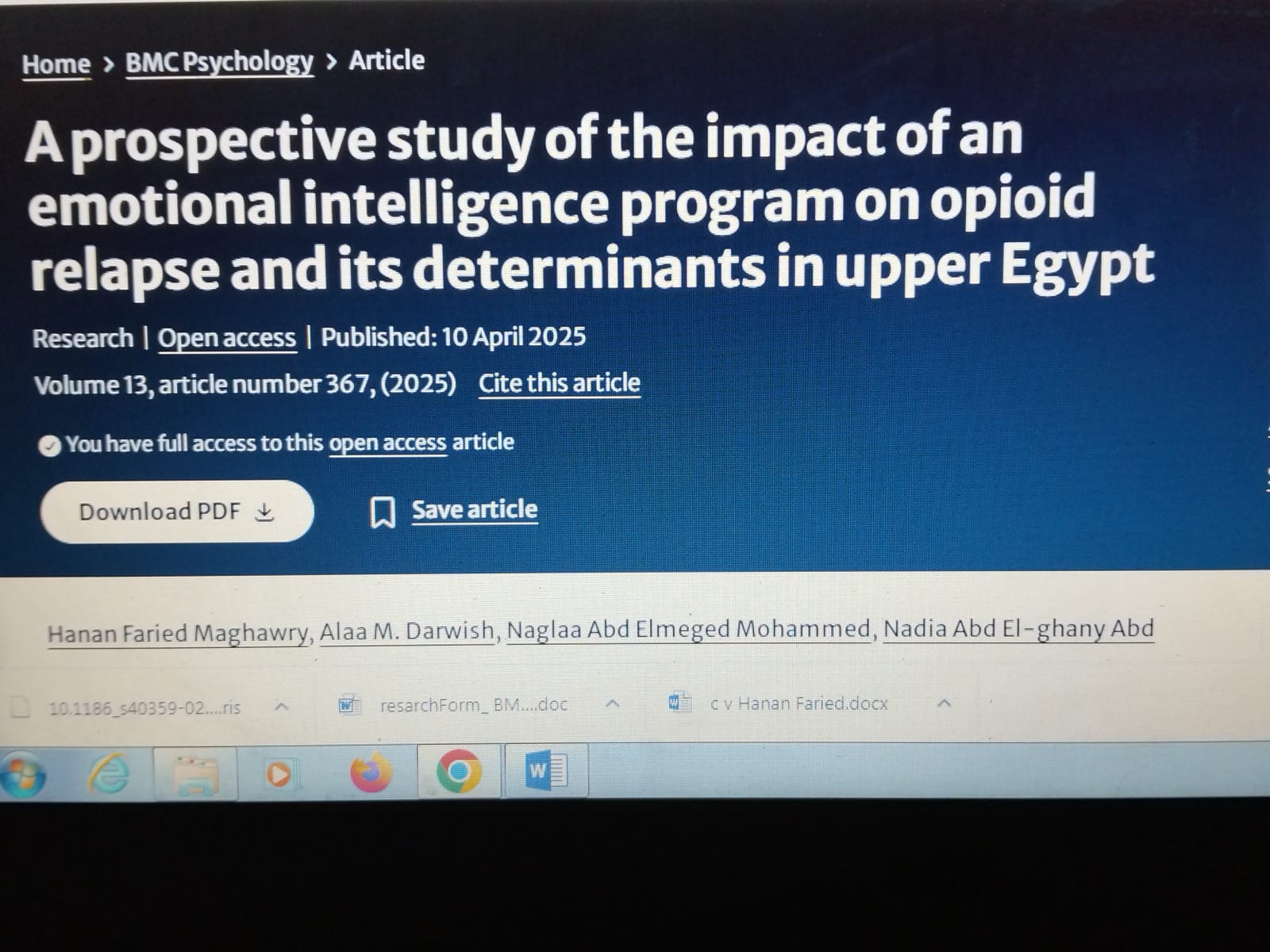
A prospective study of the impact of an emotional intelligence program on opioid relapse and its determinants in upper Egyptر

Research Abstract

Abstract
Background Opioid use is a growing concern worldwide with high relapse rates and psychiatric comorbidities.
Emotional intelligence (EI) has been associated with positive health outcomes, yet limited research exists on EI-based
interventions for opioid use disorders. The study aimed to assess EI levels among individuals with opioid addiction
and implement an EI program to reduce addiction severity and relapse rates, as well as examine potential factors that
contribute to enhancing EI.
Methods A quasi-experimental study assigned 40 males with opioid use disorder into an intervention group
receiving a 2-week EI program (n = 20) and a control group (n = 20). Healthy comparison group (without opioid use
disorder) (n = 20) was also included. Measures including the Emotional Intelligence Scale, Personality Inventory for
DSM-5, Symptom Checklist-90-Revised (SCL-90-R), Addiction Severity Index, and Advance Warning of Relapse (AWARE)
questionnaire were used to assess the groups at baseline,2 weeks and 3-month follow-up in patients with opioid use
disorder.
Results The healthy group exhibited lower scores on disinhibited personality subscales, maladaptive personality
traits, and SCL-90-R subscales than the opioid addiction groups at baseline. The EI intervention group displayed
substantial increases in EI subscale scores at the second and third follow-up assessments compared to the
control group. At AWARE scale follow-up, all control group patients had relapsed, versus only one patient in the EI
intervention group.
Conclusions Participants with opioid addiction demonstrated lower baseline EI and higher rates of psychiatric
symptoms and maladaptive personality traits than healthy group. A brief EI intervention led to significant EI increases
and lower relapse rate versus standard treatment alone.
Keywords Opioid, Emotional intelligence, Psychiatric comorbidities, Relapse, Addiction

Research Authors
Hanan Faried Maghawry, Alaa M. Darwish, Naglaa Abd Elmeged Mohammed, Nadia Abd El-ghany Abd El-hameed and Gellan K. Ahmed
Research Date
Research Department
Research File
Research Image
Research Journal
BMC Psychology
Research Pages
14
Research Publisher
Springer Nature
Research Rank
article number 367, (2025)
Research Vol
Volume 13
Research Website
BMC Psychol 13, 367 (2025). https://doi.org/10.1186/s40359-025-02638-8
Research Year
2025

Patient Information Regarding Pneumonia: Providing Comprehensive Nursing Intervention

Research Authors
Asmaa Fathy Mohamed, Shalabia Elsayed Abozead, Lamiaa Hassan Shaaban, Attyiat Hassan Hussein
Research Department
Research Journal
Assiut Scientific Nursing Journal
Research Publisher
Assiut University, Faculty of Nursing
Research Year
2024

Effect of Designed Nursing Guidelines on Reducing Postoperative Discomfort Among Patients Undergoing Abdominal Surgery

Research Authors
Mohammad Khalil Al Amari, Amal Mohammad Ahmad, Attyiat Hassan Hussein, Reda Abdu Elhamd Mahmoud
Research Department
Research Journal
Assiut Scientific Nursing Journal
Research Member
Research Publisher
Assiut University, Faculty of Nursing
Research Year
2015

Developing Postoperative Nursing Care Standards for Patients Undergoing High Tibial Osteotomy Surgery

Research Authors
Soad M Sayed, Hala M Ghanem, Attyiat H Hussein, Abd Alhameid, M Mohamed
Research Department
Research Journal
Assiut Scientific Nursing Journal
Research Member
Research Publisher
Assiut University, Faculty of Nursing
Research Year
2016

Assessment of Self Care Behaviors of Patients with Congestive Heart Failure:(Suggested Nursing Guidelines)

Research Authors
Esraa Nabil Mohammed, Ghona Abd El-naser Ali, Attyiat Hassan Hussein, Ahmed Aly Obiedallah
Research Department
Research Journal
Assiut Scientific Nursing Journal
Research Member
Research Publisher
Assiut University, Faculty of Nursing
Research Year
2016

Information Needs for Patients Undergoing Coronary Angiography: Providing Nursing Instructions

Research Authors
Malka Mohamed Abass, Shalabia Elsayed Abozead, Ahmed Abdel-Galeel, Attyiat Hassan Hussein
Research Department
Research Journal
Assiut Scientific Nursing Journal
Research Publisher
Assiut University, Faculty of Nursing
Research Year
2024
Subscribe to