
The Dean of the College receives the examiners of the doctoral dissertation of the visiting engineer/ Ibrahim Saleh Mohammed Al-Shami (Assistant Lecturer in the Department of Civil Engineering - Faculty of Engineering - Sana'a University - Republic of Yem
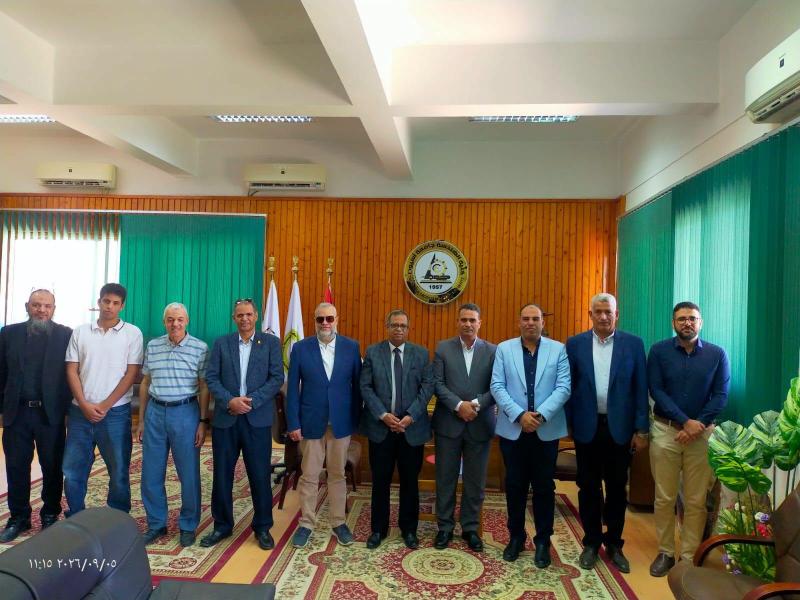
The Dean of the College Receives the Examiners of the Doctoral Dissertation of Engineer Ibrahim Saleh Mohammed Al-Shami (Assistant Lecturer, Department of Civil Engineering, Faculty of Engineering, Sana'a University, Republic of Yemen).

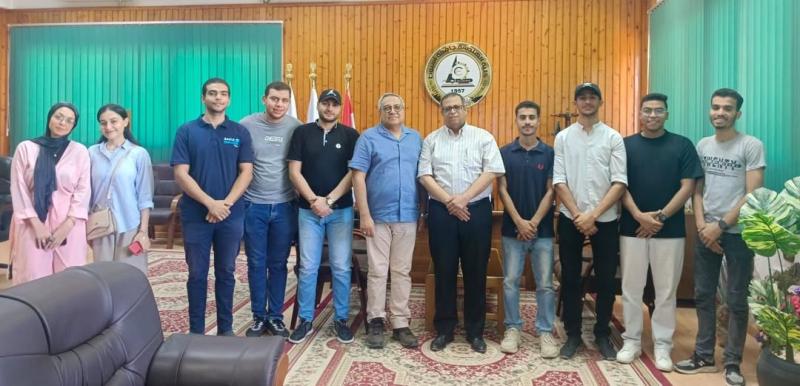
On Saturday, September 5, 2026, Professor Dr. Khaled Salah, Dean of the College, received Professor Dr. Yasser Refaat Tawfiq Mohammed, Professor of Concrete Structures, Faculty of Engineering, Minia University (Vice Dean for Community Service and Environmental Development), and Professor Dr. Ahmed Serag Farid Mahmoud Gabr, Professor of Structural Engineering, Faculty of Engineering, Fayoum University (Vice Dean for Education and Student Affairs). This meeting took place on the sidelines of their examination and discussion of the doctoral dissertation submitted by Engineer Ibrahim Saleh Mohammed Al-Shami (Assistant Lecturer, Department of Civil Engineering, Faculty of Engineering, Sana'a University, Republic of Yemen), entitled:

"Behavior of Reinforced Concrete Elements with Substandard Joints Reinforced with Fiber-Reinforced Polymers Near the Surface."

Behavior of Sub-Standard Lap-spliced ​​RC Members Strengthened Using Near-Surface Mounted FRP Composites

This project was conducted under the supervision of:

Prof. Dr. Shehata El-Dabaa Abdel-Rahim: Professor of Structural Engineering - Faculty of Engineering - Assiut University

Prof. Dr. Mohamed Fathy Mohamed Fahmy: Professor of Reinforced Concrete Structures - Faculty of Engineering - Assiut University

Associate Professor Dr. Walid Abou El-Wafa Mohamed: Assistant Professor of Structural Engineering - Faculty of Engineering - Assiut University

The judging and discussion committee consisted of:

Prof. Dr. Shehata El-Dabaa Abdel-Rahim (Professor of Structural Engineering, Faculty of Engineering, Assiut University) — Supervisor (unanimous vote)

Prof. Dr. Mohamed Fathy Mohamed Fahmy (Professor of Reinforced Concrete Structures, Faculty of Engineering, Assiut University) — Supervisor (unanimous vote)

Associate Prof. Dr. Walid Aboul-Wafa Mohamed (Assistant Professor of Structural Engineering, Faculty of Engineering, Assiut University) — Supervisor (unanimous vote)

Prof. Dr. Yasser Refaat Tawfik Mohamed: Professor of Reinforced Concrete Structures, Faculty of Engineering, Minia University (Vice Dean for Community Service and Environmental Development)

Prof. Dr. Ahmed Serag Farid Mahmoud Gabr: Professor of Structural Engineering, Faculty of Engineering, Fayoum University (Vice Dean for Education and Student Affairs)

The thesis addresses a crucial structural topic: the study of the behavior of short-length superimposed joints in reinforced concrete elements, the resulting reduction in strength and ductility, and the implications for the seismic performance of structures. The research's scientific value lies in its integrated approach, combining behavioral prediction using modern techniques, experimental investigation of the effectiveness of strengthening and restoring methods for structural elements, and numerical analysis to evaluate seismic behavior. The diversity of the study's focus, along with its correlation between the local behavior of the superimposed joint and the overall performance of structural elements and structures, are among the thesis's most significant strengths. This enhances its scientific value and supports its practical applications in the design and evaluation of reinforced concrete structures.

قد تكون صورة ‏نص‏
قد تكون صورة ‏‏المكتب البيضاوي‏ و‏نص‏‏
 
قد تكون صورة ‏نص‏
قد تكون صورة ‏‏شخص أو أكثر‏ و‏نص‏‏


The Dean and Vice Dean of the College welcomed the Assiut Robotics team after their outstanding performance in the Leaders League finals, organized by the YLF Foundation.

The Dean and Vice Dean of the Faculty of Assiut Robotics Welcome the Assiut Robotics Team After Their Outstanding Performance in the Leaders League Finals

Professor Khaled Salah, Dean of the Faculty of Assiut Robotics, and Professor Mohamed Safwat Abureya, Vice Dean for Education and Student Affairs and Supervisor of Student Activities, welcomed the Assiut Robotics team upon their return from the Leaders League finals, organized by the Youth Leaders Foundation (YLF). The finals were held on August 24, 2026.

The team's participation was generously sponsored by Professor Ahmed Abdel-Mawla, President of the University, Professor Khaled Salah, Dean of the Faculty of Assiut Robotics, and Professor Mohamed Safwat Abureya, Vice Dean for Education and Student Affairs, and supervised by Professor Mazen Abdel-Salam, Professor Emeritus in the Electrical Engineering Department.

During their participation, the team competed fiercely, reaching the finals of the competition where they presented two engineering and applied projects: the Remotely Operated Vehicle (ROV) project and the website/platform project.

The final results are expected to be announced and the winning teams honored during the competition's closing ceremony, scheduled for the end of September.

Regarding the projects the team participated in, they presented a remotely operated underwater vehicle (ROV) project. This project aims to design and build a remotely controlled underwater robot capable of operating in harsh underwater environments and performing precise exploration and maintenance tasks that simulate real-world challenges in the petroleum and offshore infrastructure sectors. The project's tasks include conducting technical inspections of submerged pipes and cables, performing disassembly and assembly operations, and collecting samples with extreme precision within narrow passages. This contributes to reducing human risks and lowering operational costs. The ROV relies on an integrated technological and engineering system that includes the distribution of thrusters to ensure precise balance and direction, a high-speed imaging and data transmission system to the ground control station, as well as the installation of robotic manipulators and advanced sensors for measuring depth and pressure and tracking marine routes.

The team also participated in the platform and website project, which offers a digital and technological solution aimed at supporting digital transformation and providing an integrated interactive environment that serves the college's students and staff, facilitating smart and seamless access to engineering and educational resources. The website provides a comprehensive interactive interface for showcasing and documenting engineering projects, managing events and training activities, and publishing academic and applied content, thus enhancing knowledge transfer among students. The platform utilizes the latest full-stack web development technologies, focusing on a flexible and responsive user interface (UI/UX) across various devices, and relies on secure and fast cloud databases. It also employs intelligent search algorithms and content categorization to ensure a seamless user experience and facilitate efficient access to information.

During the reception, the Dean of the College thanked the team's students for their honorable representation of the college. The Dean also affirmed that the university, under the leadership of Professor Dr. Ahmed Abdel-Mawla, the university president, is keen to support participation in various competitions, which contributes to developing the college students' abilities on the one hand and highlighting their capabilities to their peers, wishing them success and continued excellence at the local and then international levels.

1

The Internet of Things course, organized by the Information and Communications Technology Institute in Assiut, concluded at the college's Internet of Things lab for faculty members and teaching assistants.

The Information and Communications Technology Institute (ICT) in Assiut University concluded its Internet of Things (IoT) training course for faculty members and teaching assistants at the university's IoT lab.

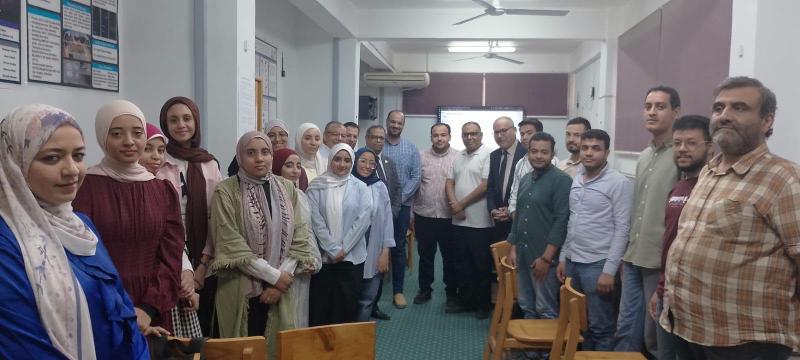
As part of the ongoing collaboration between the Faculty of Engineering at Assiut University and the ICT Institute, and in line with the faculty's commitment to developing the academic capabilities of its faculty and teaching assistants through specialized training courses, the institute organized a training course in the field of Internet of Things. The course aimed to transfer training expertise and raise the level of knowledge and technical skills in this technology. It targeted a number of teaching assistants from the Faculty of Engineering, the Egyptian National University, Sphinx University, and Assiut International Technological University. This reflects the community role played by the Faculty of Engineering at Assiut University in partnership with the institute. The practical training for the course took place in the IoT lab of the Electrical Engineering Department at Assiut University.

The closing ceremony of the training course was attended by Professor Khaled Salah Saeed, Dean of the Faculty, Engineer Ayman Ayad, Director of the Institute's Assiut branch, and Professor Mohamed Abbas, Head of the Electrical Engineering Department at the Internet of Things (IoT) Lab. The trainees expressed their appreciation for the knowledge and skills they gained during the course, which they believe will positively impact their ability to utilize this technology in their work.

In this context, the Dean of the Faculty expressed his gratitude to the University administration, headed by Professor Ahmed Abdel-Mawla, the University President, for their ongoing support and sponsorship of the Faculty's various events and activities.

The Dean also extended his thanks and appreciation to the Information and Communications Technology Institute, led by Professor Heba Saleh, the Institute's President, and Engineer Ayman Ayad, Director of the Institute's Assiut branch, for their training contributions to the Faculty's faculty members, teaching assistants, and students. He offered special thanks for holding the final training course within the Faculty, specifically at the IoT Lab in the Electrical Engineering Department. He commended the Institute for its significant role at various levels.قد تكون صورة ‏دراسة‏


قد تكون صورة ‏‏شخص أو أكثر‏ و‏أشخاص يدرسون‏‏

Important announcement

عStudents who have submitted appeals in the Civil Engineering Department must go to the office of the Vice Dean for Education and Student Affairs to review their answer booklets within one week of this announcement.

September 6, 2026

Important announcement

Students who have submitted appeals in the preparatory year must go to the office of the Dean of Student Affairs to review their answer booklets within one week of this announcement.

August 16, 2026

Important announcement

Students who have submitted appeals in the fourth year of the Electrical Engineering Department must go to the office of the Vice Dean for Education and Student Affairs to review their answer booklets within one week of this announcement.

August 16, 2026

Open circuit fault localization in dual active bridge based simultaneous battery charging systems using multi label classification

Research Abstract

This paper presents a multi-label fault localization framework for open-circuit fault diagnosis in a three-port Dual Active Bridge (DAB) converter using deep learning. The proposed method leverages time-frequency features extracted from midpoint voltage signals through the continuous wavelet transform (CWT) to generate multi-channel scalogram images. These images are then used to train a ResNet-18 convolutional neural network (CNN) for simultaneous detection and localization of single and multiple switch faults. The dataset was generated under various state-of-charge (SOC) and fault timing conditions to ensure comprehensive coverage of the converter. Simulation results demonstrate high diagnostic accuracy, with both micro- and macro-F₁ scores exceeding 99% on unseen test data. Compared to an equivalent multi-class ResNet-18 classifier, the proposed multi-label network achieved approximately 3% higher macro-F₁ score and better generalization to simultaneous fault conditions. Moreover, the model generalizes effectively to three-switch faults, achieving a micro-F₁ score of approximately 85% despite being trained only on single- and two-switch cases. Robustness analyses further confirm stable performance under dead-time variations, measurement noise, and sensor reduction, maintaining over 92% F₁-score accuracy with only two voltage sensors. In addition, real-time performance evaluation shows that the proposed framework achieves an online diagnosis latency of 136.8 ms. These findings highlight the model’s effectiveness for fault diagnosis in multi-port power converters.

Research Authors
Khaled Sayed Abd El-Naeem, Mohamed A. Nayel, Mohamed Abdelrahem, Islam Alkabbany
Research Date
Research Department
Research Journal
Scientific Reports
Research Website
https://www.nature.com/articles/s41598-026-52101-w
Research Year
2026

The Faculty Council approves the Advisory Council for the Civil Engineering Department programs at the Faculty of Engineering, Assiut University.

The Faculty Council approves the Advisory Board for the Civil Engineering Department programs at the Faculty of Engineering, Assiut University.

The Faculty Council, in its 1159th session held on July 15, 2026, approved the formation of the Advisory Board, comprised of representatives from engineering, industrial, and professional bodies in the field of civil engineering. This approval followed the Civil Engineering Department Council's ratification of the proposed board.

Professor Dr. Mohamed Abdel-Basset Abdo, the outgoing Head of the Civil Engineering Department, explained that the board approved by the Faculty Council consists of 16 members. Twelve of these members are from various engineering institutions relevant to the department's areas of specialization, in addition to four members from the department council, as follows:

* Mr. Eng. Haitham Abdel-Hamid Nasr, General Manager of the General Administration for Horizontal Expansion and Projects in Upper Egypt.

* Mr. Eng. Essam Abdel-Zaher El-Qarn, Undersecretary of the Ministry of Housing in Assiut Governorate.

* Mr. Eng. Mustafa Mohamed Abdel-Maqsoud, General Manager of the Arab Contractors branch in Assiut.

* Mr. Eng. Hatem Mokhtar Abdel Sabour, Head of the Central Administration for Water Resources and Irrigation in Assiut Governorate.

* Ms. Eng. Doaa Awad Riad, Director General of the Assiut Reconstruction Zone – Central Agency for Reconstruction.

* Mr. Eng. Ahmed Mounir, Director of Projects Department, Seventh Region – General Authority for Roads and Bridges.

* Mr. Eng. Ahmed Salah Fakhry, Director General of the Assiut Roads and Transportation Directorate.

* Mr. Eng. Nader Fawzy Samuel, Head of the Central Administration for Central Region Affairs – Egyptian National Railways.

* Mr. Eng. Mohamed Mahmoud Adawy Mohamed, Director of the Upper Egypt Branch of Misr Petroleum Maintenance Company.

* Mr. Eng. Safwat Farag Morcos, Executive Director at the Engineering Office for Contracting and Road Paving.

* Mr. Eng. Amr Ibrahim Mostafa Hassan, General Manager of Barah Real Estate Investment Company in Assiut.

* Mr. Eng. Sayed Hassan Sayed Ahmed, General Manager of Engineers Real Estate Investment and Contracting Company in Assiut.

The four members of the Civil Engineering Department Council are:

* Prof. Dr. Mohamed Abdelbaset Abdo, Head of the Civil Engineering Department Council

* Prof. Dr. Hassan Younis Ahmed, Professor of Highway and Traffic Engineering

* Prof. Dr. Shehata El-Dabaa Abdel-Rahim, Professor of Structural Engineering – Vice Dean of the Faculty of Engineering for Graduate Studies – Civil Engineering Department

* Assoc. Prof. Dr. Tarek Sayed Abouzi, Assistant Professor of Irrigation and Hydraulics Engineering

Professor Dr. Khaled Salah, Dean of the Faculty, explained that advisory councils play a pivotal and essential role in linking the academic aspect with the requirements of the local and international labor market, and ensuring the quality and accreditation of educational outcomes. The council's most prominent roles and functions include contributing to the development of curricula and study plans, ensuring quality and academic accreditation, developing and providing field training and professional opportunities for students and graduates, and supporting graduation projects and student activities. The council also contributes to establishing partnerships and applied scientific research to address the needs of society.

* He also explained that advisory councils are being formed for all the programs within the various departments of the college, and these will be announced after their approval by the college council.

Regarding the mechanism of these councils, he clarified that the council will meet at least once per semester, or whenever necessary. Departments will present topics they wish to discuss with the council for its guidance, in addition to exploring various other areas in which the council or its members can contribute.

Subscribe to