
Student Scientific Symposium on Creativity and Innovation (SCI Forum 2026)
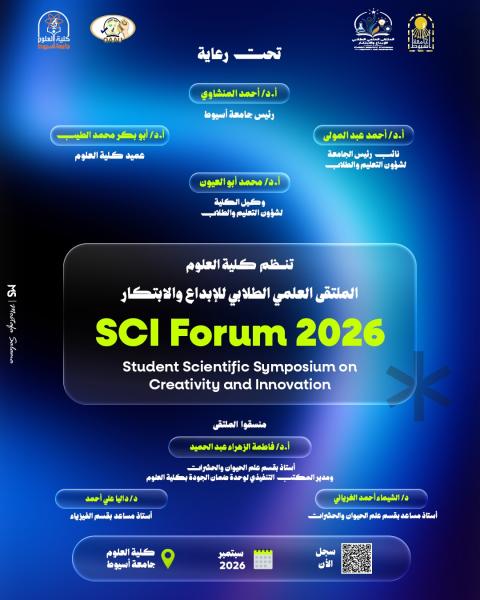
 الملتقى العلمي الطلابي للإبداع والابتكار  Student Scientific Symposium on Creativity and Innovation 
(SCI Forum 2026)
أولاً: نبذة عن الملتقى
الملتقى العلمي للإبداع والابتكار منصة أكاديمية تُنظّمها كلية العلوم، تهدف إلى تنمية مهارات البحث العلمي لدى الطلاب وتمكينهم من تحويل أفكارهم إلى مشروعات تطبيقية ذات قيمة علمية ومجتمعية.
يوفّر الملتقى بيئة علمية محفّزة تعزز التفكير الإبداعي والابتكار، حيث يشارك الطلاب في تطوير حلول عملية لمشكلات واقعية، مثل استخدام التقنيات الحيوية في إزالة الملوثات، وتطوير أنظمة استشعار ذكية لمراقبة جودة الهواء والمياه، وإنتاج مواد حيوية قابلة للتحلل للحد من التلوث البلاستيكي، وتصميم تقنيات مساعدة لذوي الهمم، بالإضافة إلى تقديم نماذج علمية مبتكرة تغطي مختلف التخصصات.
يجمع الملتقى طلاب الكلية من مختلف الأقسام لعرض أبحاثهم أمام نخبة من الأساتذة والمتخصصين، مما يُسهم في تعزيز قدراتهم البحثية وإعدادهم للمنافسة على المستويين المحلي والدولي.

ثانياً: ما الذي يميّز الملتقى عن غيره من الفعاليات؟
يرتكز الملتقى على منهجية البحث العلمي الأصيل، ولا يقتصر على تقييم المنتج النهائي فحسب؛ إذ يُولي اهتمامًا أكبر لمراحل البحث كاملةً: من تحديد المشكلة وصياغة الفرضيات، مرورًا بجمع البيانات وتحليلها، وصولًا إلى استخلاص النتائج وتفسيرها.
لا يُشترط أن يكون المشروع في صورة منتج مادي، غير أنه يمكن أن يتضمن نموذجًا تطبيقيًا أو أداةً تُسهم في دعم الفرضية البحثية. كما يُشترط تقديم عناصر البحث بأسلوب منهجي منظم يُظهر قدرة الطالب على التفكير النقدي والتحليل العلمي.

ثالثاً: شروط المشاركة
يُرجى الاطلاع على الضوابط التالية قبل التقديم:
●المشاركة متاحة لطلاب كلية العلوم بجميع المستويات الدراسية الأربعة، وطلاب الدراسات العليا بالكلية.
●تكون المشاركة فردية أو ثنائية وفقًا لطبيعة المشروع.
●يُشترط أن يكون المشروع حديث التنفيذ، وألا تتجاوز مدة العمل عليه اثنا عشر شهرًا.
●لا يُسمح للطالب بالمشاركة في أكثر من مشروع واحد خلال الدورة ذاتها.
●يجب أن يلتزم المشروع بأسس البحث العلمي، وأن يتضمن فكرة واضحة مدعومة بنتائج أو تجارب أو تحليل علمي موثوق.
●لا تُقبل المشروعات التي تعتمد فقط على الشرح النظري أو النماذج التوضيحية دون وجود جانب بحثي أو تطبيقي واضح.
●يُسمح بأن يكون المشروع جزءًا من بحث أكبر، بشرط توضيح دور الطالب ومساهمته المحددة.
●يُشترط وجود مشرف او اكثر لكل مشروع، ولا يُشترط أن يكون المشرف من داخل الكلية.

رابعاً: كيفية المشاركة
1.إعداد فكرة المشروع وكتابة خطة البحث وفق الإرشادات المعتمدة.
2.التسجيل عبر الرابط الإلكتروني المخصص للملتقى باستخدام البريد الجامعي الرسمي.
3.يتم تقديم المشروع في صورة بوستر علمي (Poster) من خلال رابط التقديم المخصص، مع الالتزام بكافة الشروط والتعليمات الموضحة داخل الرابط.( الرابط)

خامساً: مراحل المشاركة
1. التسجيل الإلكتروني
يُسجّل الطالب بيانات مشروعه عبر استمارة التسجيل الإلكترونية، مع متابعة إجراءات التقديم من خلال فريق التنظيم بالكلية.
2. استلام المشروعات وتقييمها الأوّلي
تُستقبل المشروعات المقدّمة وتُفرز مبدئيًا من قِبل لجنة علمية من أعضاء هيئة التدريس على مستوى الكلية والجامعة.
3. مرحلة التحكيم النهائي وإقامة الملتقى 
تُعرض المشروعات المقبولة على لجان تحكيم متخصصة لتقييمها وفق المعايير العلمية والأكاديمية المعتمدة.
يُعقد الملتقى مرة واحدة سنويًا خلال شهر سبتمبر، حيث يقوم المشاركون بعرض أبحاثهم ومشروعاتهم العلمية أمام لجان التحكيم والحضور.
وفي ختام الملتقى، يتم تكريم أصحاب أفضل خمسة مشروعات متميزة، وذلك بناءً على نتائج التقييم النهائي ومستوى الجودة العلمية والابتكار في المشروع.
سادساً: معايير التقييم
تُقيَّم المشروعات وفق المعايير العلمية والمهارية الآتية:
●الإبداع والأصالة: تميز الفكرة وابتكارها، وأصالتها (جديدة أو تطوير مبتكر)، مع كون العمل جهدًا شخصيًا وخاليًا من الانتحال.
●المنهج العلمي: الالتزام بأسس البحث السليم في صياغة الفرضيات وتصميم التجارب وتحليل النتائج.
●تحقيق الأهداف: ارتباط النتائج بالمشكلة البحثية ومدى بلوغ المشروع أهدافه المعلنة.
●جودة العرض: تنظيم المشروع وعرضه بصورة واضحة وجذابة.
●مهارات الأداء: الكفاءة في الشرح والقدرة على الإجابة عن الأسئلة بدقة وثقة علمية.
●الوضوح والتنظيم: تسلسل الفكرة وعرضها بشكل منطقي يسهل فهمه.
●العمل الجماعي: مستوى التكامل والتعاون بين أعضاء الفريق في المشروعات الثنائية.
●الأخلاقيات: الالتزام بضوابط الأخلاقيات العلمية والأمن والسلامة في التجارب.

سابعاً: المجالات العلمية للملتقى
يستقبل الملتقى المشروعات من مختلف التخصصات العلمية، ومن أبرزها:
●علم الحيوان
●الفيزياء والفلك
●البايوتكنولجي 
●علوم النانو 
●الكيمياء
●علوم الأرض والجيولوجيا
●الرياضيات
●علوم النبات والميكروبيولوجي 
●البرمجيات وأنظمة الحاسوب

ثامناً: روابط مهمة
1.رابط تسجيل الطلاب للمشاركه  في الملتقى  
https://docs.google.com/forms/d/e/1FAIpQLSc4OZEwIWzKjwH7RBrhfKibbWV-WMTL_jeWV_rJUej9JL3vjA/viewform?usp=publish-editor

2.رابط مجموعة الواتساب للطلاب المشاركين
https://chat.whatsapp.com/KZMguPQTYBe6t18rDJrCcb
3.رابط الواتساب لفريق تنظيم الملتقي 
https://chat.whatsapp.com/LTq9YgJduvWGEckZkQvoUA
4.رابط الواتساب لفريق المحكمين المشاركين   
 https://chat.whatsapp.com/JtQQNd05ZYhC1uJo9iQ06z 
5.رابط تسجيل المحكمين للمشاركه  في الملتقى  
https://docs.google.com/forms/d/e/1FAIpQLScu2uyokD88F4JhpdsY0U19FXz34Hox0Np3EzfT0d8e6-y9Ug/viewform?usp=header

Development of Ulva lactuca-Derived Cellulose/Nanocellulose Edible Films With Enhanced Light, Oxygen, and Water Vapor Barrier Properties and Natural Antioxidant Properties

Research Abstract

Ulva lactuca was used to produce edible films containing its methanolic extract, based on cellulose (C), cellulose nanocrystals (CNC), or their mixture (C/CNC). FT-IR analysis showed hydrogen bonding interactions among the film components. The C/CNC film exhibited reduced thickness (0.058 mm), oxygen permeability (3.11 × 10−3 g/100 µm m2 s), water vapor permeation (0.97 × 10−10 g mm m−2 s−1), and higher lightness (87.12) with blocking over 99% of light at 280–600 nm with low Pa−1. Moisture uptake followed Peleg’s model, showing lower sorption for the C/CNC film. Antioxidant assays revealed significant differences between films and the influence of food simulants.

Research Authors
Arwa A. Al-Badaani, Mahmoud S. Adam, Awatief F. Hifney & Mohamed Gomaa
Research Date
Research Journal
Journal of Aquatic Food Product Technology
Research Pages
105-121
Research Publisher
Taylor & Francis
Research Rank
1
Research Vol
34
Research Website
https://www.tandfonline.com/doi/abs/10.1080/10498850.2025.2484353
Research Year
2025

Enhancing phycocyanin productivity and thermostability in Synechocystis sp. AUPL1 using Ulva lactuca hydrolysates and ulvan polysaccharides

Research Abstract

Increasing the productivity and thermostability of phycocyanin (PC) are key challenges in its industrial production. This study utilized aqueous and acidic hydrolysates derived from the seaweed Ulva lactuca for fed-batch mixotrophic cultivation of Synechocystis sp. AUPL1. The acidic hydrolysate contained higher levels of nutrients and reducing sugars (0.08 mg mL− 1 ) compared to the aqueous hydrolysate (0.03 mg mL− 1 ). Supplementing the cyanobacterial culture with 3 % (v/v) acidic hydrolysate every three days significantly increased biomass productivity, PC content, and PC productivity, achieving approximately 2-, 3-, and 6.5-fold improvements, respectively, compared to the autotrophic control. Additionally, ulvan polysaccharide, extracted from the same seaweed, was tested as a natural preservative to prevent PC degradation at elevated temperatures. Ulvan at 3 % (w/v) significantly extended the PC half-life at 60 ◦C to 293.21 min, compared to 101.65 min in the control. Thermodynamic analysis confirmed the thermostabilizing effect of the PC-ulvan mixture, revealing that the thermal degradation process was endothermic and non-spontaneous. This study underscores the potential of U. lactuca biomass as a low-cost, sustainable nutrient source for enhancing PC productivity, while also demonstrating that ulvan effectively improves PC thermostability.

Research Authors
Mohamed Gomaa , Shimaa Abdelmohsen Ali , Awatief F. Hifney
Research Date
Research Journal
Algal Research
Research Publisher
Elsevier
Research Rank
1
Research Vol
89
Research Website
https://www.sciencedirect.com/science/article/pii/S2211926425001626
Research Year
2025

Exploring the phytochemical composition of Salsola imbricata: investigating its protective potential against UV-C radiation in earthworms and isopods models. 3 Biotech 15, 97 …

Research Abstract

The aqueous ethanolic extract of Salsola imbricata (AEESI) demonstrated significant protective effects against UV-C radiation damage, using earthworms and isopods as models for human skin and eyes, respectively. High-performance liquid chromatography (HPLC) analysis identified 15 bioactive polyphenolic compounds in AEESI, with chlorogenic acid (55.51 µg/ml) and gallic acid (46.69 µg/ml) as the dominant phenolic acids, and naringenin (40.42 µg/ml) as the primary flavonoid. The extract effectively mitigated histological and ultrastructural damage caused by UV-C radiation in both models. Additionally, quality control parameters, including moisture content, pH, acidity index, ash content, and elemental composition, were determined for the first time. These findings highlight the potential of S. imbricata extract as a protective agent against UV-C radiation-induced damage, attributed to its rich polyphenolic content.

Research Authors
A.M. et al. Eldeen, A.Z.E., El-Aziz, F.EZ.A.A., Sayed
Research Date
Research Department
Research Journal
3 Biotech
Research Pages
97
Research Publisher
Springer International Publishing
Research Vol
15
Research Year
2025

Protective effects of whey camel milk proteins conjugate with metal–organic frameworks (MOF) as antimicrobial and against cobalt-induced chloragogen cell toxicity in earthworms

Research Abstract

Camel whey protein (CWP) is rich in potent antioxidant and antimicrobial compounds, while the iron-based metal–organic framework (MOF)-235 offers high biocompatibility for drug delivery. This study synthesised and characterised CWP/MOF-235 nano-conjugates to enhance CWP stability, bioavailability, and therapeutic efficacy. GC–MS analysis confirmed the presence of hepatoprotective and antimicrobial fatty acids in CWP, including oleic acid, palmitic acid methyl ester, and cis-vaccenic acid. Antimicrobial assays revealed that CWP/MOF-235 exhibited greater activity against Candida albicans than CWP or MOF-235, achieving a maximum inhibition zone of 36.3 mm. Using earthworm (Aporrectodea caliginosa), cobalt chloride-induced chloragogen cell toxicity was effectively ameliorated by CWP/MOF-235, restoring normal intestinal histoarchitecture and reducing cellular necrosis as confirmed by light, scanning, and transmission electron microscopy. These findings demonstrate that CWP/MOF-235 nano-conjugates synergistically combine the bioactivity of camel whey proteins with the delivery potential of MOF-235, offering a promising eco-friendly strategy for managing heavy metal toxicity and microbial infections.

Research Authors
Fatma El-Zahraa Abd El-Aziz, Asmaa FA Dawood, Mervat Abdel-Baseer Tohamy Abd El-Aziz, Marwa A Ali, Hanan A Ahmed, Rana A Elbeshbeishy, Rabab M Thabit, Nermeen Welson, Dalia A Hamad
Research Date
Research Department
Research Journal
Natural Product Research
Research Year
2025

Forensic implication of Zinc sulfide and Zinc sulfide Nanoparticles toxicity on muscle histopathology and postmortem changes in rats

Research Abstract

The current study aimed to investigate the molecular toxic effects of zinc sulfide (ZnS) and zinc sulfide nanoparticles (ZnS-NPs) on rat skeletal muscle tissue. It also explored the forensic implications of ZnS toxicity on postmortem carrion infestation, particularly its potential impact on postmortem interval (PMI) estimation. ZnS nanoparticles were synthesized and characterized using X-ray diffraction (XRD) and scanning electron microscopy (SEM). Thirty Wistar rats were divided into three groups: control, ZnS-treated, and ZnS-NP–treated (both administered at the LD50 dose of 2000 mg/kg). Muscle tissues were harvested for histopathological, ultrastructural, and acridine orange staining analysis. Arthropods were col lected and identified across five decomposition stages to assess changes in carrion infestation patterns. Histopathological and ultrastructural analysis showed marked deformation, necrosis, and degeneration of muscle fibers, more severe in the ZnS-NP group. Collagen deposition significantly decreased in both treatment groups. Electron microscopy revealed dis sociation and degradation of myofibrils with increased interfibrillar spacing. Arthropod analysis indicated altered coloniza tion patterns, with decreased adult abundance and disrupted succession stages, especially during the active decay phase. ZnS and ZnS-NPs induce significant skeletal muscle toxicity that may mimic postmortem autolysis and lead to PMI misinterpretation. ZnS-NPs exert more severe effects than bulk ZnS. The observed entomological disruption highlights the forensic relevance of ZnS exposure and underscores the need for integrated toxicological and entomological analyses in PMI estimation8

Research Authors
Asmaa FA Dawood, Hanan M Alharbi, Nawaf Al Khashram, Dalia A Hamad, Leila H Sayed, Hanem S Abdel–Tawab, Nermeen N Welson, Fatma El-Zahraa A Abd El-Aziz
Research Date
Research Department
Research Journal
Forensic Science, Medicine and Pathology
Research Year
2025

Camel whey protein coated metal-organic frameworks (CWP/MOF) as a sustainable approach to treat environmental stress-induced liver toxicity by cobalt chloride in rats

Research Abstract

Background and aim: Environmental stressors, such as heavy metal pollution, can have devastating effects on biological organisms, leading to conditions like liver toxicity. This study explored the therapeutic potential of a novel iron-based metal-organic framework (Fe-MOF) in mitigating cobalt chloride-induced liver toxicity in rats. Methods: Utilizing a solvothermal synthesis method, CWP/MOF was created and characterized using X-ray diffraction, Fourier transform infrared spectroscopy, and transmission electron microscopy. Adult male rats were divided into four groups, each consisting of six rats. The groups were treated as follows: Group 1 (Control): Received 0.5 mL/day of distilled water only. Group 2 (CoCl₂): Treated with cobalt chloride (100 mg/kg/day) dissolved in distilled water. Group 3 (CoCl₂ + Fe-MOFs): Treated with cobalt chloride (100 mg/kg/day) and FeMOFs dissolved in distilled water. Group 4 (CoCl₂ + CWP/MOF): Treated with cobalt chloride (100 mg/kg/day) and CWP/MOF, dissolved in distilled water. All groups received treatment for a duration of two months. Results: there was a one-dimensional structure and multienzyme-like activity. CWP/MOF prevented apoptosis and reduced the histopathological effect and collagen fiber percentage caused by cobalt chloride in the liver. Nanotechnology was used to increase the therapeutic efficiency of camel whey protein against the harmful effects associated with environmental stress-induced liver toxicity by cobalt chloride in rats. Conclusions: This study highlights the potential of CWP/MOF as a groundbreaking therapeutic agent for induced liver toxicity, with promising applications in regenerative medicine and tissue engineering. By harnessing the unique properties of CWP/MOF, researchers may uncover new avenues for treating liver-related disorders and promoting overall health.

Research Authors
Dalia A Hamad, Asmaa FA Dawood, Hanan M Alharbi, Shereen Mahmoud Refaie, Marwa A Ali, AA Abu-Sehly, Hanem S Abdel–Tawab, Nermeen N Welson, Fatma El-Zahraa A Abd El
Research Date
Research Department
Research Journal
Journal of Trace Elements in Medicine and Biology
Research Year
2025

Fabrication of porous SnO2 microwires via semi-closed evaporation method and their application as low temperature NO2 sensors

Research Abstract

In this work, we report a novel fabrication approach for highly porous SnO2 microwires using a semi-closed thermal evaporation system under controlled low-pressure conditions. The unique microstructure of the syn thesized microwires, characterized by nanoscale porosity and high crystallinity, was achieved by tuning the deposition pressure between 0.85 and 1.15 Torr. While demonstrated with SnO2, this approach applies to a wide range of metal oxides, including single, binary, and doped systems. Unlike conventional open or VLS-based deposition methods, this system enables precise morphological control via thermal evaporation under tunable pressure conditions, promoting a vapor-solid (VS) growth mechanism. Structural and morphological charac terizations confirmed that lower pressure enhances defect density and grain boundary formation, which are critical to gas sensing behavior. The SnO2 microwires were integrated into a conductometric gas sensor and evaluated for NO2 detection. The optimized sensor exhibited a high response of 2900 % to 2 ppm NO2 at a low operating temperature of 100 ◦C, along with excellent selectivity against interfering gases such as H2, H2S, and CO. The enhanced sensing performance is attributed to the synergistic effects of grain boundary modulation, Schottky barrier formation at the Pt/SnO2 interface, and catalytic activation near the contacts. This study demonstrates the potential of porous SnO2 microwires as a promising material for low-temperature, selective NO2 sensing in environmental monitoring applications

Research Authors
NM Shaalan, A Alshoaibi, HM Abd El-Lateef, H Fares, AR Altayar, D Hamad
Research Date
Research Department
Research Journal
Materials Science in Semiconductor Processing
Research Pages
109878
Research Year
2025

Kinetics of the Thermal Dehydration of Sodium Sulfate Decahydrate Using Model-Free and Model-Fitting Approaches

Research Abstract

ABSTRACT This study investigates the complex dehydration kinetics of sodium sulfate decahydrate (Na2 SO4 .10H2 O). Analysis of TG/DTG data reveals that the dehydration process proceeds via five complex steps. Using isoconversional methods (FR, FWO, and DAEM), the kinetic parameters (Ea and ln A) of the individual steps were obtained. The Ea − α plots revealed that all deconvoluted processes are driven by a single reaction mechanism identified as a diffusion model (D3 ). A significant linear relationship between ln A and Ea with similar isokinetic temperatures characterized the kinetic compensation effect. Thermodynamic analysis indicates that the entire conversion is an endothermic and non-spontaneous process. 

Research Authors
Salma Ahmed Fakhry Mohamed Abdel Hakim Refaat Mohamed Mahfouz
Research Date
Research Department
Research Journal
International Journal of Chemical Kinetics
Research Pages
9
Research Publisher
International Journal of Chemical Kinetics
Research Vol
Volume 58, Issue 7
Research Website
https://doi.org/10.1002/kin.70083
Research Year
2026
Subscribe to